
Most SEO plans fail for a simple reason: they start with tactics instead of diagnosis. Publishing more blog posts, changing title tags, or chasing backlinks will not help much if important pages are blocked, mismatched to search intent, or impossible for users to navigate.
Website search optimization works when you improve four things together: crawlability, relevance, user experience, and authority. The 12 tips below follow that order, moving from audit findings to practical implementation so you can build an SEO strategy around evidence rather than isolated tasks.
How to use this website SEO roadmap
SEO is not a one-time checklist. Search engines need to discover and understand your pages, determine whether those pages answer a query better than alternatives, and see signals that the site is credible and useful. Users then need to complete the next step without friction.
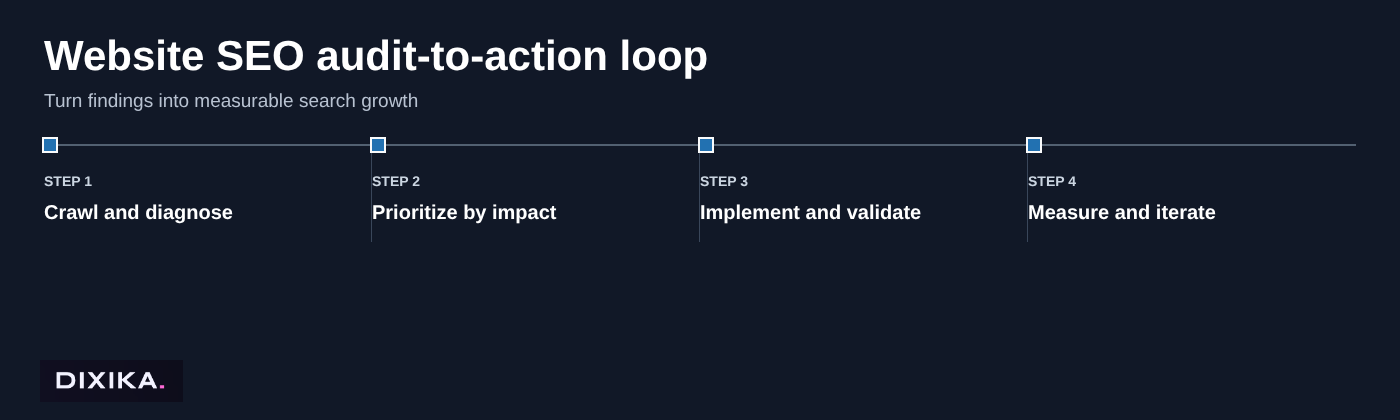
Work through these tips in sequence. Start by establishing your baseline and identifying technical barriers, then align pages to intent, improve content and internal linking, and finally measure what changed. That is how to do SEO for a website step by step without wasting months on low-impact work.
1. Set search goals and benchmark your starting point
Rankings are useful diagnostic signals, but they are not the business goal. A stronger SEO strategy starts with outcomes: qualified demo requests, purchases, trial signups, contact forms, booked consultations, or local calls and directions.
Before changing anything, document the current state. Capture indexed-page counts, non-branded clicks and impressions, conversions from organic traffic, leading landing pages, backlink quality, and page-speed data. This baseline lets you separate a real improvement from normal seasonal variation or reporting noise. For additional context, see this guide to improving organic search engine rankings.
A practical SEO strategy example for a B2B service business would begin with high-intent service pages. Improve their messaging, supporting proof, calls to action, technical accessibility, and conversion paths first. Then publish supporting guides that answer the research questions prospects ask before they are ready to buy, linking those guides to the relevant service page where it genuinely helps.
Set a small number of measurable goals for the next quarter. For example: increase non-branded organic leads from priority service pages, recover traffic to declining product pages, or improve visibility for a defined set of solution categories. A goal without a page set, audience, and conversion event is too vague to guide work.
2. Crawl your site to find indexation and technical blockers
A crawl reveals whether search engines can reach the pages you want them to rank. Focus first on issues that stop discovery, rendering, indexing, or interpretation of valuable URLs rather than treating every warning as equally urgent.
Review robots.txt rules, meta robots directives, XML sitemaps, canonical tags, redirects, broken internal links, 4xx and 5xx errors, duplicate URL patterns, and JavaScript-dependent content. A canonical pointing to another page, for instance, may be correct for a filtered URL but disastrous on a core service page. Context determines severity.
The key distinction is between intentional exclusions and accidental ones. Thank-you pages, internal search results, staging URLs, duplicate tracking variations, and thin utility pages may reasonably stay out of the index. Revenue-driving pages, useful category pages, and durable editorial resources usually should not be blocked, orphaned, canonicalized away, or absent from your sitemap without a deliberate reason.
Start with your highest-value templates and pages
Do not begin with thousands of low-value URLs. Audit the homepage, service or category pages, product pages, lead-generation pages, and URLs that have lost meaningful traffic. These templates often reveal systemic issues that affect far more than one page.
Create a simple issue log containing the URL or template, the problem, supporting evidence, owner, expected impact, dependency, and validation step. "Fix canonical tags" is not an actionable task; "replace self-conflicting canonicals across the pricing-page template, then verify Google-selected canonicals on five representative URLs" is.

3. Verify that Google can access and understand each important page
Use Google Search Console to inspect priority URLs individually. Check the indexing status, the canonical Google selected, whether the URL is eligible for indexing, and what the live test returns. If rich results are relevant to the page type, review the applicable enhancement reports as well.
Submitting a sitemap or clicking "request indexing" does not fix a weak page. It will not overcome contradictory canonical signals, poor internal linking, thin content, or a page that does not serve a clear search need. Those tools are confirmation mechanisms, not substitutes for sound implementation.
Mobile-first crawling also makes the mobile version of your site the baseline. Important content, structured data, navigation links, and functionality must be available on mobile. HTTPS and accessible HTML content are equally basic requirements; no serious SEO plan should treat them as optional refinements.
4. Map keywords to search intent before you optimize pages
Keyword research is not a process of sprinkling phrases onto pages. It is the work of matching a real user need to the right page format and topic. Assign one primary query cluster to each important page, then use related terms when they help cover the subject naturally.
Look at the search results to infer intent. A query dominated by guides and explainer articles calls for informational content. Results filled with category pages, service pages, comparison pages, local listings, or tools point to a different expectation. Trying to rank a sales page for a research query, or a blog post for a purchase-ready query, creates an uphill battle.
For newer sites, specific lower-competition topics are often the best entry point. Choose questions close to your expertise and offering, such as a narrowly defined implementation problem, industry use case, or comparison criterion. Broad topics can come later after you have built useful supporting coverage and earned credibility.
Decide whether to improve, consolidate, or create a page
Improve an existing page when it already serves the right audience and broadly matches search intent but lacks depth, clarity, proof, or optimization. Consolidate pages when two or more URLs compete for essentially the same query and offer no distinct value. Create a new page only when there is a clearly separate need, audience, or intent.
When consolidating, choose the strongest destination based on relevance, links, performance, and conversion potential. Redirect retired URLs appropriately, update internal links, and preserve useful information from the old pages. Deleting content without a redirect and link cleanup is a common way to throw away equity.
5. Rewrite titles, headings, and snippets around the page's real promise
A good title tag leads with the subject, makes a specific promise, and gives searchers a reason to choose your result. It should be unique to the page. Repeating a brand name and a string of near-identical keywords across dozens of titles is not optimization.
Do not obsess over character counts as though a single cutoff decides performance. Write a clear, compelling title first, then tighten it where needed. For a service page, the differentiator might be the audience, method, location, or outcome. For a guide, it might be the level of detail or practical scope.
Use one clear H1 that reflects the core subject. Build H2 and H3 sections around the questions and decisions a reader needs to make. This makes pages easier to scan and gives writers a structure for complete coverage without resorting to repetitive keyword use.
Meta descriptions are click-through copy, not a direct ranking lever. Write them to clarify what the reader will get, then make sure the page delivers. A snippet promising a definitive checklist that leads to vague generalities creates poor engagement and weakens trust.
6. Make each core page the best answer to its search intent
Search optimization becomes durable when the page is genuinely useful after the click. Answer the central question early, state who the page is for, and give readers the decision criteria or next actions they need. Do not bury the useful material beneath a long generic setup.
A strong content-quality review asks whether the page includes relevant expertise, concrete examples, accurate claims, and enough depth to resolve the intent. It should remove unsupported superlatives and stale advice rather than adding words simply to appear comprehensive.
- For educational guides: explain the process, common failure points, examples, and trade-offs readers will encounter in practice.
- For commercial pages: explain the problem solved, fit criteria, process, deliverables, evidence, and the next conversion step.
- For comparisons: use meaningful selection criteria and be candid about cases where one option is not the best fit.
Information gain matters. Original research, product details, process screenshots, expert review, useful comparison tables, or well-maintained FAQs can make a page worth citing. Clear authorship, source citations for factual claims, and transparent update practices also matter when the subject carries meaningful trust or accuracy expectations.
7. Build topic clusters with purposeful internal links
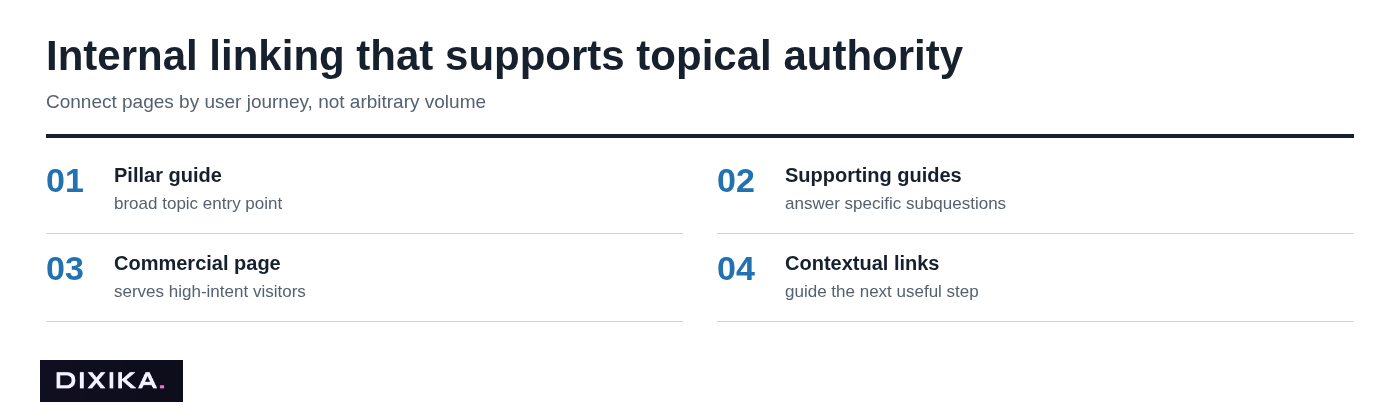
Internal links tell both readers and search engines how your content fits together. A practical hub-and-spoke structure uses a broad pillar page as the entry point for a major topic, with focused supporting pages that answer narrower questions. Those supporting pages should link back to the hub where useful and forward to the most relevant next step.
Link based on the user's journey, not an arbitrary quota. Use descriptive anchor text in relevant body copy, especially where a reader would naturally want more detail. Prioritize pages that need discovery, contextual relevance, or a clearer route from informational content to commercial pages. For outreach and authority-building considerations, see these link building SEO tips.
To find gaps, compare your crawl data with indexed URLs and analytics landing pages. Pages with no internal links, very few contextual links, or links only from navigation deserve a review. An orphaned page may still be indexed, but it is harder for search engines and users to discover in context.
8. Improve page experience where it affects users and search performance
Performance work should solve visible friction, not chase perfect dashboard scores. Slow-loading pages, jumping layouts, unresponsive mobile controls, confusing navigation, and intrusive pop-ups make it harder for people to consume content or convert.
Start with the largest and most valuable templates. Responsive layouts, readable type, stable image dimensions, sensible lazy loading, caching, reduced render-blocking resources, and simpler page components often deliver more value than isolated tweaks to a low-traffic blog post.
Core Web Vitals are useful diagnostic metrics, especially when real-user data identifies a recurring problem. Use them to locate template-level issues and validate fixes, but keep the priority tied to user friction, crawl and rendering efficiency, or conversion performance. A fast page that answers the wrong question is still not a strong search result.
9. Use structured data only when it accurately represents visible content
Structured data helps search engines interpret certain page types and can support eligibility for enhanced search appearances. It does not guarantee rich results, and it cannot compensate for weak content or a poor technical foundation.
Use markup that fits the page and reflects visible information. Common examples include Organization, LocalBusiness, Product, Article, BreadcrumbList, and FAQPage where appropriate and compliant with current search guidelines. Do not add reviews, FAQs, product details, or business attributes that users cannot see or that do not accurately apply.
Validate markup before deployment, then monitor Search Console enhancement reports and page-level results afterward. Treat schema as a precision task: correct, maintained markup is useful; excessive or misleading markup creates avoidable risk.
10. Earn relevant links and brand mentions with assets worth citing
Authority is not a contest to accumulate the largest number of backlinks. The useful links are relevant, editorially earned, topically credible, and capable of sending the right audience to your site.
Create assets people have a reason to reference: original data, expert commentary on a timely issue, genuinely useful tools, distinctive case studies, or resources that save journalists, creators, and customers time. Outreach works better when the asset solves a problem for the recipient's audience rather than merely asking for a link. For broader approaches, review search engine optimization link-building strategies and alternatives.
Avoid paid-link schemes, generic guest-post networks, and indiscriminate directory submissions. They can create a backlink report that looks busy while producing little demand, little referral traffic, and unnecessary risk. A smaller number of strong mentions is usually more valuable than a large volume of irrelevant placements.
11. Optimize for AI-generated answers without abandoning core SEO
AI search optimization is not a separate shortcut around SEO. It is the practice of making useful, attributable information easy for AI-powered search experiences to retrieve, interpret, and cite. The same basics still apply: crawlable pages, clear structure, credible evidence, and a site that consistently covers its subject well. See What Is AI Search Optimization? A Practical Guide to AI Visibility for more background.
Make direct answers easy to find. Use descriptive headings, define entities clearly, keep facts current, and support important claims with authoritative primary sources where appropriate. Original evidence, specific processes, and accurate product or service details are more useful than generic summaries that repeat what already exists elsewhere.
Measure AI-search visibility carefully. For this purpose, an appearance is an observed mention or link to your brand or page in an AI-powered search response, while a citation is a source attribution shown with that response. Track branded mentions, referral traffic, assisted conversions, citation or appearance patterns, and changes in demand alongside traditional search data. These are observed third-party behaviors, not guaranteed ranking signals; patterns over time matter more than a handful of anecdotal prompts.
12. Measure changes, validate fixes, and prioritize the next sprint
SEO reporting should explain what changed, why it changed, and what to do next. Annotate releases and major content updates, compare matched date ranges, separate branded from non-branded performance, and review landing pages by intent and conversion value.
Ranking movement alone is insufficient. Pair Search Console data with analytics, conversion tracking, crawl validation, and user-behavior evidence. For example, compare before-and-after indexed priority URLs, non-branded clicks to a defined set of landing pages, qualified organic conversions, or internal-link coverage for pages that need discovery. If impressions rise but qualified leads do not, the issue may be query quality, page intent, messaging, or the conversion path rather than rankings.
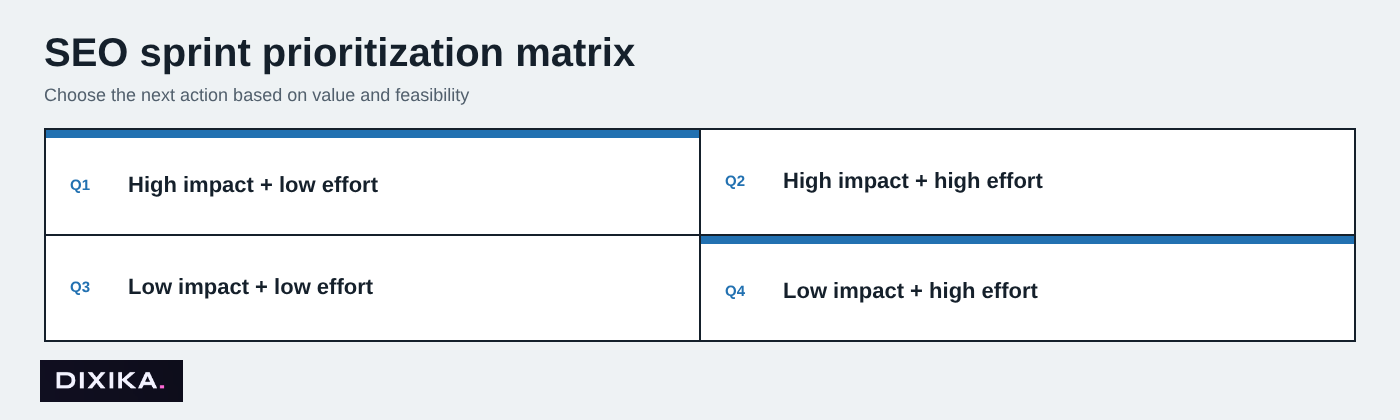
Use a simple prioritization model for each proposed task: expected impact, confidence in the diagnosis, effort, dependencies, and time to learn. This prevents an audit from becoming a static backlog full of minor fixes while high-value pages and technical blockers wait for attention.
Put the roadmap into an assigned workflow
| Action | Evidence to review | Owner | Priority | Validation method |
|---|---|---|---|---|
| Fix technical blockers | Crawl and indexation findings | SEO and development | High | Re-crawl priority URLs and inspect indexing |
| Improve priority pages | Intent, landing-page, and conversion data | Content and product marketing | High | Review page quality and conversion performance |
| Strengthen internal links | Orphan-page and contextual-link gaps | Content and SEO | Medium | Confirm links on affected pages and re-crawl |
Turn your audit into a focused 90-day SEO plan
In the first 30 days, establish baselines and fix the blockers that keep valuable pages from being crawled, indexed, or understood. In the next phase, strengthen high-intent pages, improve internal links, and remove overlap that is diluting relevance. Then use measured content gaps and promotion opportunities to publish evidence-led resources that deserve attention.
The best SEO strategy is rarely the most complicated one. It is a consistent cycle of finding the highest-value constraint, making a verifiable improvement, measuring the result, and choosing the next move based on evidence.
Teams that need support across technical SEO, conversion-aware content, authority link building, or visibility in AI-generated answers can consult Dixika for a focused search growth roadmap.