Most link building fails long before the first outreach email goes out. The team promotes a page nobody needs to reference, targets a generic database of sites, and measures success by raw link count. That approach can create activity, but it rarely creates durable rankings.
Sustainable link building is slower in the right places: asset creation, prospect qualification, editorial outreach, and review. The payoff is a backlink profile that makes sense to readers, publishers, and search engines alike.
What Is SEO Link Building - and What Makes It Sustainable?
SEO link building is the process of earning or acquiring hyperlinks from other websites to your pages. Links help search engines discover content and can serve as signals of authority and relevance when they come from credible, contextually appropriate sources.
The important qualifier is sustainable. Sustainable rankings do not come from collecting the highest possible number of backlinks or finding loopholes in ranking systems. They come from publishing useful resources, earning editorial references from relevant sites, and using a process your team could confidently explain to a client, editor, or search engine reviewer.
A strong link is usually relevant to the topic, placed naturally within useful content, and valuable to the linking page's audience. A weak link may still appear in a backlink report, but it is unlikely to build lasting authority - and may create unnecessary risk if it comes from manipulative tactics.
1. Create Assets People Have a Genuine Reason to Cite
Use these link building SEO tips as a quality-first operating system. Start with an asset that deserves attention, then move into prospecting, outreach, and measurement. Scaling outreach before you have a credible reason for someone to link is one of the most expensive mistakes a team can make.
Ask a simple question before launching a campaign: Why would a publisher add this page to their article? If the honest answer is "because we want a backlink," the asset needs more work. If the answer is "because it gives their readers a current statistic, a useful tool, or a clearer explanation," you have a real angle.
Build for citation value, not just organic traffic
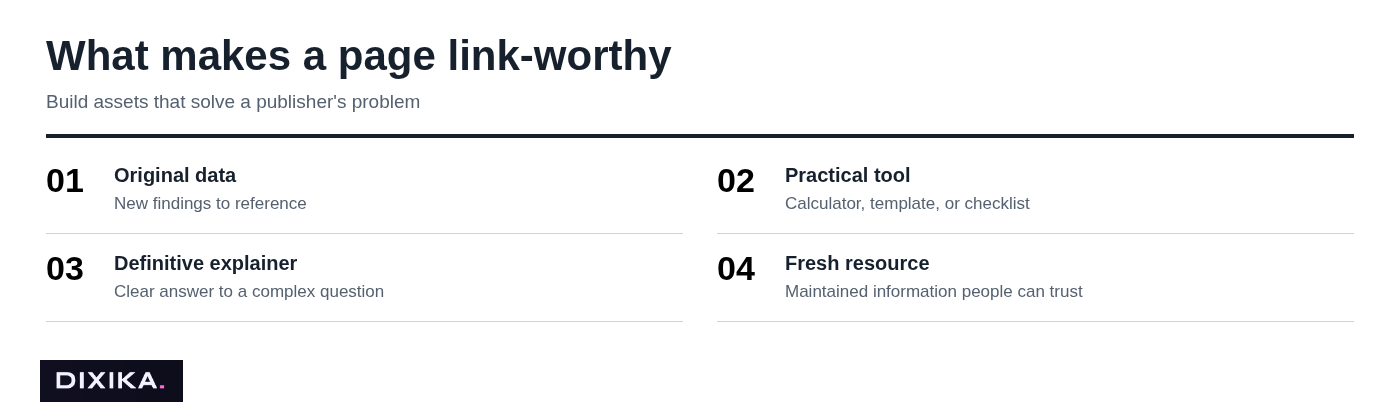
Pages built solely around a target keyword can rank, but they are not automatically link-worthy. Citation-worthy assets solve a problem for the person creating the linking content. They give an editor a source, a writer a practical resource, or a reader an answer that is hard to find elsewhere.
Good formats include original research, proprietary datasets, free calculators, templates, checklists, expert-led guides, and regularly maintained reference pages. Match the format to the need of the referring page. A finance writer may need fresh benchmark data; an operations blog may be more likely to cite a downloadable planning template.
2. Prioritize Topical Relevance Over Surface-Level Authority Metrics
A link from a respected publication in your field can be more meaningful than a link from a broadly popular site with no connection to your audience. Search engines evaluate context, and so do the people who may click through. A niche industry publication linking to a technical guide can send qualified visitors and reinforce what that guide is about.
Metrics such as Domain Rating, Domain Authority, and estimated organic traffic can be useful screening signals, but they are not a verdict on quality. They can be inflated, outdated, or blind to the actual editorial value of a page. Check whether the source covers related topics, has genuine standards, reaches an overlapping audience, and maintains indexed content.
In practice, a contextual mention in a well-maintained article often beats a sitewide footer link or a generic placement on a high-metric domain. Do not confuse a score in a tool with a recommendation from a real publisher.
3. Build a Prospect List Around Pages, Not Just Domains
Domain-level prospecting is convenient, but editorial decisions happen at the page level. Instead of collecting hundreds of websites that look authoritative, identify the exact articles where your resource would improve the content.
Start by defining the topic cluster, target audience, and types of pages likely to cite your asset. For example, a new industry study may fit statistics roundups, trend reports, and research-backed guides. A calculator may fit resource pages, how-to articles, and comparison posts.
Your prospecting sheet should include the specific URL, relevant section or anchor context, contact details, pitch angle, status, and next action. That information turns a vague "link request" into an informed editorial suggestion and prevents your outreach from becoming generic at scale.
4. Use Competitor Backlinks to Find Proven Link Opportunities
Competitor backlink research is valuable because it reveals which publications, resource hubs, and article formats already link to content in your category. The goal is not to imitate every backlink a competitor has. It is to identify proven opportunities where your page can offer a stronger, fresher, or more relevant resource.
Compare at the page level whenever possible. If a competitor's report attracts links from industry newsletters, research pages, and relevant blogs, review the asset itself and the context around each placement. You may find that their data is old, their coverage is narrow, or their guide omits a use case your content handles well.
Find the gap between your asset and theirs
Look for a meaningful difference that a publisher can act on. Your resource might use more current data, include a downloadable template, explain a process more clearly, or cover a specialized audience the competitor ignored. "We have a similar article" is weak outreach. "Our 2026 dataset updates the figure cited in section three and includes the underlying methodology" gives an editor a concrete reason to review it.
Ahrefs
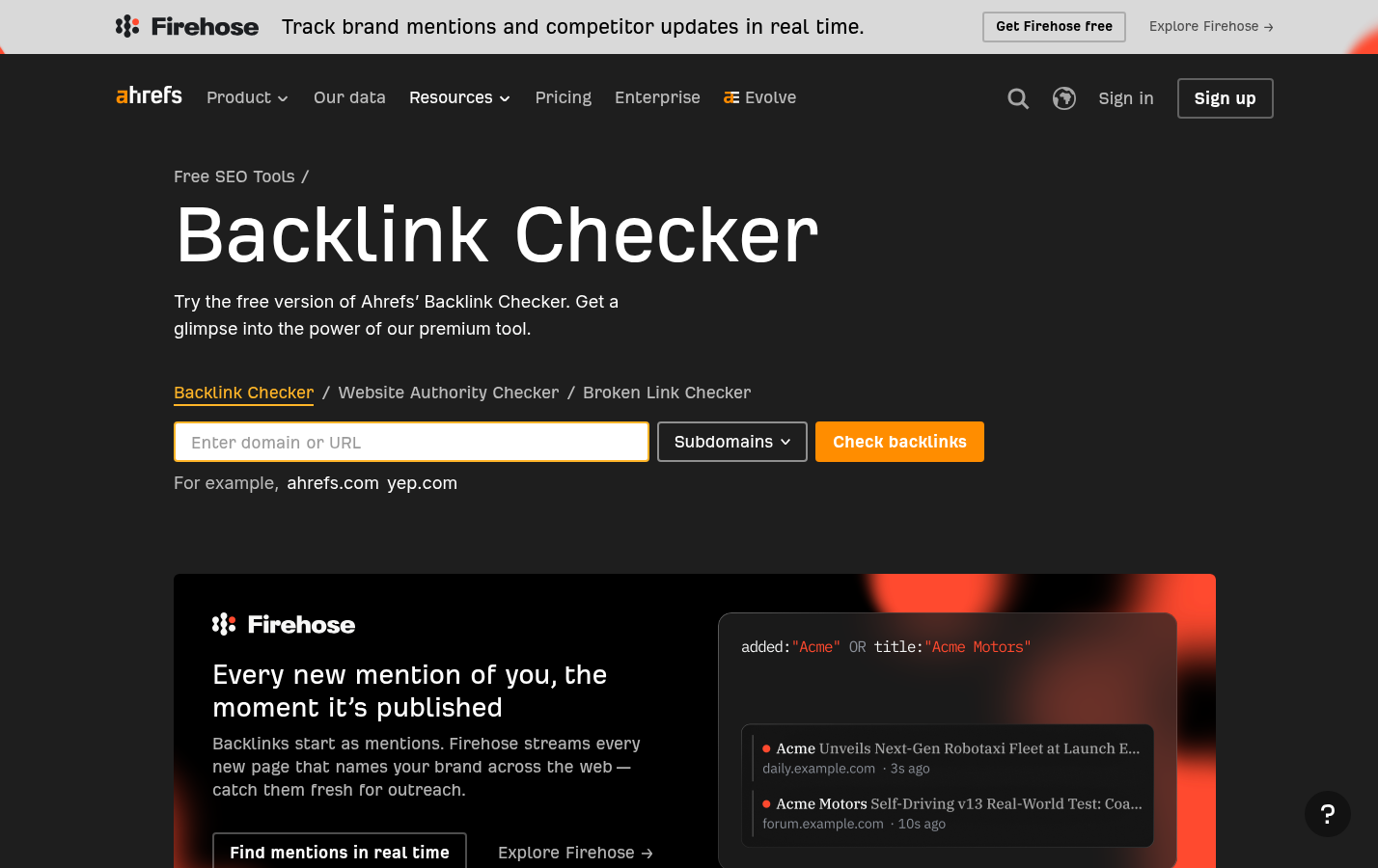
Ahrefs' Backlink Checker is particularly useful for quickly reviewing a competing URL's backlinks and referring domains, which makes it practical for uncovering page-level link prospects. Use it to spot repeated publications, resource pages, and content formats that have already shown a willingness to cite material like yours.
Its limitation is that backlink data alone does not tell you whether a placement is worth pursuing. You still need to assess relevance, editorial quality, and whether your asset genuinely improves on the cited source. It is best suited to SEO teams that can turn raw backlink data into qualified outreach opportunities rather than treating every referring domain as a target.
5. Turn Unlinked Mentions and Broken References Into Helpful Outreach
Some of the most practical link opportunities already exist in partial form. A publication may mention your company, product, research, or subject-matter expert without linking. Another article may cite a dead external resource where your current page would be a helpful replacement.
For unlinked mentions, verify that the mention is accurate and that a link would improve the reader experience. For broken-link outreach, check the old destination, understand what it originally provided, and offer a replacement that truly serves the same purpose. A broken URL is not permission to pitch an unrelated commercial page.
Lead with the correction or benefit. Point to the exact mention or broken reference, briefly explain why your resource fits, and let the editor decide. This is far more effective than sending a broad request to "add our link."
6. Write Outreach That Makes the Editor's Decision Easy
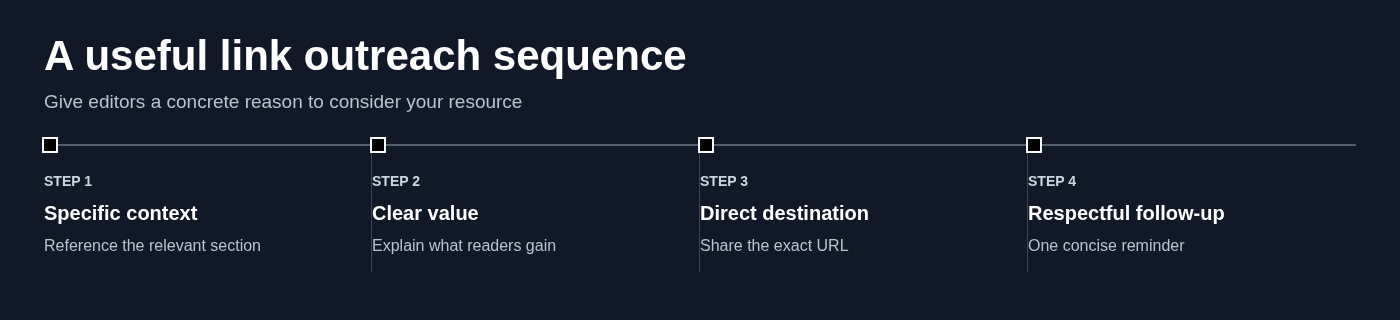
Editors are busy, and most link-building emails create work rather than reduce it. A good outreach message makes the decision simple: it identifies the exact page, references the relevant section, explains the reader benefit, and provides the precise destination.
Segment recipients by why their page is relevant. One group may cite an outdated statistic, another may maintain a resource list, and another may cover the same problem for a specific audience. The opening line should reflect that distinction. Personalization is not inserting a first name; it is demonstrating that you understand the page and its readers.
Avoid inflated claims, fake familiarity, and long narratives about your company. Also avoid aggressive follow-up sequences. One polite reminder is reasonable when the suggestion is genuinely useful. Repeated emails after silence are not persistence; they are a fast way to damage relationships.
A simple editorial outreach structure
Keep the message short enough to scan. Mention the relevant article and section, describe the useful gap or update, share the exact resource, and make a low-friction request. An editor should not have to hunt for the page you want them to consider or guess why it belongs there.
7. Earn Editorial Links Through Digital PR and Expert Contributions
Digital PR works when you have something worth covering: original data, a credible expert perspective, a timely analysis, or firsthand experience that helps a journalist or publisher tell a better story. The link is a result of contributing real value, not the sole purpose of the contribution.
Offer useful commentary to journalists, industry newsletters, podcasts, and relevant publications. Be specific, responsive, and prepared to support claims with evidence. A vague quote about "the future of marketing" is easy to ignore; a clear explanation grounded in current data or operational experience is more likely to be included.
Guest contributions can work too, but set a high bar. The audience should fit, the publication should have real editorial review, and the article should stand on its own even without a backlink. If the only apparent value is a followed link, it is probably not a placement worth chasing.
8. Build Relationships With Publishers and Subject-Matter Experts
The best link-building relationships are not built in a single email. They grow when your team consistently shares useful sources, responds quickly when asked for input, and respects editorial independence. A publisher remembers people who make their work easier.
Follow relevant writers and experts, read what they publish, and contribute where you have real expertise. That might mean supplying data for a story, introducing a knowledgeable source, or sharing a well-researched resource with no immediate ask. Over time, this creates familiarity that cold outreach cannot manufacture.
Do not mistake relationship building for reciprocal-link trading. "You link to me and I will link to you" offers little audience value and can quickly become a transactional pattern. A healthy relationship may lead to mutual references, but each link should still make sense on its own merits.
9. Match Each Campaign to a Page With Clear Search and Business Value
Not every page on your site deserves a link-building campaign. Prioritize URLs that support a clear search opportunity, strengthen an important topic cluster, or contribute to a meaningful conversion path. Otherwise, teams can spend months earning links to pages that do little for visibility or revenue.
Review internal linking, content gaps, ranking pages, and user journeys before selecting a destination. A supporting guide with strong internal links to a relevant service page may be a better outreach target than the service page itself. Internal linking can then help distribute that authority to commercial pages; review our services when mapping those content-to-conversion paths.
Use a small number of relevant target pages per campaign. Repeatedly pushing every link to a homepage or product page creates a poor editorial fit and limits what your link-building effort can accomplish.
10. Scale Link Building With Segmentation and Process, Not Spam
Scale should mean a more reliable system, not a larger blast radius. Divide prospects by sector, publication type, content format, and use case so each group receives a pitch that fits its editorial reality.
A resource-page manager needs a different message from a journalist covering a timely trend. A niche publication may care about a specialized workflow that a broad business blog would not. Creating a few meaningful pitch variants is more effective than automating one generic message across thousands of contacts.
Use a lightweight CRM or spreadsheet to track contact history, notes, campaign status, outcomes, and next steps. This prevents duplicate outreach, gives teammates context, and makes it easier to see which angles actually earn placements. Process protects quality as volume grows.
11. Measure Link Quality and Ranking Impact Over Time
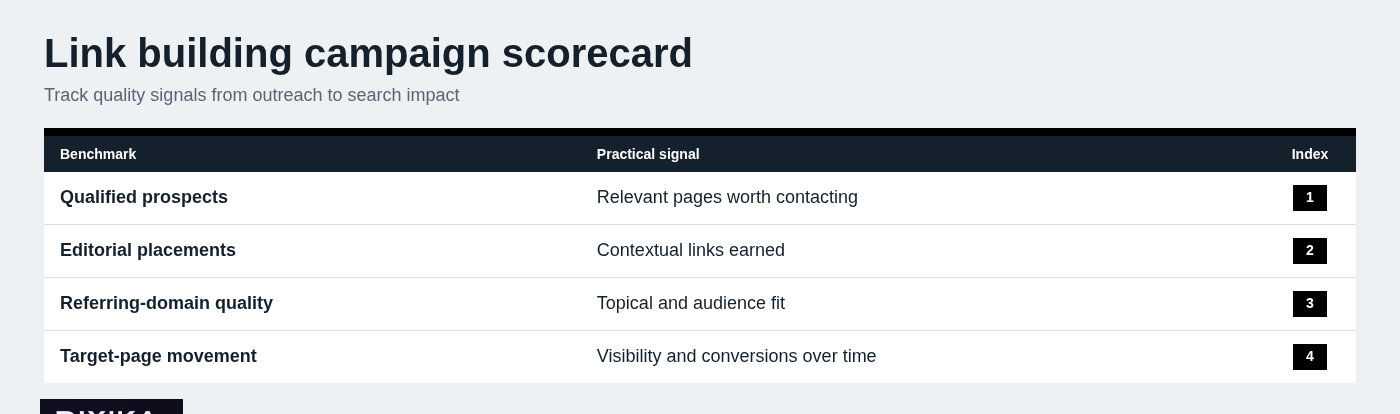
Raw links acquired is an incomplete metric. A campaign can produce dozens of low-value placements while missing the pages and publications that would actually support long-term growth. Track quality from the first prospecting decision through to search performance.
Useful measures include qualified prospects, positive replies, editorial placements, new referring domains, topical relevance, target-page visibility, organic traffic, and assisted conversions where your analytics setup supports them. Review individual placements as well as aggregates. A link that sends qualified referral traffic or appears in a trusted industry resource may matter more than several generic mentions.
Ranking movement also takes time. Links work alongside content quality, technical health, internal linking, competition, and search intent. Treat campaign reporting as a learning loop: which asset types earned attention, which publisher segments converted, and which pages showed stronger visibility after promotion?
12. Avoid Shortcuts That Put Long-Term Rankings at Risk
Paid link schemes that pass ranking value, automated link blasts, private blog networks, irrelevant directory submissions, and manipulated anchor text all promise speed. What they usually create is a brittle backlink profile: one that is hard to defend, disconnected from real audiences, and vulnerable to algorithmic changes or manual review.
The test is straightforward. Would this placement still be useful if search engines did not exist? If the answer is no, it is unlikely to be a strong foundation for sustainable rankings. That does not mean every link needs to come from a major media outlet. It means every link should have a plausible editorial purpose.
Be especially cautious with vendors selling fixed quantities of guaranteed links. A guarantee of volume tells you nothing about relevance, editorial standards, or long-term value. Quality link building requires judgment, which is exactly why it cannot be reduced to a bulk order.
Put These Link Building Strategies Into a Repeatable System
Effective link building follows a simple sequence: create something worth citing, find pages where it genuinely fits, make a specific value-led suggestion, and learn from the quality of the outcomes. Each step reinforces the next. Better assets improve outreach; better prospecting improves response rates; better measurement improves future campaigns.
Do not chase links as isolated trophies. Build authority through useful content, sound technical foundations, relevant relationships, and editorial references that help real readers. Teams that need an integrated plan for content, technical SEO, and authority building can explore Dixika's SEO services.