
Organic rankings are not won by sprinkling keywords into a page or chasing a better score in an SEO tool. They improve when a search engine can crawl and understand your page, when the page fulfills the searcher's task better than competing results, and when your site has enough relevant authority to deserve visibility.
That sounds simple, but the work is not. A page can be well written and still fail because it is not indexed. A technically sound page can sit on page two because it answers the wrong question. And a number-one ranking can be commercially worthless if the query never brings qualified buyers.
This guide explains how to improve organic search engine rankings with a practical system: diagnose the constraint, prioritize the right opportunities, make pages more useful, and measure results against business outcomes.
What Organic Search Rankings Mean - and What Actually Influences Them
Organic search results are unpaid listings selected by a search engine's algorithms. They are different from sponsored ads, Shopping placements, map-based local packs, video carousels, featured snippets, AI-generated answer surfaces, and other search engine results page features.
In digital marketing, organic search is the traffic people reach by clicking those unpaid listings. A search result may look like a standard blue link, but its visibility depends on far more than its numerical rank. A result at position four below ads, a featured snippet, and a local pack may receive fewer clicks than a lower-volume result in position six on a cleaner page.
Rankings are also query- and context-specific. A website does not have one universal Google position. Visibility can differ by country, city, device, language, personalization, search history, the exact phrasing of a query, and the result types Google chooses to display.
Organic search vs paid search is not an either-or decision. Paid media can create immediate exposure while campaigns are active. SEO takes longer, but useful pages can continue attracting qualified visitors after publication and optimization. The strongest growth programs often use both: paid search for immediate demand capture and organic search for durable discoverability across a broader range of queries.
A quick-start plan for improving rankings
If you need a sensible order of operations, start here:
- Confirm that important pages can be crawled, indexed, and reached through internal links.
- Find queries with real demand, clear business value, and a realistic path to competing.
- Map each priority intent cluster to one appropriate page.
- Improve that page's usefulness, format, accuracy, and evidence.
- Strengthen internal links and earn relevant external citations where justified.
- Measure query-page performance, qualified traffic, and conversions before deciding what to do next.
Meaningful movement can take weeks or months. The timeline depends on competition, site condition, crawl frequency, the scale of the changes, and whether the page needs stronger relevance, stronger authority, or both. Anyone promising predictable first-page rankings on a fixed schedule is selling certainty that search does not offer.

Set the Right Ranking Goals Before You Optimize
A ranking goal should begin with the business question behind a query. Traffic is useful only when it reaches the right audience and supports a meaningful next step: a demo request, subscription, purchase, lead, trial, or assisted pipeline opportunity.
Tracking a keyword in isolation causes bad decisions. You need to know the search intent, the page URL ranking for that term, the country and device being measured, and the layout of the live results. A position change can mean very little if a different URL is ranking, a local pack has pushed standard listings down, or the query has shifted from research intent to purchase intent.
Choose keywords by intent, business value, and realistic opportunity
Search intent is the task a person is trying to complete. Broadly, queries tend to be informational, commercial, transactional, or navigational. Informational searches ask for explanations or guidance. Commercial searches compare options. Transactional searches signal a desire to buy, book, or request something. Navigational searches seek a specific brand or destination.
The current results are usually the best evidence of intent. If Google mainly returns guides, comparison pages, and definition-style content, a hard-selling service page is unlikely to be the right fit. If the results are product pages and pricing comparisons, publishing another broad explainer may miss the opportunity.
Prioritize a query when three conditions line up:
- Business value: The audience and intent can plausibly lead to a valuable outcome.
- Topical fit: Your site has credible expertise, relevant products or services, and supporting content around the subject.
- Competitive opportunity: You can create a more useful page or reasonably narrow the authority gap.
Do not dismiss lower-volume queries. In B2B, a specific comparison or problem-focused query may generate only a modest number of searches while producing far more qualified conversations than a broad vanity term.
Establish a baseline that explains performance
Google Search Console should be the starting point for an organic search baseline. Capture impressions, clicks, click-through rate, average position, indexed priority URLs, query-page pairs, and trends over time before making major changes.
Separate branded and non-branded performance. Branded searches often rise because awareness is growing, not because your SEO program has improved discovery among new audiences. Both are valuable, but they answer different questions.
Keep a change log. Annotate site releases, migrations, content updates, redirects, link campaigns, tracking changes, and major marketing launches. Without that record, teams often mistake coincidence for causation when performance changes.
Diagnose Why a Page Is Not Ranking
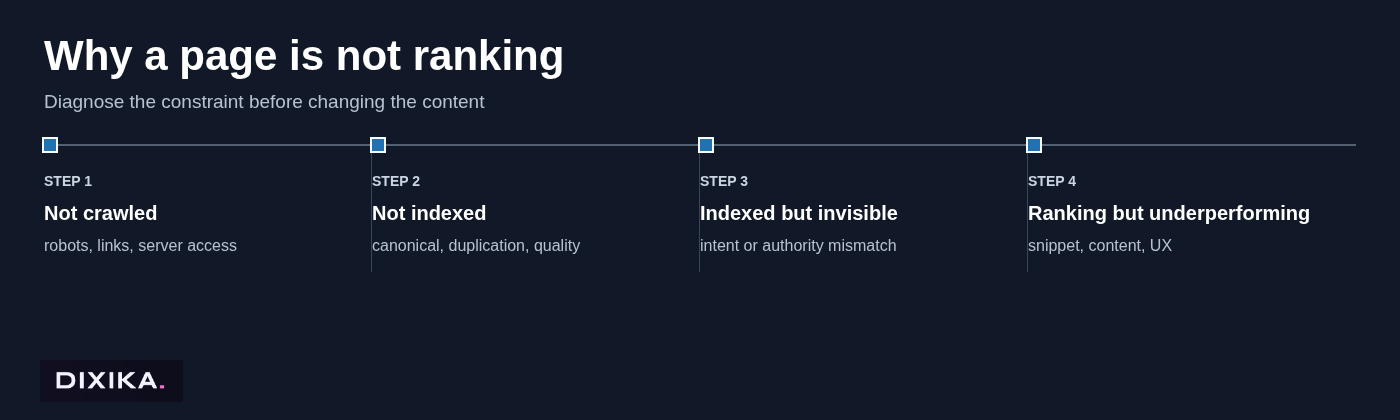
Before rewriting content, identify the actual constraint. This prevents a common waste of effort: investing in a better article when the URL is blocked, canonicalized elsewhere, buried in site architecture, or competing with another page on the same domain.
There are three fundamentally different situations. A page may not be indexed at all. It may be indexed but not competitive. Or it may rank, but for the wrong query, the wrong audience, or the wrong page on your site.
Confirm crawling, indexation, and canonical signals
Start with the basics. Review robots directives, noindex tags, XML sitemap inclusion, HTTP status codes, redirect behavior, canonical tags, duplicate URL variants, and internal links pointing to the page. A detailed technical SEO audit can help organize this review across templates and priority URLs.
Look for familiar problems: important pages blocked by robots.txt, accidental noindex directives left from staging, self-conflicting canonicals, redirect chains, parameterized duplicates, or pages that have no meaningful internal path from the rest of the site. If a URL is not linked internally and does not appear in a sitemap, it may be technically available but practically undiscoverable.
Indexation is not a quality endorsement. An indexed URL is eligible to appear, but it still needs relevance, usefulness, and sufficient signals of trust to rank well against alternatives.
Read the live SERP before rewriting the page
Search the target query and study what the results are doing. Identify the dominant content type, format, depth, freshness, common entities and subtopics, and the searcher's likely task. A query that returns calculators is asking for something different from one that returns opinion pieces, even if both contain similar keywords.
Do not copy competitors mechanically. The goal is to identify what they fail to do. Maybe they provide generic advice without an implementation sequence. Maybe their comparisons omit decision criteria. Maybe they lack current evidence, practical examples, or guidance for a particular audience.
That gap is where a better page begins. Matching the expected format gets you into consideration; adding clarity and useful substance is what gives searchers a reason to choose your result.
Build a Keyword-to-Page Map That Prevents Cannibalization
Keyword cannibalization happens when multiple pages on the same site compete for the same or very similar intent. It is not automatically a problem when two URLs rank for related terms; sometimes different pages legitimately serve different tasks. The problem appears when search engines cannot tell which page should be the primary answer.
One primary page should usually own a primary intent cluster. Closely related questions can become sections within that page or be covered by supporting pages that clearly link back to the main resource.
Watch for rotating URLs, unstable rankings, nearly identical pages, similar title tags, and internal anchor text that points competing pages at the same query. These are signs your site may be splitting relevance and link equity across pages.
Use topic clusters without creating thin pages
A topic cluster is a connected group of pages covering a subject from distinct angles. A hub page addresses a broad topic, supporting pages answer narrower questions, and conversion pages help readers evaluate or buy a solution. The model works only when each page serves a genuinely different searcher task.
For an organic search example, a comprehensive guide could target a broad query such as "what is organic search in digital marketing." A related service page could target a higher-intent query from teams looking for help improving organic visibility. The guide can explain the concept and link naturally to the service page when readers need implementation support; the service page should not try to replace the guide.
Creating separate pages for tiny keyword variations usually creates thin, repetitive content. Build another page only when the query deserves a different format, depth, audience, or decision stage.
Decide whether to consolidate, redirect, or differentiate
Merge pages when they answer the same question, target the same audience, and have no meaningful reason to exist separately. Preserve the strongest useful material, select the best URL as the destination, and use a 301 redirect for the obsolete version.
Redirect an outdated URL when its purpose has ended and a clear replacement exists. If no suitable replacement exists, do not redirect it arbitrarily to the homepage; that creates a poor experience and can confuse search engines.
Keep separate pages when the intents are distinct. For example, a "how to choose" guide and a "pricing" page may relate to the same product category but support different decisions. Differentiate them with distinct titles, openings, sections, calls to action, and internal-link anchors.
After consolidation, update internal links across the site. Leaving old links pointed at redirected or competing URLs weakens the clarity you were trying to create.
Create Pages That Are the Best Result for the Searcher's Task
The central principle of ranking improvement is intent satisfaction. A strong page answers the core question early, then gives readers the depth, proof, caveats, and next action appropriate to that query.
There is no universal word-count formula. A simple question may deserve a direct answer and a few supporting points. A high-stakes B2B comparison may require definitions, decision criteria, implementation considerations, examples, and evidence. The right depth is the amount needed to complete the task without making the reader work through filler.
Useful pages tend to share several traits: clear structure, accurate claims, complete coverage of important considerations, original analysis, readable language, and examples that help readers apply the advice. Where firsthand experience is relevant, make it visible through details of the process rather than vague claims of expertise.
Match the format the SERP rewards
Format is often the first ranking decision. Some searches call for a guide. Others call for a comparison, product or category page, template, calculator, troubleshooting article, or local landing page.
Use the live results as evidence. If the top results are comparison tables, a long narrative essay is probably a weak fit. If searchers are asking how to solve a technical issue, a product page without diagnostic steps is unlikely to earn trust.
Still, do not produce a generic replica. If every ranking guide repeats the same surface-level tips, a more useful angle might be a decision tree, a realistic workflow, a cost model, a template, or audience-specific implementation advice.
Improve information gain and credibility
Information gain is the additional value a reader gets from your page that they did not receive from the other results. It can come from original examples, process details, proprietary data, expert review, transparent methodology, current updates, or carefully attributed claims.
For example, instead of saying "improve internal linking," show how a team can identify high-authority relevant pages, select a priority destination, write a descriptive contextual anchor, and verify that the destination has a clear role in the reader journey. Specificity is more credible because it is more useful.
Do not treat E-E-A-T as a checklist. Author bios and credentials can help readers assess credibility, but they do not rescue thin or inaccurate content. Trust comes from the page itself: whether it is correct, transparent, well-supported, and written by someone who understands the topic.

Optimize On-Page Signals Without Chasing a Keyword Density Formula
On-page SEO helps search engines understand what a page is about. It includes descriptive title tags, a clear main heading, logical subheadings, useful opening copy, relevant image alt text, and language that naturally covers the subject.
It does not mean forcing an exact phrase into every paragraph. Keyword density formulas are outdated because they confuse repetition with relevance. Pages rank by addressing a query comprehensively and clearly, not by hitting a numerical repetition target.
Use important terminology where it genuinely improves precision. Then write naturally enough that a real person can understand the page quickly. On-page signals support strong content; they cannot compensate for poor intent fit or a weak page.
Write titles and meta descriptions that earn qualified clicks
A title tag should be accurate, distinct, specific, and aligned with the content. It should tell a searcher why the page is relevant without making a promise the page cannot keep.
Good titles often combine the topic with a clear benefit or audience fit. Avoid repetitive boilerplate, excessive punctuation, vague superlatives, and clickbait. A title that earns the wrong click can increase visits while reducing qualified engagement.
Meta descriptions are not a direct ranking lever, and search engines may rewrite them. They still matter because they can influence how a result is presented. Write concise descriptions that explain the page's value, reflect the actual content, and help the right searcher decide to click.
Use structured data for eligibility, not as a ranking shortcut
Structured data, often called schema markup, provides machine-readable context about page content. When valid and supported, it may make a page eligible for relevant rich-result treatments.
Use it to clarify visible content, not to manufacture search features. Markup must match what users can actually see on the page, follow the relevant guidelines, and be validated after implementation. Unsupported, misleading, or spammy markup is not a shortcut to better rankings.
Fix Technical SEO Issues That Suppress Organic Visibility
Technical SEO matters most when it removes a real barrier. The highest-priority issues usually involve crawler access, indexation control, duplicate management, rendering, mobile usability, performance, and site architecture.
Not every technical score improvement leads to a ranking gain. A small performance tweak on one low-traffic page may be less valuable than fixing a template-level issue that affects hundreds of critical URLs. Prioritize based on affected pages, business importance, and the severity of user or crawler friction.
Make important content discoverable and easy to render
Important pages should be reachable through a shallow, logical internal-link structure. Revenue- and traffic-critical URLs should not require users or crawlers to pass through several obscure layers of navigation.
Audit orphan pages, JavaScript rendering dependencies, pagination, faceted navigation, XML sitemaps, and status-code handling. JavaScript is not inherently bad for SEO, but content and links that depend on complicated client-side rendering can create risk when rendering fails or takes too long.
Faceted navigation deserves special attention for ecommerce and large databases. Uncontrolled filters can create an enormous number of near-duplicate URLs that distract crawling from pages that matter. Use indexation and canonical controls intentionally, based on whether filtered combinations serve genuine search demand.
Improve page experience where it blocks users
Page experience is not a cosmetic afterthought. Mobile usability, intrusive interstitials, slow-loading media, unstable layouts, and inaccessible interactions can prevent visitors from completing the task that brought them to your site.
Core Web Vitals are useful diagnostic signals, particularly when a template affects many pages. Improve images, scripts, fonts, layout stability, and interaction responsiveness where they create measurable friction. Do not obsess over isolated lab scores while ignoring the content or conversion path users actually encounter.
Accessibility improvements often support both usability and technical quality. Clear heading structure, readable contrast, descriptive controls, keyboard-friendly interactions, and sensible alt text make a site easier to use for more people.
Use Internal Links to Distribute Context and Authority
Internal links help visitors find related information, help search engines discover URLs, and clarify how your content fits together. They also indicate which pages your site considers important within a topic.
A repeatable internal-linking audit is straightforward:
- Identify strong, relevant pages that already earn traffic or links.
- Select priority pages that need more discovery, context, or support.
- Add contextual links where they help the reader continue naturally.
- Use descriptive anchors that accurately explain the destination.
- Remove broken, outdated, or misleading paths.
The link should make sense even if rankings did not exist. A reader should be able to understand why the destination is useful at that exact point in the journey.
Build links around reader journeys, not navigation clutter
Natural internal links often belong in definitions, prerequisite steps, comparisons, proof points, related use cases, and next-stage conversion pages. A guide on organic visibility, for instance, may link to a deeper technical SEO resource after explaining why crawlability matters.
Avoid sitewide keyword-rich footer links and oversized blocks of loosely related articles. These patterns create clutter, dilute attention, and rarely help readers. Fewer, well-placed contextual links are usually more useful than a page full of arbitrary destinations.
Earn Relevant Backlinks Through Assets Worth Citing
Backlinks are links from other websites to yours. Editorial links can reinforce authority and discovery, especially when they come from credible, relevant sources that chose to cite your content because it added value.
Raw link volume is a poor goal. A small number of relevant editorial mentions can matter more than a large number of low-quality, unrelated links. Effective search engine optimization link building is relationship- and asset-driven work, not a volume purchase.
Choose linkable assets that fit your market
The best linkable assets solve a real problem for people who publish, advise, or make decisions in your market. Possible formats include original research, proprietary data, useful tools, templates, expert commentary, definitive resources, and visual explainers that make a complex topic easier to understand.
Before creating an asset, identify who would have a reason to reference it. A benchmark report may be useful to journalists and industry analysts. A detailed implementation template may be useful to consultants and practitioners. A calculator may be useful to buyers evaluating a cost or capacity decision.
Every asset does not need to be a large study. A well-made resource that answers a recurring question better than existing pages can earn citations over time.
Run outreach that offers a legitimate editorial reason
Outreach works when the recipient can immediately see why your resource is relevant to their audience. Build a prospect list based on topical fit, verify that each site is legitimate, choose a personalized angle, and make a concise case for why the resource improves their existing article or upcoming coverage.
Follow up sparingly. Persistent automated sequences sent to irrelevant contacts do not build links; they damage trust. Review any acquired link for relevance, editorial quality, and placement rather than treating every new referring domain as a win.
Avoid scaled low-quality guest posting, irrelevant directories, paid link schemes, and automated outreach designed only to manipulate rankings. Those tactics create risk and often produce little lasting value.
Improve CTR and SERP Real Estate Where You Already Have Visibility
Click-through rate, or CTR, is the percentage of impressions that become clicks. It is most useful when evaluated by query and page, not as one sitewide number. In Search Console, look for pages with high impressions, middling positions, or unexpectedly weak CTR compared with the surrounding query set.
The available clicks vary by SERP. Ads, featured snippets, AI-generated answer surfaces, videos, image results, local packs, and shopping modules can all reduce or redistribute attention. A lower CTR may reflect the result page layout rather than a weak title alone.
Make snippets more useful than adjacent results
Improve what searchers see before they click. Refine the title, make the introductory answer direct, organize headings around real questions, and include current details such as dates, pricing, or availability when relevant to the page.
Structured content can also support rich-result eligibility where appropriate, as covered in the on-page section. But the central job is to make your result more useful than the listings around it.
Keep the promise consistent. If a title says "complete comparison," the page should provide decision criteria, not a thin overview. Better clicks that turn into immediate exits are not a sustainable win.
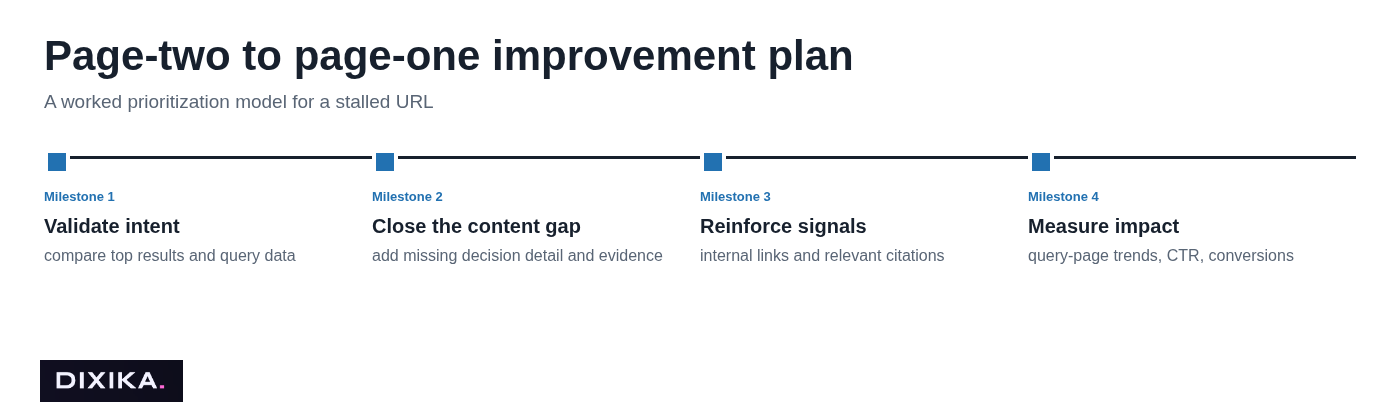
A Worked Example: Move a Stalled Page From Page Two to Page One
Imagine a B2B software company has a guide ranking between positions 11 and 18 for a valuable non-branded query. The team sees the page-two ranking and immediately suggests adding more keywords, compressing images, and publishing several supporting posts.
That is activity, not diagnosis. A better approach is to determine what is actually keeping the page from competing, then make a focused change set.
Step 1: Identify the limiting factor
First, confirm that the target URL is indexed, returns a healthy status code, has a self-referencing canonical, and appears in the XML sitemap. It does. Search Console shows stable impressions, so the page is being surfaced, but it is not earning enough clicks or moving past page two.
Next, inspect the live results. Most top-ranking pages use a comparison-led format: they explain who each option is for, list practical trade-offs, provide implementation considerations, and include a decision framework. The stalled guide is accurate, but it is mostly a broad overview. It lacks the criteria a buyer needs to compare approaches and does not explain what happens after a selection is made.
Then review internal links. Several authoritative pages on the company's site discuss adjacent problems but do not link to this guide. The evidence points to an intent and usefulness gap, reinforced by weak topical connections. It does not point to random technical adjustments as the first priority.
Step 2: Make a focused change set and measure it
The team rewrites the page around a clear decision framework. It adds a comparison table based on real evaluation criteria, an example implementation path for a mid-market buyer, and a section explaining when each approach is a poor fit. The opening now answers the core query directly rather than spending several paragraphs on background.
They add contextual internal links from relevant high-performing pages, using anchors that accurately describe the guide. They test a more specific title that reflects the comparison-led angle. Finally, they reach out to a limited set of relevant publications and experts whose readers would benefit from the new decision resource.
Over the following weeks, they track the target query and related query cluster for impressions, clicks, CTR, average position, and target URL stability. They also review assisted conversions and downstream lead quality. A short-term position fluctuation does not prove success or failure; the team needs enough time and enough data to see whether visibility, clicks, and business outcomes improve together.
The lesson is not that these exact actions guarantee page-one rankings. It is that a page close to competing often needs a specific, evidence-based improvement plan rather than a pile of disconnected SEO tasks.
Measure Organic Search Success Beyond Average Position
Average position is useful context, but it is not a complete success metric. It can conceal URL switching, changes in query mix, growth in branded demand, geographic differences, and shifts in SERP features. A position improvement is less meaningful if clicks and qualified conversions do not follow.
Use a consistent measurement cadence. Check weekly for release-related anomalies, crawl issues, indexing changes, and sudden drops. Review trends monthly to identify content, CTR, and query opportunities. Reassess priorities quarterly as competitors, demand, site architecture, and business goals change.
Use a practical organic search scorecard
A useful organic search scorecard includes:
- Non-branded impressions, clicks, CTR, and query visibility.
- Priority URL visibility and whether the intended URL ranks.
- Indexed status for business-critical pages.
- Organic conversions, conversion rate, revenue, or pipeline where available.
- Relevant backlinks and referring domains.
- Share of voice across a defined, commercially meaningful keyword set.
Segment the data when it will change your decisions. Common segments include country, device, directory, page template, intent group, new versus refreshed content, and branded versus non-branded queries. A sitewide average often hides the page group that needs attention most.
Know when a ranking drop needs urgent action
Normal volatility happens. A few days of movement for a small query set is not necessarily a crisis. Urgent action is more appropriate when there is a sudden broad decline, deindexation of priority pages, migration errors, lost canonical control, a manual action, server failures, or sustained displacement across important query clusters.
Document what changed, then investigate the affected URLs and queries. Check indexation, crawl signals, canonical tags, redirects, robots directives, internal links, and the live SERP before reacting. This discipline prevents teams from making destructive changes in response to normal variation.
Is SEO Still Worth It in 2026?
Yes, SEO is still worth it in 2026 when it is tied to genuine demand and business outcomes. Search behavior is changing, and AI-generated answers can satisfy some questions without a traditional click. That does not make organic visibility irrelevant; it raises the standard for what deserves visibility.
Useful source material, clear entity information, technically accessible pages, accurate citations, and recognizable topical authority all matter in a search environment that includes both conventional results and AI answer surfaces. For a practical overview of this shift, see what AI search optimization means for visibility. Rankings remain valuable, but they are not the only goal.
The practical approach is to build pages people can trust, make them easy for search systems to access and interpret, strengthen the brand's source footprint, and diversify acquisition rather than depending on one query or one channel.
Build a Sustainable Organic Ranking Program
Sustainable organic growth comes from a repeatable operating model, not isolated optimizations. Fix constraints first. Publish and improve pages that match genuine search intent. Connect those pages through sensible internal linking, earn relevant authority through assets worth citing, and learn from query-level measurement.
The order matters. There is little value in promoting a page that is not indexable, and little value in perfecting a title for a page that does not solve the searcher's problem. Start with the limiting factor, make the highest-impact change, and keep the record of what changed and why.
Teams that need help building that system can explore Dixika's support across technical SEO, content strategy, link building, and AI-search visibility. The objective is not a temporary ranking spike. It is a stronger search presence that continues to earn qualified attention as your market and search results evolve.