
AI search optimization is the practice of making your brand and its information easy for AI-powered search experiences to retrieve, trust, synthesize, and cite. It does not replace traditional SEO. It extends it, so your business can appear in generated answers as well as standard organic results.
For most teams, the practical goal is simple: publish useful, technically accessible, well-supported information that an AI answer system can confidently use when someone asks a relevant question. That requires more than adding a few AI-related keywords to old pages.
AI search optimization, defined: earning citations and mentions in AI answers
AI search optimization focuses on earning accurate mentions and citations in generated search responses. When a user asks a question, an AI search experience may gather information from multiple sources, summarize it, recommend options, and link or cite the sources it used.
You may also hear this called generative engine optimization (GEO), answer engine optimization (AEO), or AI SEO. The terms overlap, but the underlying work is consistent: help machines understand what your company knows, why it is credible, and which page provides the best evidence for a specific answer.
Traditional SEO still matters because AI systems need accessible source material. A well-indexed, useful page with clear topical relevance has a far better chance of becoming part of an AI-generated answer than a page search engines cannot crawl, understand, or trust.
How AI search differs from traditional search
Traditional search largely asks, "Which pages should rank for this query?" AI search adds another question: "Which sources should be used to construct the answer?" Your page may not need to hold the first blue-link position to be useful, but it must contain information strong enough to be selected.
That changes the visibility model. A conventional results page gives users a list of links to evaluate. An AI-generated answer may provide a direct response, citations, suggested follow-up prompts, product comparisons, or a short set of sources. Users may click through less often for simple questions, while high-consideration queries can still drive valuable referrals when your source adds proof or depth.
Optimizing a website for generative AI features on Google Search does not mean finding secret markup that guarantees inclusion. Structured data can help clarify eligible visible content when used accurately, but it is not a citation switch. The durable work remains sound technical SEO, clear information architecture, original content, and credible evidence.

Where AI search visibility matters most
AI search visibility matters wherever your buyers use conversational questions to research a problem, compare options, validate a shortlist, or investigate an unfamiliar category. The major experiences include Google AI features, ChatGPT search, Microsoft Copilot, Perplexity, and Gemini. They overlap, but they do not use identical sources, interfaces, or response patterns.
There is no universal top-three AI search engine list that applies to every business. The right channels depend on your audience, region, buying cycle, and query type. A B2B buyer researching software may use Google and ChatGPT differently from a consumer looking for local recommendations or technical troubleshooting.
Focus AI visibility efforts on audience behavior and business relevance.
How AI systems decide what to cite or mention
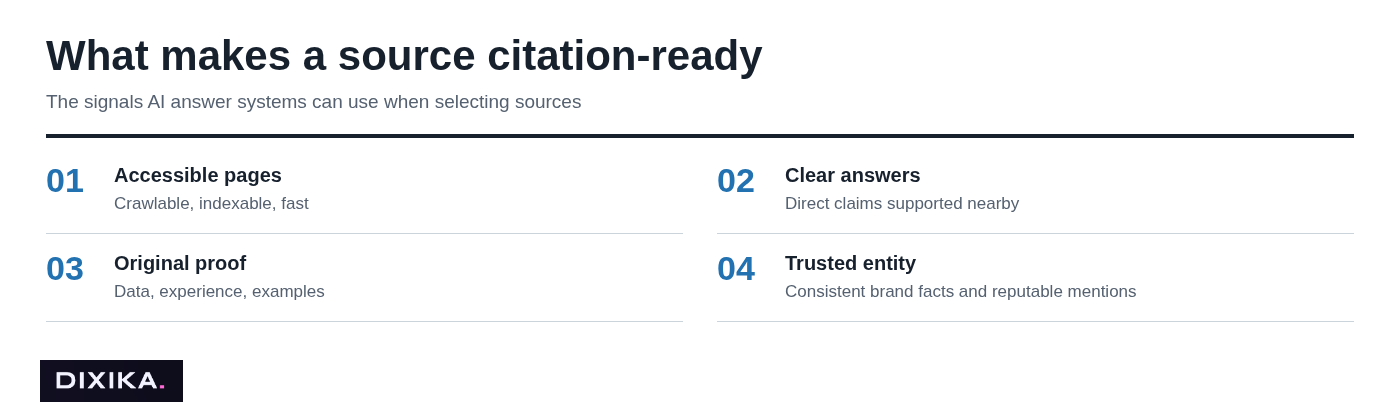
AI answer systems tend to favor sources that are accessible, relevant, clear, credible, and current. That does not mean there is a public, fixed formula. Citation choices can change based on the prompt wording, location, account state, available sources, and model behavior.
In practice, the strongest signals are usually overlapping rather than isolated:
- Crawlability and indexability: Search systems must be able to access and process the page.
- Topical relevance: The page should directly address the user's question rather than mentioning it in passing.
- Clear passages: Concise claims, definitions, steps, and comparisons are easier to retrieve and synthesize.
- Original proof: Firsthand experience, data, methodology, examples, and expert insight make a source more valuable.
- Third-party corroboration: Reputable mentions and links support the legitimacy of your claims and brand.
- Entity consistency: Your company, people, products, and expertise should be described consistently across credible locations.
- Freshness: Current facts matter, especially for pricing, product capability, regulations, and fast-moving markets.
Ignore the so-called 30% rule in AI if it is presented as a universal optimization tactic. There is no reliable rule saying that a certain percentage of AI-written content, keywords, or page structure will earn AI citations. Accurate, complete, verifiable answers beat arbitrary percentages.
A practical workflow to optimize your website for AI search
A useful AI search optimization program starts with customer questions and ends with measurable business outcomes. Do not begin by publishing a large volume of generic AI-assisted content. Begin by identifying the answers your market needs and the evidence your site can credibly provide.
For Google-specific work, follow standard Search Essentials, allow crawling where appropriate, and use structured data only when it accurately reflects content visible on the page. Do not create pages solely for AI features; create pages that genuinely help users make decisions.
1. Find the questions that trigger AI answers in your market
Map the high-intent questions your buyers ask before, during, and after a purchase. Include comparison prompts, "best for" queries, implementation questions, alternatives, pricing concerns, and likely follow-up questions.
For each prompt, identify the page that should be the best answer. Then review cited sources: What methodology, recency, detail, examples, or proof do they offer that your page lacks? This turns vague AI visibility work into a specific content gap list.
2. Remove technical barriers before publishing more content
AI-ready content is still ineffective if it is inaccessible. Review robots directives, status codes, JavaScript rendering, canonical tags, sitemap inclusion, internal links, mobile usability, and whether critical content is hidden behind login walls or script-dependent interfaces. A technical SEO audit can help organize this review.
Technical SEO remains foundational whether a business serves a local market or operates nationally. Local targeting does not make crawlability, site architecture, or indexation less important.
3. Build pages that answer, prove, and explain
Write answer-first sections with descriptive headings, then support the answer with explanation and evidence. Include practical steps, dated details where relevant, transparent authorship, clear definitions, and sources for factual claims.
For example, a strong comparison page explains its selection criteria, who each option suits, where each option falls short, and how information was verified. A lightly rephrased commodity article has little reason to become a preferred citation when dozens of similar pages already exist.
4. Build authority beyond your own site
Authority is reinforced outside your domain. Earned media mentions, expert contributions, relevant industry directories, digital PR, and editorially earned links can corroborate that your company is real, knowledgeable, and associated with a topic.
Search engine optimization link building supports AI visibility when it prioritizes relevance and quality over volume. A handful of credible mentions with consistent brand information is more useful than a large batch of low-value placements built solely to manipulate rankings.
5. Test prompts and measure visibility over time
Create a repeatable set of prompts tied to your customer journey. Record which brands and sources appear, how they are characterized, which pages receive citations, and where competitors have stronger evidence.
Measure referral traffic, assisted conversions, branded search growth, organic performance, and citation or mention trends together. One favorable answer is not proof of durable visibility; repeated inclusion for commercially meaningful prompts is more informative.
What AI search optimization looks like: a concrete example
Consider a B2B software company trying to appear for "best project management software for creative agencies." It may already have a comparison page, but the page could be too broad to earn a citation in an answer tailored to agency workflows.
An audit might reveal that competing sources explain their evaluation method, distinguish approval workflows from general task management, include updated product facts, and cite firsthand customer research. The company's existing page may simply list tools with short descriptions and no explanation of why they were selected.
The better response is not to stuff the phrase into more headings. The company could add transparent comparison criteria, original user survey findings, creative-agency use cases, an expert review process, updated documentation, and internal links to relevant workflow guides. Success would be recurring citations for relevant prompts and qualified visits from users who need that level of detail, not a single appearance in one generated response.

Do AI search optimization tools help? What to look for
Tools can monitor prompts, mentions, citations, competitors, and source patterns, but they cannot compensate for inaccessible, thin, inaccurate, or unsupported content. Prioritize coverage of the answer engines your buyers use, controlled prompt testing, source capture, historical tracking, and transparent methodology.
Start with a short list of business-critical prompts, manual testing, first-party search data, web analytics, and a spreadsheet for citation tracking. Paid tooling or specialist support may become useful as technical complexity and monitoring needs grow.
Likely direction for AI SEO in 2026
AI SEO will likely require measurement beyond a single rank position, combining organic traffic, AI referrals, citations, brand mentions, and conversion assistance. Accessible sites, useful pages, strong internal linking, and credible brands remain valuable across both conventional and AI-powered search.
Common AI search optimization mistakes to avoid
The most common mistake is treating AI search as a content-volume game. Publishing generic AI-written pages without original insight usually adds little value for readers or answer systems.
- Accidentally blocking useful crawlers or hiding key information behind difficult rendering.
- Chasing unverified citation tactics or supposed ranking formulas.
- Using inaccurate schema that does not match visible page content.
- Attempting to manipulate citations through low-quality source networks.
- Updating pages without checking whether facts, prices, features, or claims remain current.
- Measuring mentions alone instead of relevance, accuracy, referrals, and commercial impact.
A mention only matters when it is accurate, contextually appropriate, and connected to a page or brand experience that earns the visitor's trust.
Start with answers your audience can verify
AI search optimization is disciplined SEO plus citation-worthy information, technical accessibility, and ongoing evidence-based testing. The brands most likely to win are not those trying to game a model; they are the ones producing answers their audience can check and trust.
Organizations that need an audit of technical SEO, content, authority, and AI-answer visibility can consult Dixika for an AI search optimization strategy.