
AI answer engines can mention your brand before a buyer ever visits your site. The problem is that many teams approach this as a new bag of tricks: publish more AI-generated pages, add a few schema fields, and hope ChatGPT or Google AI Overviews notice.
That approach fails because generative engines need something more substantial to work with: clear facts, credible evidence, accessible pages, and independent validation. A strong GEO program makes your business easier to find, verify, summarize, and recommend without abandoning the SEO fundamentals that already drive durable search visibility.
Define GEO Before You Build a Geo-Targeted SEO Plan
Generative engine optimization (GEO) is the practice of improving the likelihood that AI answer engines accurately cite, recommend, or summarize your brand when users ask relevant questions. It applies to tools and experiences such as ChatGPT, Gemini, Perplexity, and AI-generated answers in search.
The term can be confusing because "geo-targeted" often means geographic SEO. This guide focuses on Generative Engine Optimization, then shows how to make your supporting evidence relevant to real locations, regions, and service areas where that matters. It is not a guide to geographic targeting alone.
GEO is real, but it is still evolving. It is not a settled standalone ranking system, and no responsible provider can guarantee that a specific AI model will mention a brand for a given prompt. Models, retrieval sources, user context, and answer formats change. The practical opportunity is to build the kind of public evidence that makes accurate inclusion more likely over time.
Set the Scope: GEO Extends SEO Rather Than Replacing It
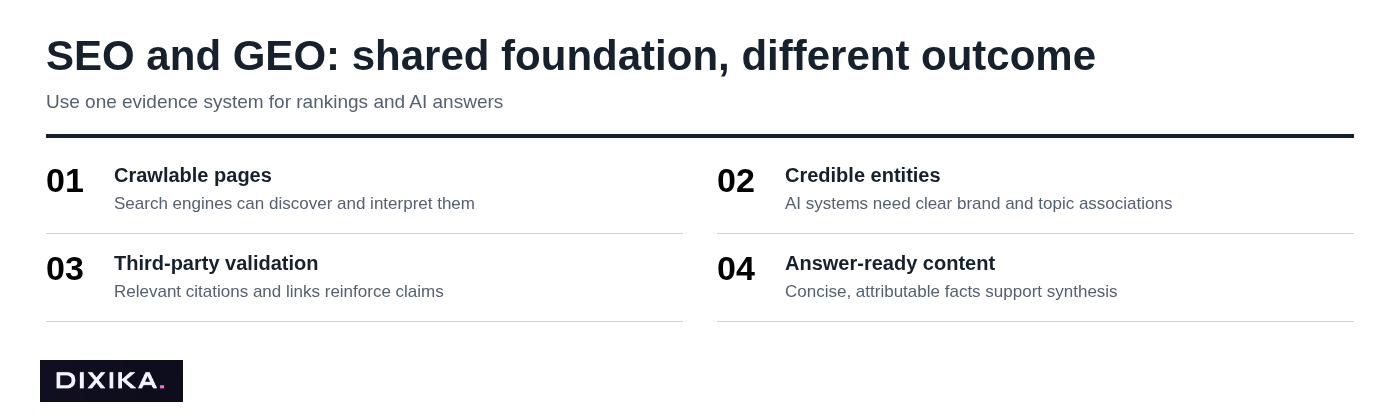
GEO does not replace SEO. Technical SEO, useful content, sound site architecture, recognizable expertise, and relevant links remain the foundation. If search engines cannot crawl and understand your pages, or if your site offers no credible reason to trust its claims, AI answer visibility will be hard to sustain.
What changes is the outcome you are optimizing for. Traditional SEO often focuses on rankings and clicks for a defined query. GEO also considers whether an AI system can synthesize your information, associate your company with the right category, include you in a comparison, and cite a source that supports a recommendation.
That means a page can rank reasonably well yet be difficult for an answer engine to use if it is vague, outdated, unsupported, or unclear about who the company serves. Conversely, a well-supported expert source may be cited for a narrow question even if it does not hold the top organic position.
SEO is not dead because of AI. Search behavior is changing, but people still need reliable pages, products, documentation, reviews, comparisons, and local business information. AI systems also depend on a web ecosystem that SEO helps make crawlable and understandable.
Do not confuse generative engine optimization with Bayesian optimization, convex optimization, linear optimization, or topology optimization. Those are separate mathematical and engineering disciplines. GEO here is about improving visibility in generative search and AI answer experiences.
Choose the AI Questions and Places That Matter to Your Business
Do not begin with a giant list of generic keywords. Start with the questions a qualified buyer asks when they are evaluating a solution, comparing providers, or trying to solve a specific problem.
For each priority prompt, record the audience, problem, product or service category, relevant location, desired page, and the evidence needed to support an answer. A B2B agency might target "What should a SaaS company look for in a technical SEO audit?" while a local provider may focus on "Who offers [service] in [city] for [specific situation]?"
Use location modifiers only when they reflect genuine demand. City, region, industry, availability, regulations, language, and local proof can all matter. Adding every location name to every prompt does not create local relevance; it creates thin, repetitive content.
Build a prompt map from customer language
Pull phrasing from sales-call notes, support tickets, customer reviews, on-site search, search query reports, competitor comparison pages, and relevant Reddit discussions. Customers rarely use the tidy language in an internal keyword spreadsheet. Their wording reveals what they need to know before they buy.
Group the prompts into three useful categories:
- Informational prompts: "How does generative engine optimization work?" or "What should a local SEO audit include?"
- Shortlist prompts: "Best GEO services for a B2B software company" or "SEO agency for technical content migrations."
- Local decision prompts: "Best [provider type] near me," "in London," or "for companies operating under [regional regulation]."
Assign one primary page to each prompt cluster. If no page can answer the question accurately, add it to the content backlog rather than forcing an existing page to cover a subject it does not own.

Audit Whether AI Systems Can Find, Verify, and Cite You
Before making changes, establish a baseline. Run your highest-value prompts across the AI experiences your audience actually uses, and record whether your brand appears, how it is described, whether a source is cited, and whether the answer is accurate.
A simple spreadsheet is enough. Include the date, engine, exact prompt, answer snapshot, cited domains, brand status, positioning, accuracy notes, and next action. For example, "mentioned but described as a content agency only" is a different problem from "not mentioned at all."
Then audit the evidence behind the answer. Check whether key pages are indexable, whether the company name and service descriptions are consistent, whether team and author information is present, and whether first-party proof and third-party coverage support the claims you want to make.
Separate visibility gaps from evidence gaps
An absent brand mention does not automatically mean an AI engine is ignoring you. The prompt may not naturally justify including your business, or the system may lack accessible source coverage, clear positioning, topical authority, or reliable third-party evidence.
Look for the gap beneath the result. If competing brands are cited from detailed comparison pages, you may need a clearer category page. If the answer relies on industry publications and associations, the gap may be external validation rather than another blog post.
Do not treat any generative result as deterministic. Answers can vary by model version, retrieval sources, personalization, geography, phrasing, and time. The goal is repeated, meaningful measurement, not a screenshot of one favorable response.
Create Citation-Worthy Pages for the Questions You Want to Own
AI systems have more reason to use pages that contribute specific, verifiable information. Prioritize pages with real service details, a transparent pricing approach where appropriate, methodology, case evidence, product documentation, expert commentary, policies, and clear local capabilities.
Put the direct answer near the top of the page, then provide the supporting detail. Use descriptive headings, plain language, accessible HTML, visible update dates, and structured data where it genuinely fits. Structured data can clarify a page's meaning, but it cannot make weak content authoritative.
For example, a strong GEO services page might explain the audit process, the types of evidence reviewed, the deliverables, the difference between technical fixes and authority-building, and the limits of what can be promised. It should not merely repeat "we help you rank in AI" in five variations.
Location pages deserve the same standard. A thin page that swaps "Manchester" for "Bristol" offers little value. Build useful local pages with region-specific constraints, named team expertise, relevant projects, customer proof, service availability, local regulations where applicable, and practical guidance for buyers in that market.
Make claims easy to verify
Place each meaningful claim close to its supporting evidence. If you say your team specializes in a market, show the relevant experience. If you publish original findings, explain the sample, method, and date. If you cite an expert, name the person and establish why their perspective is relevant.
Useful supporting evidence can include primary data, detailed case studies, named testimonials, certifications, service policies, transparent methodology, and credible source attribution. The common mistake is publishing generic AI-written pages full of broad promises but no information that a reader or system can independently check.
Strengthen Entity Signals and Local Trust
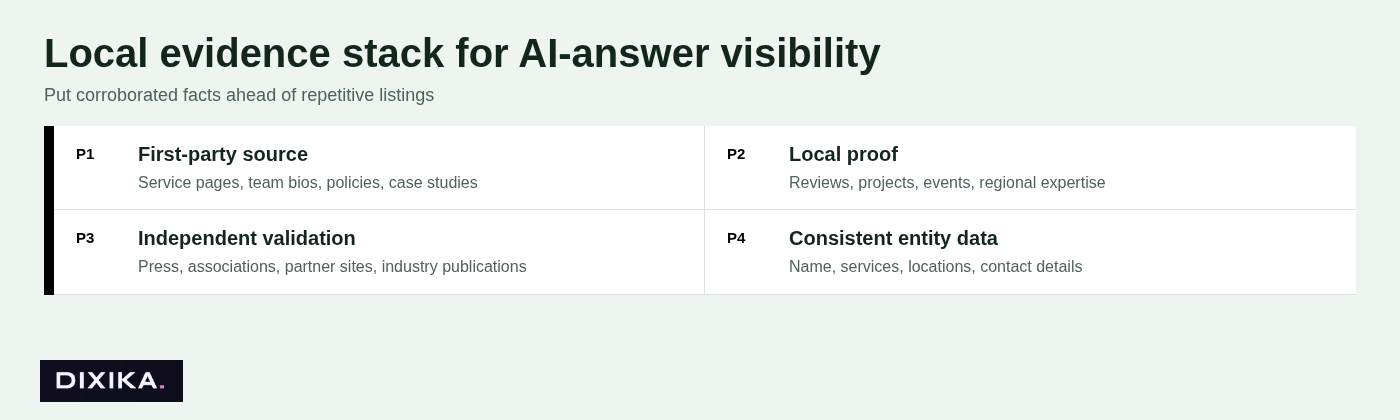
Your brand should be easy to identify across the web. Keep your business name, website, contact details, service categories, leadership information, service areas, and core positioning consistent on the sources that matter.
For local businesses, that includes a maintained Google Business Profile, reputable industry directories, review platforms, local press, professional associations, event listings, and partner sites. For national or B2B companies, it may include software marketplaces, trade publications, conference profiles, customer partner pages, and recognized expert communities.
These are not listings to collect for their own sake. They are corroborating signals. When independent sources consistently connect your company to the same services, expertise, geography, and people, it becomes easier for machines and people to understand the entity behind the website.
Schema can help communicate structured details, but it is not a shortcut. Adding Organization or LocalBusiness markup cannot compensate for inaccurate public information, missing proof, or a mismatch between what your site claims and what reputable sources show.
Earn Relevant Mentions and Links That Reinforce Your Expertise
Link building supports GEO when links and mentions come from credible sources that provide context. A relevant industry publication, local association, customer story, partner directory, or expert interview can reinforce the expertise and category associations you want answer engines to recognize.
Focus on work worth referencing: original research, useful data, detailed expert commentary, partner resources, local initiatives, niche publications, and practical tools or guides. The best default is to create a resource that helps the publisher's audience first, then earn the mention because it adds value.
Avoid buying irrelevant links or pursuing high-volume placements with no topical connection. Those tactics may create a busy report, but they do not reliably build the kind of evidence needed for durable search or AI visibility.
Reddit can be useful for understanding objections, terminology, and unmet needs. Participate only where you can contribute genuine expertise, disclose an affiliation when it is relevant, and do not astroturf discussions. Treat Reddit strategy as audience research and relationship-building, not a shortcut to force citations in AI answers.
Measure GEO Progress Without Chasing a Single Ranking
A GEO scorecard should combine several signals rather than pretending there is one universal AI ranking. Track prompt coverage, accurate brand mentions, citations or source inclusion, the sentiment and positioning of the mention, referral traffic, assisted conversions, branded search growth, and organic performance.
Segment results by engine, audience, region, topic cluster, and query intent. A brand may have strong visibility for educational prompts but weak inclusion in shortlist prompts, which points to a different content and authority problem.
Keep answer snapshots. Generative outputs are volatile, and a monthly note showing the exact prompt, cited sources, and response context is more useful than an untraceable score. When movement occurs, document what changed first: a new page, technical accessibility fix, updated company information, earned press, or new third-party coverage.
Use a practical 90-day rollout
Days 1-30: establish the baseline, select priority prompt clusters, audit technical accessibility, review entity consistency, and identify the largest evidence gaps. Limit the first phase to the questions most closely tied to revenue or qualified demand.
Days 31-60: improve or create the highest-priority answer-ready pages. Add missing proof, update weak service and location pages, clarify authorship and methodology, and fix technical issues that block crawling or interpretation.
Days 61-90: begin targeted authority-building, publish original assets where justified, reinforce local trust signals, and compare the new answer snapshots against the baseline. Keep improving the pages and evidence that support the most valuable prompts.
Implementation can move quickly. Trusted third-party validation and durable visibility take longer, especially in competitive categories. A three-month rollout should establish a working system, not promise permanent dominance in every AI answer.
Decide Whether to Build GEO In-House or Use GEO Services
GEO costs vary too much for one honest flat number. The budget depends on your site's condition, number of markets and topic clusters, content gaps, technical work, internal publishing capacity, analytics maturity, and the scope of digital PR or link-building needed to earn independent validation.
In-house work is a sensible option when you already have capable SEO, content, web, and analytics resources. A small team can begin with a prompt map, an evidence audit, a few high-value page improvements, and disciplined reporting. You can do SEO on your own, and those same fundamentals are the starting point for GEO.
Use a generative engine optimization company when the work crosses several specialties: technical SEO, content strategy, entity cleanup, digital PR, link acquisition, measurement, and ongoing iteration. The right partner should show how its work ties to evidence and business questions, not sell a secret method for manipulating models. If you are comparing options, review Dixika's services overview to see how those capabilities can fit together.
Beginners can teach themselves SEO with reputable free resources and practical site work. Google SEO is learnable, but it is not mastered in a few days; most people need weeks to understand the basics and months of hands-on practice to make sound decisions. A free course can be useful, but a GEO certification or SEO badge is not proof of competence. Judge training by whether the curriculum is current, explains search fundamentals, and requires real audits, publishing, measurement, and problem-solving.
Learning SEO remains worth it in 2026 because the underlying work - making information discoverable, useful, trustworthy, and measurable - still matters across search and AI discovery. ChatGPT can help draft briefs, summarize research, suggest technical checks, and organize data, but it cannot replace verification, judgment, or direct knowledge of your customers and site.
Build an Evidence-Led GEO Program That Also Improves SEO
The strongest GEO program is built on accurate, useful information that answers real buyer questions in context. Make your pages crawlable, state what you do clearly, support important claims with evidence, and earn independent recognition from sources your audience already trusts.
The goal is not to manipulate AI answers. It is to become an understandable, credible source that search engines, answer engines, and prospective customers can verify. Done well, that work improves both AI-answer visibility and the SEO foundation underneath it.
Teams that need help auditing gaps and executing the work can explore Dixika's technical SEO, content, authority-building, and AI visibility services.