
Technical SEO problems rarely announce themselves clearly. A drop in organic traffic might be caused by a release that changed canonical tags, a rendering failure that hid key content from crawlers, or a flood of duplicate URLs consuming crawl attention. Running a crawler is easy. Finding the actual mechanism, getting the right fix shipped, and proving it worked is the expert part.
This guide explains what technical SEO experts do, when you need one, how serious diagnoses work, and how to turn a technical SEO audit into an implementation plan your developers and leadership team can use.
What Technical SEO Experts Actually Do
Technical SEO is the work that makes a website discoverable, crawlable, indexable, understandable, fast, and resilient as the site changes. It is not a collection of isolated tags or a one-time checklist. It is the discipline of making sure search engines can reliably access the pages that matter, interpret what those pages mean, and keep doing so after redesigns, releases, migrations, and content expansion.
The boundary between technical SEO, content SEO, link building, and web development is real, but it is not rigid. Content teams decide what should exist and how well it answers a searcher's need. Link building strategies for SEO teams and agencies help establish authority and discovery signals. Developers build the systems, templates, infrastructure, and user experiences. Technical SEO connects those pieces so valuable pages are structurally eligible to perform.
In practice, an SEO expert does not just identify "issues." They protect revenue-generating category pages from accidental deindexing, make a content hub easier to discover through internal links, prevent a migration from losing historic equity, and translate search requirements into specifications that engineering teams can implement safely.
The quick answer: diagnose constraints, prioritize impact, and implement durable fixes
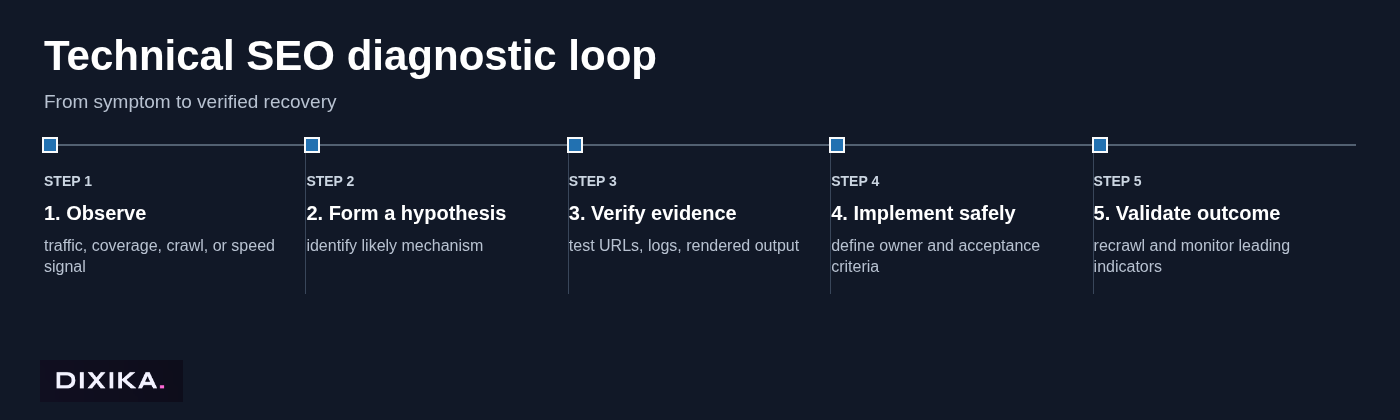
A capable technical SEO expert follows a repeatable workflow: investigate the symptom, form and test a root-cause hypothesis, define a safe fix, support implementation, and validate the outcome. That may involve crawl data, server responses, Search Console, analytics, raw and rendered HTML, template logic, and release history.
An automated technical SEO audit can surface useful clues. It cannot reliably tell you whether a warning affects important URLs, whether it is intentional, which system created it, or what change will fix it without creating a different problem. The value lies in judgment, evidence, and execution.

When You Need a Technical SEO Expert Instead of a Basic Audit
Routine site hygiene can be monitored internally: obvious broken links, sitemap errors, unexpected 404s, and a handful of missing page titles. Expert involvement becomes more valuable when the problem is ambiguous, carries material traffic or revenue risk, or requires coordination across product, engineering, content, and analytics.
If an issue can affect thousands of URLs through one template, treat it as a systems problem. A basic audit may identify the pattern; an experienced technical SEO expert should determine whether it is truly harmful and how to resolve it without disrupting users or operations.
Warning signs that merit expert involvement
- An unexplained organic traffic or ranking decline, especially after a release.
- Important pages disappearing from search results or remaining excluded despite being in the sitemap.
- Sharp crawl-volume changes with no obvious change in site size.
- Rapid growth in parameter, duplicate, or near-duplicate URLs.
- Slow performance concentrated on a major page template, device type, or market.
- JavaScript rendering failures, empty source HTML, or links that depend on unreliable client-side behavior.
- Post-release regressions in canonicals, robots directives, redirects, structured data, or internal linking.
Not every fluctuation requires an emergency investigation. But if the affected pages are commercial categories, high-converting product pages, major editorial hubs, or an entire country folder, waiting for a monthly report is usually a mistake.
High-risk moments: migrations, redesigns, platform changes, and international expansion
The highest-risk technical SEO work happens before launch, not after a decline. Site migrations, domain changes, CMS replacements, framework changes, redesigns, and international expansions all alter the systems search engines use to understand a site.
Experts create pre-launch requirements, review staging environments, map redirects, define canonical and indexation rules, and prepare post-launch validation. This is particularly important for ecommerce sites with faceted navigation, JavaScript applications, marketplaces with user-generated inventory, and publishing sites with years of archived content.
A migration is not successful because the new site looks correct in a browser. It is successful when priority URLs redirect correctly, critical pages remain crawlable and indexable, internal links point to the right destinations, and organic visibility stabilizes or improves after launch.
The Diagnostic Model: How Experts Find the Root Cause
Technical SEO diagnosis is an evidence loop, not a crawler export. Symptoms such as falling traffic, excluded pages, or poor performance scores can have several causes. Every recommendation should connect the observed symptom to a plausible mechanism, supporting evidence, a remediation path, and a way to confirm success.
Experts combine crawler data with server behavior, Search Console signals, analytics, rendered HTML, sitemap coverage, template review, and, where appropriate, log-file data. No single source tells the full story.
Start with the business symptom, not a tool's issue count
A useful investigation starts with what changed for the business. Did non-branded category-page traffic fall? Did lead-generating location pages stop appearing? Did new products become hard to find in search? Those questions produce testable technical hypotheses.
For example, a crawler may report 2,000 duplicate title tags and 500 redirect chains. That does not automatically make either issue urgent. If one category template has mistakenly added a noindex directive to 20,000 pages that generate qualified revenue, that is the priority even if the tool assigns it a lower severity score.
Good technical SEO prioritization considers affected URL volume, business value, likely search impact, confidence in the diagnosis, implementation effort, and release risk.
Triangulate evidence before prescribing a fix
Before recommending a change, test representative URLs across the affected set. Compare raw source code with rendered output. Check HTTP status codes, canonical targets, robots directives, internal links, sitemap inclusion, and search performance patterns. If a page is excluded, establish whether that is intentional and whether the relevant signals agree.
Consider a page that appears in an XML sitemap but is not indexed. The sitemap alone is not proof that the page should rank or even be indexed. An expert checks whether the page is internally linked, whether its canonical points to itself, whether it has useful unique content, whether parameter rules create duplicates, and whether the server returns a clean 200 response.
Recommendations should also record confidence and assumptions. A conclusion based on samples can change if deeper log analysis or a template review reveals a broader rule. Being explicit about uncertainty prevents expensive fixes based on weak evidence.
Crawlability: Controlling How Search Engines Reach the Site
Crawlability concerns the routes search engines use to discover and fetch URLs. A page cannot generally be indexed reliably if a crawler cannot find or access it, but crawlability is broader than a robots.txt file. Navigation, internal links, response codes, URL generation, sitemaps, and server reliability all shape how efficiently a search engine explores a site.
Robots directives, XML sitemaps, and crawl-path design
Experts assess robots.txt rules, meta robots tags, X-Robots-Tag headers, sitemap inclusion, HTTP responses, and internal linking as one system. A blocked URL cannot be crawled to process an on-page noindex directive. A noindexed page included in a sitemap sends an inconsistent signal. A page that is technically allowed but only reachable through a complex client-side interaction may be difficult to discover at scale.
XML sitemaps support discovery and help communicate the URLs you consider canonical. They do not force indexing, override poor content quality, or correct conflicting canonical signals. The best sitemap is clean, current, limited to indexable canonical URLs, and supported by the site's actual internal-link architecture.
Crawl budget on large or dynamically generated sites
Crawl budget matters most when a site has many URLs, frequent content changes, or an effectively unlimited URL space. Ecommerce filters, sort orders, calendars, search-result pages, session parameters, and internal search URLs can generate millions of low-value variations from a modest catalog.
The goal is not to block everything with a parameter. It is to preserve access to valuable category, product, editorial, and high-intent filtered pages while reducing wasted crawling of meaningless combinations. That usually involves clear parameter governance, controlled filter behavior, stable internal links, canonical rules, and careful decisions about what should be discoverable at all.
Weak pagination and orphaned inventory are common problems. If older products or articles disappear from navigable paths, search engines may treat them as low priority even when those pages still earn demand and links.
Indexability: Making the Right Pages Eligible to Appear
Crawling and indexing are related but different. Crawling means a search engine can fetch a URL. Indexing means the search engine has decided that URL, or its content, is eligible for inclusion in its search systems. A crawlable page can remain excluded because it is duplicate, thin, canonicalized elsewhere, noindexed, soft-404-like, or otherwise not considered useful.
Technical SEO experts determine which URL should represent a set of substantially similar pages, then align the surrounding systems around that decision.
Status codes, noindex rules, canonicals, and redirect chains
Common conflicts include indexable URLs whose canonicals point elsewhere, noindexed pages included in XML sitemaps, redirects used as canonical targets, long redirect chains, soft 404s that return 200 status codes, and inconsistent HTTP/HTTPS or www/non-www variants.
The principle is simple: canonical signals should agree. If a URL is the preferred version, it should generally return a 200 status, use a self-referencing canonical, appear in relevant sitemaps, receive internal links, and contain the intended content. If it is not preferred, internal links, redirects, canonicals, and sitemap rules should point toward the preferred alternative.
There are exceptions, but inconsistency should be intentional and documented rather than accidental.
Duplicate content created by site architecture
Many duplicate-content problems are architectural rather than editorial. Filters and sort orders can reproduce the same category inventory. Tracking parameters can create duplicate landing URLs. CMS taxonomies can put similar archive pages in competition. Print versions, localization variants, and service-area pages can multiply near-identical text.
The correct solution depends on user value and search demand. Experts may use canonicalization when variations should consolidate to one representative URL; noindexing when a page must remain available to users but should not compete in search; redirects when an old URL has been permanently replaced; or controlled crawl access when an infinite URL space is the central problem.
Applying the same fix to every duplicate pattern is a common mistake. A high-intent filtered category page may deserve to be indexable and internally linked, while a temporary sort-order URL almost certainly does not.
Site Architecture and Internal Links: Making Importance Legible
Search engines infer importance partly from how a site connects its pages. Site architecture is the intentional structure of categories, hubs, subtopics, product families, and navigation paths. Internal links are the routes that make that structure legible to both users and crawlers.
Technical SEO experts evaluate whether important commercial and informational pages are reachable through meaningful paths, not merely whether they exist in a sitemap. A page buried behind five clicks, isolated from related content, and absent from navigation is harder to discover and easier to deprioritize.
Findability, depth, and orphan-page detection
Orphan pages have no discoverable internal links, even though they may still appear in analytics, a CMS export, a sitemap, or backlink reports. Experts compare those data sets to find valuable pages that the site's crawl path has disconnected.
The fix is rarely "add links everywhere." It is usually a clearer relationship between pages: a product category linking to high-value subcategories, a pillar guide linking to its supporting articles, or a related-content module connecting relevant services, use cases, and resources. Context matters. A well-placed editorial link communicates more than a sitewide footer link.
As covered in the section on indexability, internal links should reinforce canonical decisions. Linking inconsistently to parameterized or non-preferred URL versions weakens the clarity of the system.
URLs, pagination, and faceted navigation
Stable, readable URL patterns make governance easier, particularly for large catalogs and international sites. That does not mean every URL needs to be short or stripped of parameters. It means the business should know which URL patterns can be indexed, which are user-only variations, and how canonical, pagination, and internal-link rules apply to each.
Pagination needs a design suited to the content model. A product category with hundreds of items needs a different approach from a long-form article archive or a marketplace with rapidly changing listings. Infinite scroll can work for users, but critical items and links must remain accessible through crawlable pagination or equivalent discoverable paths.
Rendering and JavaScript SEO: Verifying What Bots Can Use
Modern websites can look complete in a browser while delivering very little useful content in the initial HTML response. That gap is where JavaScript SEO becomes important. JavaScript is not inherently bad for SEO, but relying on client-side execution for primary content, navigation, canonical tags, or indexation directives creates additional points of failure.
Compare raw HTML, rendered HTML, and the user-facing page
Experts compare three views: the raw HTML returned by the server, the rendered HTML after scripts run, and the page a user sees in a browser. They check whether primary content, meaningful internal links, canonical tags, robots directives, structured data, and status behavior remain correct across each view.
Common issues include hydration errors, blocked resources, client-side routing that does not expose stable URLs, content injected too late, and pages where a browser displays information that a crawler cannot reliably process. A rendered check can also reveal the opposite problem: the technical rendering is fine, and the root cause lies in indexation rules or weak architecture instead.
Choose the right rendering strategy for critical content
Server-side rendering generates HTML on the server for each request. Static generation produces HTML ahead of time. Progressive enhancement delivers a functional core experience first, then uses JavaScript to improve interaction. These approaches can make critical page content and links more reliable without requiring a site to abandon modern JavaScript.
The right choice depends on content volatility, engineering stack, cache behavior, release process, page experience, and maintenance capacity. Dynamic rendering may be considered in specific cases, but it should not become a permanent substitute for a sound architecture. The objective is dependable access to critical content and signals, not a blanket rule to remove JavaScript.

Performance and Core Web Vitals: Fixing Template-Level Bottlenecks
Performance work is most useful when it improves the experience across many important URLs. Technical SEO experts connect speed data to specific rendering and interaction bottlenecks, then turn those findings into engineering work that can be measured after release.
Chasing a perfect lab score on one page is not a performance strategy. A repeatable improvement to a category, product, article, or location-page template is usually more valuable.
Investigate LCP, INP, and CLS in context
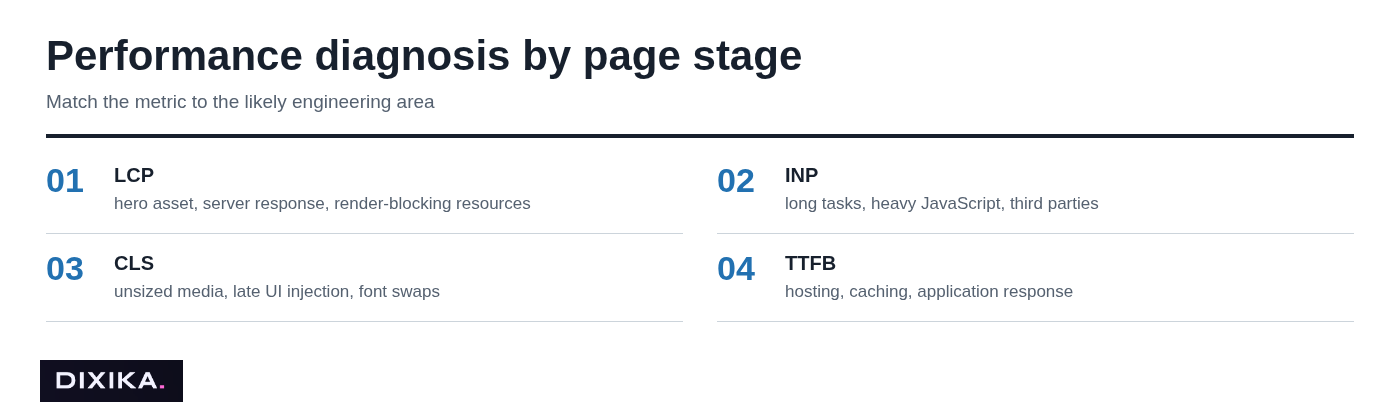
Core Web Vitals are user-experience measurements. Largest Contentful Paint, or LCP, reflects how quickly the main visible content loads. Interaction to Next Paint, or INP, reflects responsiveness after user interactions. Cumulative Layout Shift, or CLS, measures unexpected layout movement.
Use field data where available because it represents real visitors, then segment it by template, device, and traffic source. A poor LCP on mobile product pages might involve oversized hero images, slow server response, render-blocking stylesheets, or third-party scripts. Poor INP may come from long JavaScript tasks or heavy tag-manager activity. CLS often stems from unsized images, late-injected banners, font swaps, or UI elements that load after the page begins rendering.
Not every slow page has the same root cause. Grouping results by page type prevents a homepage fix from being incorrectly applied to a product-detail or editorial template.
Turn performance findings into an engineering backlog
A useful recommendation names the affected templates, likely cause, technical owner, expected benefit, release risk, and validation method. For example: optimize hero-image delivery across product pages; owner: frontend and platform teams; validation: compare field LCP by mobile product template over the next reporting period.
Prioritize changes with broad reach, such as caching improvements, image-dimension standards, removal of unnecessary render-blocking resources, or a reduced third-party script footprint. Isolated micro-optimizations are appropriate only after larger template-level constraints have been addressed.
Structured Data and Entity Signals: Making Meaning Machine-Readable
Structured data, often called schema markup, is not a ranking shortcut. Its purpose is to communicate accurate, machine-readable information about a page, product, organization, article, breadcrumb, or other supported entity. It works best when it confirms visible page content and consistent business data rather than attempting to manufacture eligibility.
Entity signals are the broader set of clues that establish who an organization is, what it offers, and how its pages relate. Clear organization information, consistent naming, author and publisher details where relevant, and accurate structured data all help reduce ambiguity.
Implement structured data that matches visible page content
Choose a schema type based on what the page genuinely contains. Product markup belongs on a product page with visible product details. Article markup belongs on editorial content. Breadcrumb markup should reflect real navigational hierarchy. Organization, LocalBusiness, and FAQ markup should only describe information users can actually see and verify.
Experts review required and recommended properties, nesting, identifiers, and consistency with visible content. Marking up hidden claims, unsupported ratings, or questions that do not appear on the page is misleading and can create eligibility problems.
Validate eligibility, errors, and template rollout
Validate representative URLs before rolling markup across thousands of pages. Then monitor relevant search-feature reporting, track errors introduced by template changes, and ensure the schema remains accurate as product data, editorial metadata, or local-business information changes.
Reusable templates make structured data scalable, but they also make mistakes scalable. One faulty conditional in a template can generate incorrect markup across an entire site.
International, Mobile, and Platform-Specific Technical SEO
Technical SEO types are context-specific disciplines, not separate checklists that every site needs. A local service business does not need the same crawl-budget controls as a marketplace. A multilingual ecommerce platform has different risks from a B2B publisher. Good experts scope their work to the site's implementation and growth model.
Hreflang and regional URL systems
Hreflang annotations help search engines understand language and regional alternatives. They require reciprocal references, self-references, accurate language-region targeting, and alignment with canonical URLs. If a page points to alternate versions, those alternate versions need to return the relationship correctly.
The architecture comes first. Decide whether markets use country domains, subdomains, subfolders, or another stable model. Then ensure each version has a clear purpose. Hreflang cannot repair duplicate regional pages with no meaningful differences, inconsistent canonicals, or unreliable URL mapping.
Ecommerce, publishing, and local-service implementation patterns
Ecommerce sites commonly face product-variant duplication, faceted navigation, out-of-stock handling, pagination, and rapidly changing inventory. Publishing sites often struggle with archive bloat, tag and author pages, content syndication, and the internal linking of older articles. Local-service businesses may create near-duplicate location pages, unclear service-area structures, or inconsistent business details across the site.
The diagnostic pattern remains the same: identify the business-critical page set, inspect the architecture and template rules, validate actual search behavior, and choose a solution that improves both discoverability and user usefulness.
From Technical SEO Audit to an Implementation Plan
A technical SEO audit becomes useful only when it changes what the organization does next. A generic crawl report can list broken links and tag warnings. A decision-ready audit explains which findings matter, where they occur, why they happen, who can fix them, and how the team will know the fix worked.
For complex sites, the audit should create a shared language between leadership, SEO, product, content, and engineering. It should reduce debate, not add another spreadsheet of unranked warnings.
What a decision-ready technical SEO audit report contains
- An executive summary of likely impact and the highest-priority risks.
- Clear scope and methodology, including the systems and URL sets reviewed.
- Evidence for each material finding, with representative examples.
- Affected templates or URL patterns, not only individual URLs.
- The root cause or a clearly stated hypothesis requiring further validation.
- Remediation requirements, technical owner, effort estimate, and release risk.
- Acceptance criteria and validation steps for confirming the change.
Issue severity by itself is insufficient. A "high" warning affecting a handful of unimportant pages may not outrank a medium-severity defect affecting every commercial category. Reach, business value, confidence, effort, and risk determine the real priority.
Prioritize by impact, confidence, effort, and release risk
Start by protecting indexability and migration safety. Next, resolve sitewide template failures and systemic crawl waste. Then address scalable quality improvements, such as internal-link modules, structured-data enhancements, and performance work across high-value templates.
Separate urgent containment from durable remediation. If a release accidentally adds noindex tags to key pages, containment means reversing the rule immediately. Durable remediation means adding automated tests, release checks, or template safeguards so the same error does not return.

Worked Example: Diagnosing an Ecommerce Category-Page Indexing Decline
Consider a fictional ecommerce retailer with category pages for broad product groups and selected high-intent filters, such as "/running-shoes/waterproof/" and "/running-shoes/trail/." Following a platform release, organic landings across filtered categories begin to decline.
The initial temptation is to blame an algorithm update or thin content. A disciplined diagnosis starts with evidence instead.
The symptom and evidence collection
First, compare organic landing-page trends before and after the release. The decline is concentrated in filtered category URLs rather than parent categories or product pages. Search Console shows more affected URLs falling into canonical-related exclusion states, while parent categories remain indexed.
Next, crawl representative filtered pages and inspect their responses. They return 200 status codes, are not blocked by robots.txt, and still appear in navigation. The sitemap includes some of them. However, their canonical tags now point to the unfiltered parent category.
The investigation continues by checking rendered output. The same canonical is present after rendering, so this is not a JavaScript-only issue. Internal links still point to the filtered pages, and those pages contain product sets that are materially different from the parent category. The observations support a clear hypothesis: a template change is consolidating useful filtered landing pages into broader categories.
The root cause, remediation specification, and validation plan
The root cause is not simply "bad canonicals." The business needs rules for which filters create a distinct, search-worthy landing page and which filters are temporary user controls. Waterproof, trail, and wide-fit may represent stable demand and differentiated inventory. A sort order or a price slider may not.
The remediation specification could define an approved set of indexable filter combinations. Those URLs should return 200 status codes, use self-referencing canonicals, receive deliberate internal links from category hubs or relevant guides, and appear in the sitemap if they remain strategically important. Non-approved combinations should be governed consistently through canonicalization, noindexing, or crawl controls based on the platform's behavior.
Before release, test the logic in staging across representative categories, empty-result states, mobile rendering, and pagination. After deployment, monitor rendered canonicals, crawl discovery, index coverage, and impressions for the affected URL group. Recovery may take time, but the leading indicators should change first: the correct canonical signals should be live, crawling should reach the approved pages, and exclusion patterns should begin to improve.

How to Evaluate Technical SEO Experts or an Audit Service
Buying technical SEO expertise is not about finding the longest checklist. It is about finding a partner who can distinguish signal from noise, communicate with developers, and stay accountable through implementation and validation.
At minimum, a technical SEO expert should diagnose problems from evidence, analyze the templates and platform rules creating them, collaborate with developers on a safe implementation, and validate results after release. A general SEO consultant or crawler-only provider may identify opportunities, but this capability set is what turns findings into durable technical improvements.
Whether you hire a consultant, build an internal capability, or engage an agency, look for a method that treats technical SEO as an operating discipline rather than a one-off document. Teams comparing providers can also review this guide on how to choose and use a technical SEO audit service.
Questions to ask before hiring
- How do you validate findings beyond an automated crawl?
- How do you determine whether an issue affects meaningful traffic, revenue, or priority URLs?
- When appropriate, can you work with server logs, rendered HTML, platform rules, and release history?
- How do you translate recommendations into tickets developers can estimate and ship?
- How do you handle migration planning and post-launch monitoring?
- What success metrics and acceptance criteria do you define for each major recommendation?
- Which findings are manually verified, and which are tool-generated leads that still need investigation?
Red flags in technical SEO proposals
Be skeptical of guaranteed rankings, one-size-fits-all checklists, unexplained severity scores, and recommendations that lack examples or evidence. A proposal should not present every crawler warning as a business risk.
Other warning signs include no implementation support, no developer collaboration model, vague promises to "fix technical SEO," and deliverables that omit owners, risks, or validation steps. The audit is not the finish line. It should make the next phase easier to execute.
A Practical Technical SEO Audit Checklist for Ongoing Monitoring
An ongoing technical SEO checklist is a triage layer, not a replacement for diagnosis. It helps teams spot changes early so they can investigate before a small defect becomes a large visibility problem.
Weekly and monthly checks
- Review organic traffic and index coverage trends by important page type.
- Monitor unusual crawl spikes, drops, or growth in unexpected URL patterns.
- Check robots.txt, XML sitemap, and major redirect changes after releases.
- Track status-code shifts, especially rises in 4xx, 5xx, soft 404, or redirected URLs.
- Review Core Web Vitals by template and device, not only sitewide averages.
- Check structured-data errors and warnings on representative templates.
- Monitor internal-link regressions and newly orphaned priority pages.
- Maintain release annotations so traffic changes can be compared with deployments.
Pre- and post-release checks
- Crawl staging where access and setup allow it.
- Confirm staging robots and noindex controls cannot accidentally reach production.
- Test canonical tags, redirects, status codes, and priority URL patterns.
- Compare raw HTML and rendered output for critical content, links, and directives.
- Validate structured data on representative pages.
- Run QA across key page types, including categories, products, articles, locations, and international versions where relevant.
- Monitor production immediately after deployment for indexation, crawl, and performance regressions.
Build Technical SEO Into How Your Site Changes
The strongest technical SEO programs are not periodic cleanup projects. They are quality-control systems built into planning, development, content production, and releases. That means defining indexation rules before templates are built, checking critical signals before deployments, and treating unexpected search changes as diagnosable systems behavior.
The operating principle is simple: treat search visibility as a release-quality concern, not a periodic cleanup task.
If your team is facing a migration, persistent indexation issue, or complex technical SEO audit, Dixika can help with diagnosis and implementation planning that connects search visibility to practical engineering work.