
Choosing between organic search and paid search is rarely a philosophical marketing decision. It is usually a response to a business constraint: you need qualified leads this quarter, you need to reduce acquisition costs over time, or you need both without wasting budget on overlapping activity.
Paid search can put an offer in front of active buyers quickly. Organic search can turn useful pages, technical improvements, and subject-matter expertise into a durable source of discovery. The mistake is treating one as "free" and the other as "expensive" before looking at timing, economics, and the kind of demand you are trying to capture.
Organic Search vs Paid Search: The Quick Verdict
Organic search is unpaid visibility earned in search results through relevant, accessible, useful pages that rank for a query. Paid search, commonly called PPC, uses sponsored placements bought through advertising platforms, usually with a cost incurred when someone clicks.
Choose paid search when you need immediate, controllable demand capture. Choose organic search when you need compounding visibility, stronger non-branded discovery, and a lower marginal acquisition cost over time. Most established businesses should not frame organic search vs paid search PPC as an either-or choice; they should decide what each channel must accomplish.
Choose paid search when speed, testing, or a time-bound offer matters
Paid search is often the practical answer for a product launch, a seasonal campaign, an inventory-sensitive offer, or an urgent pipeline gap. If someone searches for a high-intent term and your offer is ready, an approved campaign can begin competing for that demand far sooner than a new organic page can earn a prominent position.
It is also useful for rapid message validation. You can compare offers, headlines, landing pages, and query themes before committing months of editorial effort. That does not mean every click is valuable. Paying for traffic does not guarantee profitability; conversion tracking, bid economics, and landing-page quality determine whether PPC creates revenue or just activity.
Choose organic search when durable demand and topic authority matter
Organic search is better suited to evergreen questions, non-branded category discovery, comparison research, and complex buying journeys where prospects need education before they are ready to request a demo or buy. A strong page can keep attracting relevant visitors long after publication, especially when it is supported by a coherent topic cluster and solid internal linking.
SEO does not promise a fixed rank or immediate traffic. Competitive queries, weak site architecture, poor crawlability, and limited topical credibility can all slow progress. But when the underlying demand is durable, organic visibility becomes an asset rather than a campaign that disappears at the end of the month. For a broader framework, see How to Improve Organic Search Engine Rankings: The Definitive Guide.
What Counts as Organic Search and Paid Search?
On a search results page, paid search placements are typically marked as sponsored or ad results. Advertisers bid to appear for relevant queries, subject to auction dynamics, targeting settings, ad relevance, and platform policies. Shopping placements are also paid placements, even though their format differs from text ads.
Organic search results are the standard unpaid listings that search engines select because they appear relevant and useful for the query. Organic visibility can also include local results, depending on the business and query, although local rankings have their own signals and constraints.
The line matters because this is not a comparison of SEO against every marketing channel. Social-media reach is not organic search, and display advertising or paid social is not paid search. Search is distinctive because it often starts with declared intent: a person has typed a need, problem, brand, or category into a search engine.
Search results are also changing. AI-generated answer environments, answer boxes, shopping modules, map packs, videos, and other features can take attention away from traditional blue links. That makes page format, entity clarity, source credibility, and the actual search-result layout important considerations for both SEO and PPC. For more on this shift, see What Is AI Search Optimization? A Practical Guide to AI Visibility.
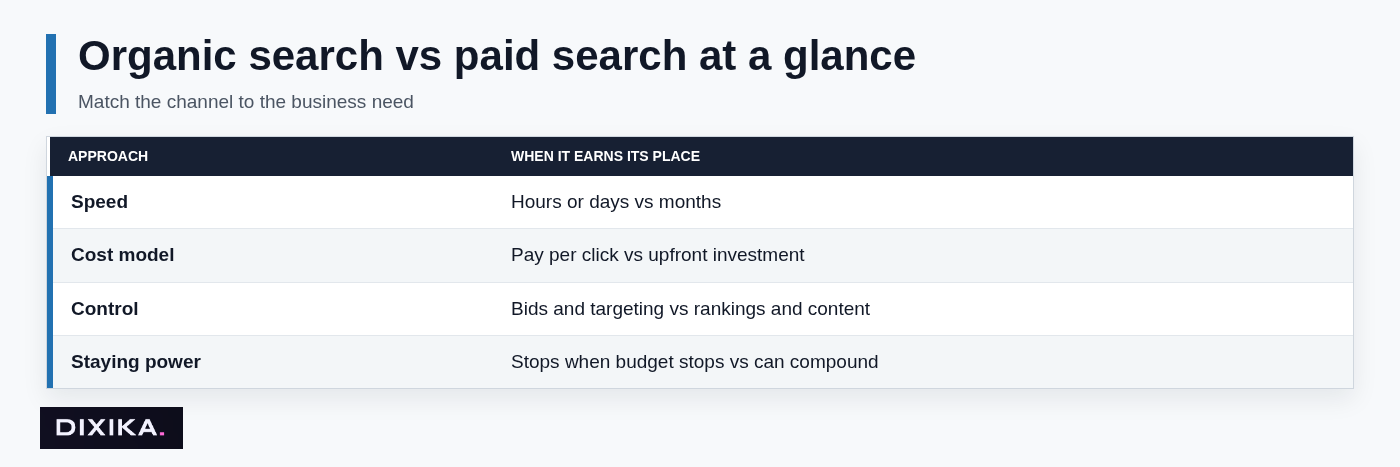
Comparison Table: Organic Search vs Paid Search PPC
Neither channel wins every category. The better choice depends on your offer, market, website, measurement maturity, and how quickly the business needs a result.
| Factor | Organic search | Paid search PPC |
|---|---|---|
| Time to traction | Usually months; can be faster for low-competition opportunities or existing authority | Potentially hours or days after setup and approval |
| Cost structure | Upfront and ongoing investment in technical work, content, expertise, and authority | Variable spend driven by clicks, bids, management, and landing-page work |
| Targeting control | Influence relevance through content, structure, and technical quality | Direct controls for keywords, location, schedule, device, audiences, and budget |
| Scalability | Can compound when pages earn and retain visibility | Scales quickly until budget, auction costs, or conversion efficiency become limiting |
| Durability | Strong pages can generate traffic after publication, but need maintenance | Visibility generally stops when spend stops |
| Trust and intent | Useful across research, comparison, and purchase journeys | Especially effective when query, message, offer, and landing page tightly align |
| Measurement | Requires patience and attention to assisted conversions and non-branded growth | Faster feedback through click, conversion, CPA, and impression-share data |
| Operational requirements | Technical SEO, content production, internal linking, authority building, and ongoing updates | Tracking, account management, query control, creative testing, and conversion optimization |
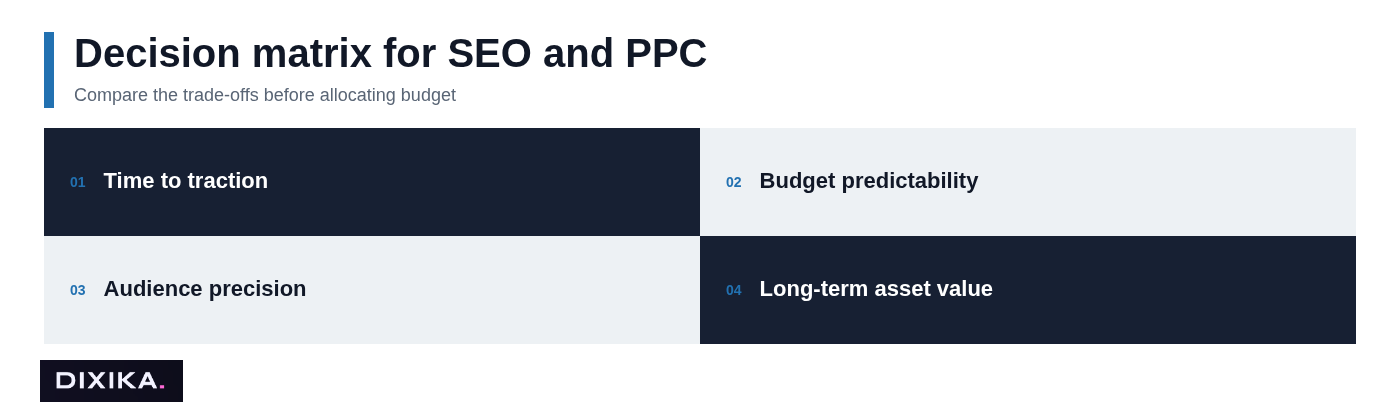
Cost: Free Clicks vs Pay-Per-Click Is the Wrong Comparison
Organic clicks are not free. You may not pay a search engine for each visit, but meaningful SEO requires investment in technical remediation, content production, expert review, internal linking, digital PR or link earning, tools, and specialist time. There is also opportunity cost: publishing generic pages that never become competitive can consume a budget that should have gone elsewhere.
Paid-search costs are more visible because they appear as media spend. But CPC is only one part of the picture. You also need to account for conversion rate, cost per acquisition, impression share, campaign management, creative work, tracking, and the landing pages required to turn clicks into business outcomes.
Compare channels through incremental profit, customer lifetime value, payback period, and marginal cost, not raw traffic volume. A low-CPC campaign that produces poor-fit leads is not efficient. Likewise, a high-investment SEO program can be justified if it repeatedly drives qualified demand from valuable categories.
How organic-search investment behaves over time
SEO investment is often front-loaded. A site may need crawl and indexation fixes, clearer architecture, better internal linking, stronger pages, and credible supporting signals before rankings respond. Once those foundations are in place, a useful page can accumulate rankings, links, engagement signals, and conversions without requiring payment for each incremental visit.
That does not mean organic performance rises forever. It can plateau when competitors improve, decline when content becomes stale, or stall when the site lacks authority for the topic. Costs increase in competitive search results, on sites with weak architecture, in markets where expert input is essential, and wherever the existing content lacks credibility.
How paid-search spend behaves over time
PPC is a variable-cost channel. Budget caps can limit reach, auction conditions can raise CPCs, and visibility usually ends when the campaign stops spending. That makes it easier to activate than SEO, but it also creates ongoing dependency if paid search is the only route to demand.
A mature account can become more efficient through tighter query control, negative keywords, better audience signals, stronger creative, and conversion-rate optimization. Those improvements matter, but they do not remove the auction. The business is still paying to compete for each new opportunity.
Timing: How Fast Can Each Channel Produce Results?
Ads can begin serving once campaigns are configured, approved, and eligible for the auction. That makes paid search useful when the business needs feedback or leads now. Early performance data can arrive quickly, although enough conversion volume is still needed before you make confident decisions about profitability.
Organic rankings take longer because search engines must crawl, index, understand, compare, and trust your pages. Meaningful SEO progress commonly requires sustained work over months, particularly in competitive B2B categories. Existing authority, clean technical foundations, an underserved query, and an already-indexed site can shorten the path; none guarantee it.
Watch leading indicators rather than waiting only for a revenue chart. For SEO, monitor indexing, impressions, qualified keyword movement, non-branded clicks, and conversions. For PPC, look at impression share, qualified clicks, search terms, conversion volume, and CPA.
Is SEO still worth it in 2026? Yes, when your audience searches for problems you can answer well and your business can invest in the underlying asset. Search-result layouts are more crowded, and AI answers can alter click behavior, so publishing thin keyword pages is not enough. The case for SEO is durable discoverability: technically sound pages, genuine expertise, clear entities, and content that helps a buyer make progress.

Control and Targeting: Precision Today vs Visibility You Earn
PPC offers direct levers. Teams can adjust keyword match behavior, geography, device, audience signals, ad schedules, creative, budgets, and bidding approaches. That precision is valuable when a company serves only certain markets, has limited sales capacity, or needs to push a specific offer during a fixed window.
But targeting is not absolute. Query variation, matching behavior, auction competition, policy restrictions, and shifts in user intent can all influence where ads appear. A carefully configured campaign still needs ongoing search-term review and exclusion work.
SEO gives you a different kind of control. You can improve page relevance, information architecture, internal linking, structured information, crawl accessibility, page experience, and content quality. You cannot directly set a ranking position. Competitors, algorithm changes, changing intent, and SERP features influence the final result.
Click Quality, Trust, and Conversion Intent
Paid search often excels at explicit commercial intent. A person searching "enterprise payroll software demo" or "emergency commercial plumber" is signaling a different level of urgency than someone asking how to solve a problem. A closely matched ad and landing page can perform extremely well in these situations.
Organic content is well suited to the broader research-to-purchase journey. It can answer the early question, support category comparison, explain implementation considerations, and earn visibility before a buyer has selected a vendor. That is especially valuable in B2B, where multiple stakeholders may research at different stages.
Trust should not be reduced to "people trust organic results more." Some searchers skip ads; others click them without hesitation when the message directly addresses their need. Relevance is the real issue.
- Informational queries: Prioritize organic guides, explainers, and supporting content. Use paid search selectively when the query reliably leads to a valuable next step.
- Commercial investigation: Use strong organic comparison and category pages, then test PPC where the economics support it.
- Transactional queries: PPC can capture demand immediately; organic landing pages can build a lower-cost route over time.
- Navigational queries: Protect brand visibility when necessary, but judge paid coverage by incremental value rather than habit.
Measurement: How to Judge SEO and PPC Fairly
Use a shared scorecard before comparing channels. The core metrics should be qualified leads or revenue, conversion rate, acquisition cost, pipeline quality, customer lifetime value, and payback period. Where possible, test incrementality: did the activity create additional outcomes, or did it merely receive credit for demand that would have converted anyway?
For PPC, diagnose performance through search terms, impression share, quality signals, auction metrics, click-through rate, conversion volume, and CPA. These indicators help reveal whether the problem is targeting, ad relevance, landing-page fit, bids, or demand itself.
For SEO, track indexed pages, technical health, impressions, qualified rankings, non-branded clicks, assisted conversions, and conversion quality. Rankings matter, but they are not the business outcome. A page ranking third for a useful query can outperform a first-place page targeting the wrong audience.
Do not rely on last-click attribution alone. Organic content often introduces a prospect early, then a later branded search, direct visit, or paid click gets the recorded credit. Evaluate the full path where your analytics setup allows it.
Best Use Cases for Organic Search
Organic search is a strong fit when a business has recurring customer questions and a market with consistent searchable demand. It is particularly valuable for building non-branded category visibility, creating useful product comparison pages, supporting local or service pages where the business can genuinely compete, and reducing reliance on paid acquisition over time.
For example, a B2B software company may build a cluster around a problem its buyers research months before purchasing. A professional services firm may create location and service pages backed by clear proof of expertise. An ecommerce brand may strengthen category and buying-guide pages that address how customers actually compare products.
SEO is a poor near-term fit when pipeline is urgently empty, the offer will disappear in a few weeks, the company cannot improve its site or publish useful material, or there is little real search demand. It is also a poor fit when the plan is to produce generic articles without a distinct point of view, evidence, or connection to the business.
Best Use Cases for Paid Search
Paid search is a strong fit for launches, urgent services, promotions with a defined end date, high-intent bottom-funnel terms, demand validation, and temporary pipeline gaps. It can also help a business learn which phrases prospects use when they are closest to acting.
Consider a company introducing a new offer that cannot wait for organic rankings, or a service business that needs leads in a narrowly defined geography. In both cases, paid search can create controlled exposure while the team learns which messages and landing-page elements convert.
PPC is a poor fit when unit economics are weak, the offer is not competitive, the landing page fails to persuade, conversion tracking is unreliable, or the category is restricted by ad policies. It also struggles where search volume exists but commercial intent does not. High click volume is not a substitute for buyer intent.
When the Strongest Strategy Uses Both Channels
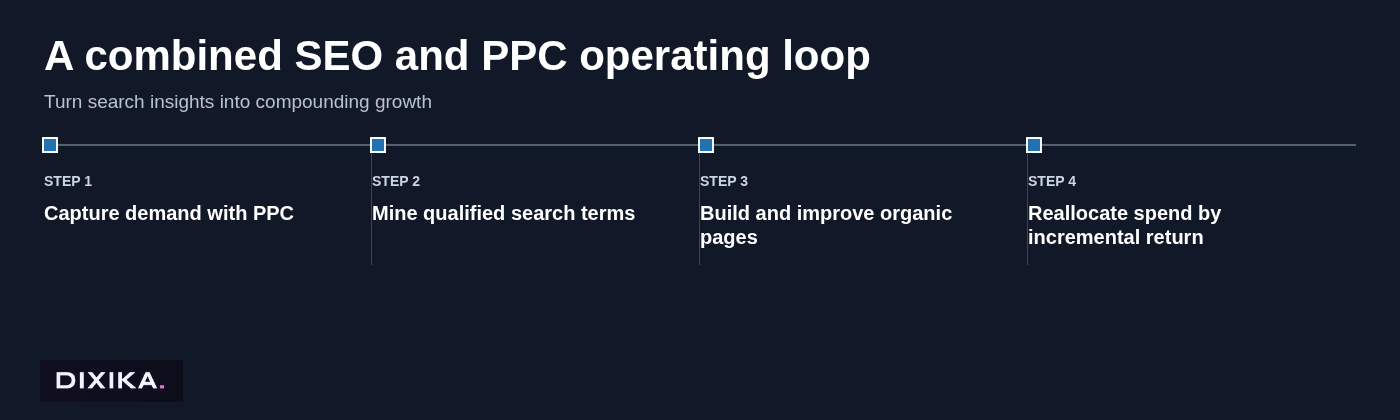
The best search programs make PPC and SEO inform each other. PPC captures demand while you learn quickly; SEO turns validated opportunities into durable pages and a stronger site. This is more useful than maintaining two isolated channel reports.
Use paid-search query data to identify the language and commercial themes that repeatedly produce qualified leads. Use that evidence to prioritize organic pages, strengthen briefs, and decide which comparisons or use cases deserve deeper coverage. In the other direction, organic pages with strong engagement can inform ad headlines, landing-page structure, and offer framing.
Paid campaigns can cover important demand while new pages mature. As organic visibility grows, reduce paid dependency only where the data supports it. Do not automatically pause ads because an organic listing ranks well. Check whether the paid placement creates incremental conversions, whether the term is branded or non-branded, how crowded the SERP is, and whether the two results serve different intent.
How to Allocate Your Next 90 Days of Search Budget
Start with the constraint, not a predetermined channel split. Assess urgency, available budget, tracking maturity, current site authority, content base, sales-cycle length, and expected customer value. Then create a measurable hypothesis for each investment.
A new site that needs leads now
Put enough budget into PPC to capture high-intent demand and learn quickly, but do not spend the entire quarter renting traffic. In parallel, fix obvious technical barriers, define core commercial pages, and publish the handful of organic assets most closely tied to durable buyer demand. A technical SEO audit service can help identify the highest-priority barriers. The goal is immediate lead flow plus the beginning of an organic foundation.
An established site with weak organic visibility
Prioritize a technical and content opportunity assessment. A site may already have enough authority to improve quickly once architecture, internal linking, thin pages, and topic gaps are addressed. Keep PPC focused on proven commercial terms and areas where organic coverage is not yet adequate, rather than spreading spend across every possible keyword.
A mature business optimizing its channel mix
Use incrementality and customer quality to guide reallocation. Maintain paid coverage where it produces additional profitable demand, use SEO to expand non-branded discovery, and regularly test terms where organic rankings may reduce the need for aggressive bidding. Mature teams should also refresh older content instead of treating published pages as finished.
Review the allocation every month, with a fuller decision at the end of the 90 days. Reallocate based on conversion quality and observed return, not on which channel produced the prettiest traffic graph.
Make Organic and Paid Search Work for the Job at Hand
PPC buys immediacy and control. Organic search builds a durable discoverability asset. Pick paid search if you need demand now, need to test an offer quickly, or are promoting something with a fixed deadline. Pick organic search if you need to own recurring non-branded demand, educate buyers, and lower dependence on per-click acquisition over time.
Pick both if you have immediate revenue targets and a market worth building for. Let PPC reveal demand and protect important gaps, while SEO improves the site, expands useful coverage, and compounds visibility. Businesses planning for long-term search growth can consult Dixika on technical SEO, content strategy, link building, and AI-search visibility.