
The wrong SEO agency can burn six months on reports, keyword lists, and activity that never reaches revenue. The right one identifies the constraint holding growth back, gets the right work shipped, and shows how that work connects to qualified pipeline or sales.
That distinction matters even more in 2026. Traditional rankings still matter, but buyers also discover brands through AI-generated answers, cited sources, Reddit discussions, comparison pages, and non-branded searches. The best SEO agency is not the one that promises first-page rankings fastest. It is the one with a credible strategy, the people to execute it, and a measurement model tied to commercial outcomes.
What the Best SEO Agency Looks Like in 2026
A strong agency connects business goals to measurable organic growth. It starts by understanding your revenue model, target audience, sales cycle, competitive position, site limitations, and internal capacity before recommending a program.
Modern SEO work has to cover more than keyword tracking. A capable partner should be able to prioritize technical constraints, build or improve content, earn relevant authority, support implementation, and adapt the program for AI-generated search experiences. Those capabilities do not always need to come from one provider, but they do need to work together.
Quick verdict: prioritize evidence, operating model, and AI-search capability
Choose an agency with relevant proof, transparent methods, access to the senior people doing the work, and a plan that addresses both conventional search and AI answer visibility. Look for a diagnosis of your specific situation, not a pre-packaged menu of monthly deliverables.
No credible agency can guarantee a specific ranking, traffic number, or inclusion in an AI-generated response. Search engines and answer systems remain outside anyone's control. What an agency can promise is a disciplined process: sound analysis, defensible execution, honest reporting, and continuous prioritization as evidence changes.

Comparison Matrix: How to Evaluate SEO Agencies Side by Side
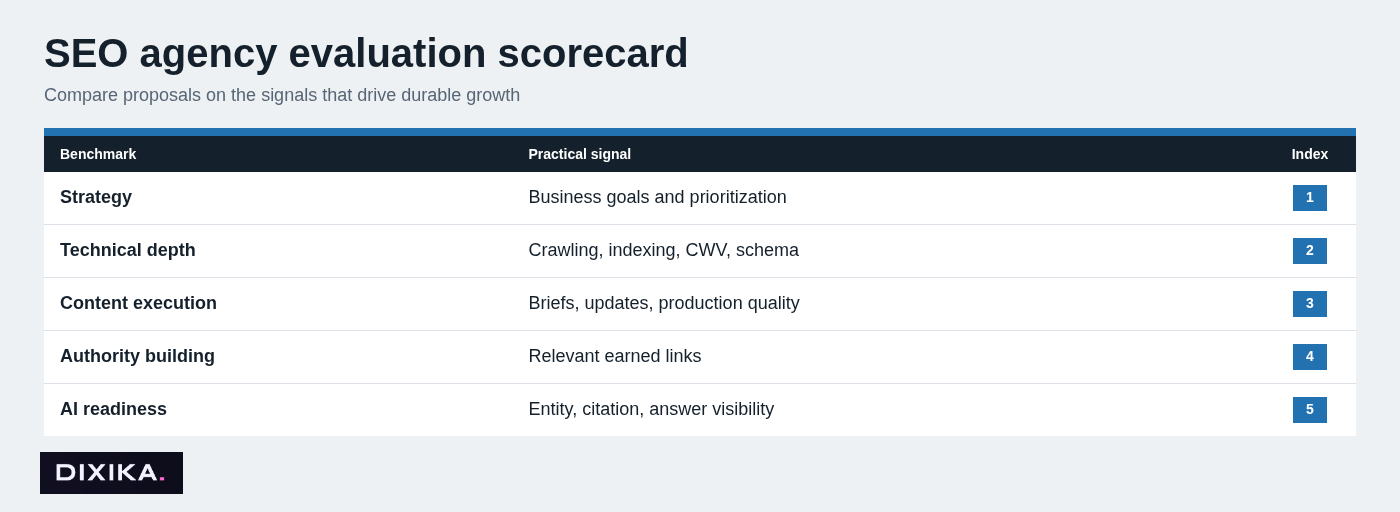
Use the same scorecard for every discovery call and proposal. This prevents the most polished sales presentation from winning by default and makes trade-offs visible. Weight the criteria according to your actual bottleneck: a JavaScript-heavy marketplace should assign more weight to technical depth, while an established site with weak authority may put more emphasis on earned links.
| Evaluation area | What strong looks like | What to question |
|---|---|---|
| Strategy | Business-led diagnosis, clear prioritization, explicit assumptions | Generic keyword lists and identical roadmaps |
| Technical SEO audit depth | Crawling, indexing, rendering, architecture, CWV, schema, measurement | Automated audit exports without implementation detail |
| Content execution | Intent-led briefs, expert review, updates, internal linking, iteration | Publishing volume presented as the strategy |
| Link acquisition quality | Relevant editorial placements, clear standards, visible URLs and anchors | Guaranteed quantities with vague sourcing |
| AI search optimization | Entity clarity, citation research, query monitoring, source-worthy content | Claims of guaranteed AI answer placement |
| Reporting | Work completed, decisions, qualified traffic, conversions, next actions | Rankings-only dashboards |
| Communication | Senior access, shared workflow, named owners, responsive working sessions | Sales-team access that disappears after signing |
| Pricing model | Scope and responsibilities clearly tied to fees | Low retainers with unclear exclusions or delivery capacity |
| Relevant case evidence | Comparable market, challenge, work, timeline, and business outcome | Logo walls and isolated traffic screenshots |
1. Strategy: Does the Agency Diagnose Before It Prescribes?
A credible engagement begins with discovery. The agency should review your market, search landscape, analytics, current content, competitors, conversion paths, and operational constraints before it decides what comes first.
This matters because the same ranking opportunity can have very different value across businesses. A high-volume informational topic may be a poor priority for a company with a long enterprise sales cycle and limited follow-up capacity. Conversely, a lower-volume comparison or integration page may influence qualified buyers far more directly.
Expect a roadmap that explains why initiatives are sequenced as they are. It should account for target markets, product positioning, available subject-matter experts, development capacity, content approvals, and the work already underway internally.
Questions that reveal strategic depth
- Which growth opportunity would you prioritize first, and why?
- What assumptions are you making about our buyers, site, competitors, and conversion path?
- What evidence would cause you to change priorities after the first month or quarter?
- What should be completed, learned, or validated in the first 90 days?
- Which recommendations require our engineering, product, sales, or legal teams to participate?
Generic keyword lists are not a strategy. Neither is a boilerplate roadmap that could apply to any company in any market. If a proposal lacks a point of view on trade-offs, it is probably built around selling deliverables rather than solving your growth problem.
2. Technical SEO: Can the Agency Find and Fix the Constraints That Matter?
Technical SEO is where many programs become either genuinely valuable or quietly ineffective. If search engines cannot crawl, render, understand, prioritize, or index the pages that matter, more content and links may simply amplify a weak foundation.
A substantive audit should assess crawlability, indexation, site architecture, internal linking, rendering behavior, page performance, duplicate content, structured data, migration risks, and measurement integrity. For a practical framework, see this guide to conducting a technical SEO audit. It should also separate meaningful issues from harmless tool warnings.
The useful output is not a giant spreadsheet of errors. It is an actionable plan with severity, expected impact, dependencies, owners, implementation specifications, and a method for validating fixes after release.
What to expect from technical SEO experts
Good technical specialists work from hypotheses. They explain what appears to be happening, what evidence supports it, how the issue affects discovery or performance, and what change should be tested or implemented. They should be comfortable working with developers rather than handing over vague recommendations such as "improve site speed."
Large, JavaScript-heavy, international, marketplace, and ecommerce sites often need deeper technical expertise. In those environments, routing, faceted navigation, rendering, localization, product duplication, inventory changes, and release processes can have a larger impact than another round of blog publishing.
3. Content: Can the Agency Build Topical Authority and Improve Existing Assets?
Content programs fail when they are built around output instead of usefulness. Publishing dozens of pages without clear search intent, expert input, distinct value, or a place in your site architecture rarely creates durable authority.
Evaluate whether the agency can connect keyword research to real audience questions, commercial intent, subject-matter expertise, and conversion paths. Strong work includes content gap analysis, topic clusters, information architecture, detailed briefs, editorial production, factual review, internal linking, and performance-based updates.
Existing content is often the fastest opportunity. A capable agency should know how to identify pages with declining visibility, incomplete coverage, weak conversion performance, cannibalization, or outdated information, then decide whether to refresh, consolidate, redirect, or leave them alone.
Evidence to request before signing
Ask for anonymized or permissioned examples that show the original problem, strategic rationale, work completed, timeline, and business-relevant outcome. A traffic chart alone is not enough; it does not reveal whether the result came from sound strategy, a temporary trend, paid promotion, or unrelated brand demand.
Also ask how the agency handles approvals, factual review, brand voice, and regulated-industry requirements. If your legal or product teams need to approve claims, that workflow should be part of the plan from day one rather than an excuse after deadlines slip.
4. Authority Building: Are Links Earned Through Relevant, Defensible Methods?
Links still matter, but raw referring-domain totals are a poor way to judge a program. The best links are relevant to your market, placed in genuine editorial context, useful to readers, and earned through methods you would be comfortable explaining publicly.
Legitimate approaches include digital PR, data-led or genuinely useful linkable assets, relationship-led outreach, resource link building, expert contributions, and reclaiming unlinked brand mentions. For more ideas, review these link building strategies. The method should fit the asset and audience, not force every campaign into the same outreach template.
Authority work also needs coordination with content and technical priorities. A well-earned link to a thin, poorly structured, or commercially irrelevant page is less valuable than support for a page that can answer a real need and move a qualified visitor toward the next step.
Link-building red flags
- Guaranteed monthly link quantities without stated relevance or quality standards
- Private blog networks or sites built primarily to sell placements
- Undisclosed paid placements presented as earned editorial coverage
- Links from irrelevant publications with no audience overlap
- Reports that hide destination URLs, source URLs, or anchor text
- No policy for removing or remediating problematic placements
Ask for sample placements, prospecting criteria, editorial standards, disclosure practices, and reporting examples. A reputable provider should be able to explain how it assesses relevance and what it refuses to do.
5. AI Search Readiness: Does the Plan Improve Visibility Beyond Blue Links?
AI-generated search experiences have changed how people encounter brands, especially during early research and comparison. That does not make foundational SEO obsolete. It raises the bar for clarity, evidence, and source-worthiness.
Useful AI-search work focuses on making your company and content easier to understand and cite. That can include clearer entity signals, well-structured information, original first-party evidence, accurate citations, answer-focused pages, stronger FAQ coverage where it is genuinely helpful, and a broader footprint across trusted sources.
No agency controls whether ChatGPT, Google AI Overviews, or another answer engine cites a particular page. Systems change, query results vary, and source selection is not fully transparent. Treat AI visibility as a monitored and iterated channel, not as an inventory of placements an agency can sell.
What AI-search work should include
A practical program includes monitoring a relevant query set, tracking brand and competitor mentions, researching recurring source and citation patterns, prioritizing content gaps, improving structured-data hygiene, and reporting observed signals separately from promised outcomes. Teams can also use LLM model benchmarks for SEO and GEO strategy when comparing how answer systems respond to different queries.
ChatGPT can assist with research, outlining, and draft production, but it cannot replace technical validation, original customer insight, editorial judgment, or accountable implementation. It can also be confidently wrong. Agencies that use AI responsibly still need experts who check claims, understand search behavior, and know what should be published under your brand.

6. Reporting and Measurement: Will You See Progress, Decisions, and Business Impact?
Rankings are a signal, not the outcome. A useful agency report shows what was completed, what changed, what obstacles remain, what the team learned, and what should happen next.
Depending on your business, reporting should include organic visibility, qualified traffic, conversions, assisted revenue, lead quality, and performance by market, product line, content cluster, or audience segment. It should also show leading indicators, such as pages improved, technical fixes deployed, content published or refreshed, and authority work completed.
Attribution has limits. Enterprise deals can take months, users may return through direct traffic, and analytics configurations are rarely perfect. A trustworthy agency discusses those limitations plainly rather than assigning every positive movement to its own activity.
A useful reporting cadence
Use regular working sessions to resolve blockers and make decisions, monthly executive reporting to summarize progress and commercial implications, and quarterly strategy resets to account for results, new launches, competitive movement, and changing search conditions.
Dashboards are helpful, but they are not a substitute for interpretation. If the agency sends data exports without explaining what matters or what to do next, your team is still doing the strategic work alone.
7. Team, Communication, and Execution: Who Will Actually Do the Work?
The sales team is not the delivery team. Before signing, understand who will own strategy, technical analysis, content, outreach, reporting, and account management - and how much senior involvement you will receive after onboarding.
Capacity matters as much as expertise. A brilliant strategy will not create growth if no one can write the ticket, review the copy, secure the approval, or implement the fix. The best agency relationships create a shared workflow across marketing, product, engineering, sales, and subject-matter experts.
Ask for the delivery team - not only the sales team
Meet the strategist and key specialists who will run the account. Ask what work is done in-house, what is subcontracted, and how quality is controlled across those contributors.
Request a clear responsibility map covering recommendations, implementation, approvals, publishing, analytics access, and performance analysis. This single exercise often exposes proposals that assume your internal team will do far more work than expected.
8. SEO Agency Fees: Compare Scope and Economics, Not Just Monthly Retainers
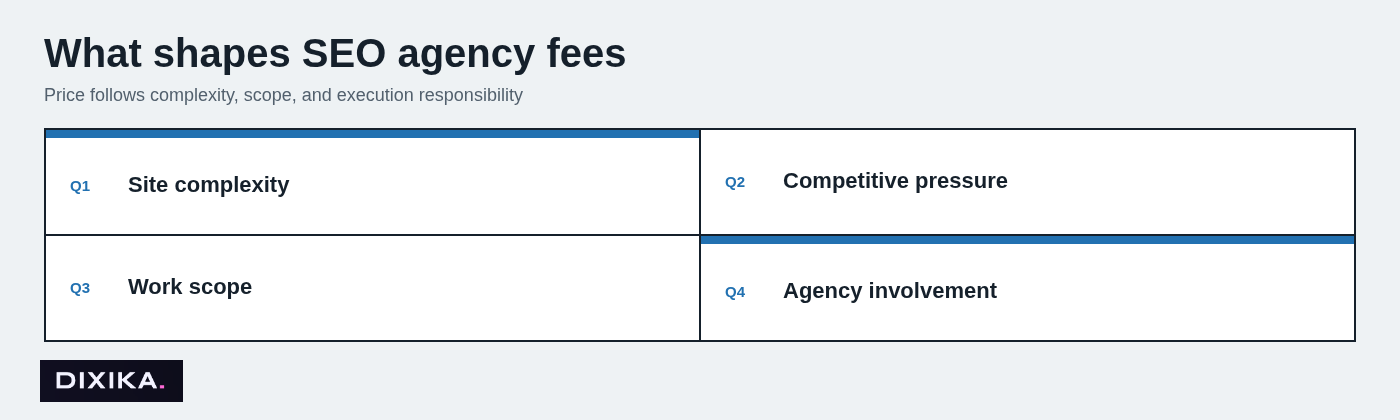
SEO agency pricing varies because the work varies. Small or local engagements may begin in the low thousands per month, while competitive, technical, enterprise, or international programs can require significantly larger monthly investments. Audits, migrations, and major implementation projects are often scoped separately.
Common models include monthly retainers, fixed-scope projects, hourly consulting, and performance-linked components. None is automatically better. The right model depends on site complexity, market competition, required execution, speed of change, and whether the agency is advising your team or doing the work itself.
Compare what is actually included: senior strategy time, technical specifications, content production, editorial oversight, digital PR or outreach, implementation support, reporting, and meetings. Two proposals with similar retainers can represent radically different levels of expertise and delivery.
9. Compare Agency Types Before Choosing a Partner
There is no universally best SEO agency model. The better question is which type of partner can address your primary constraint without creating new coordination problems.
Dixika: integrated search growth for SEO, content, authority, Reddit, and AI visibility
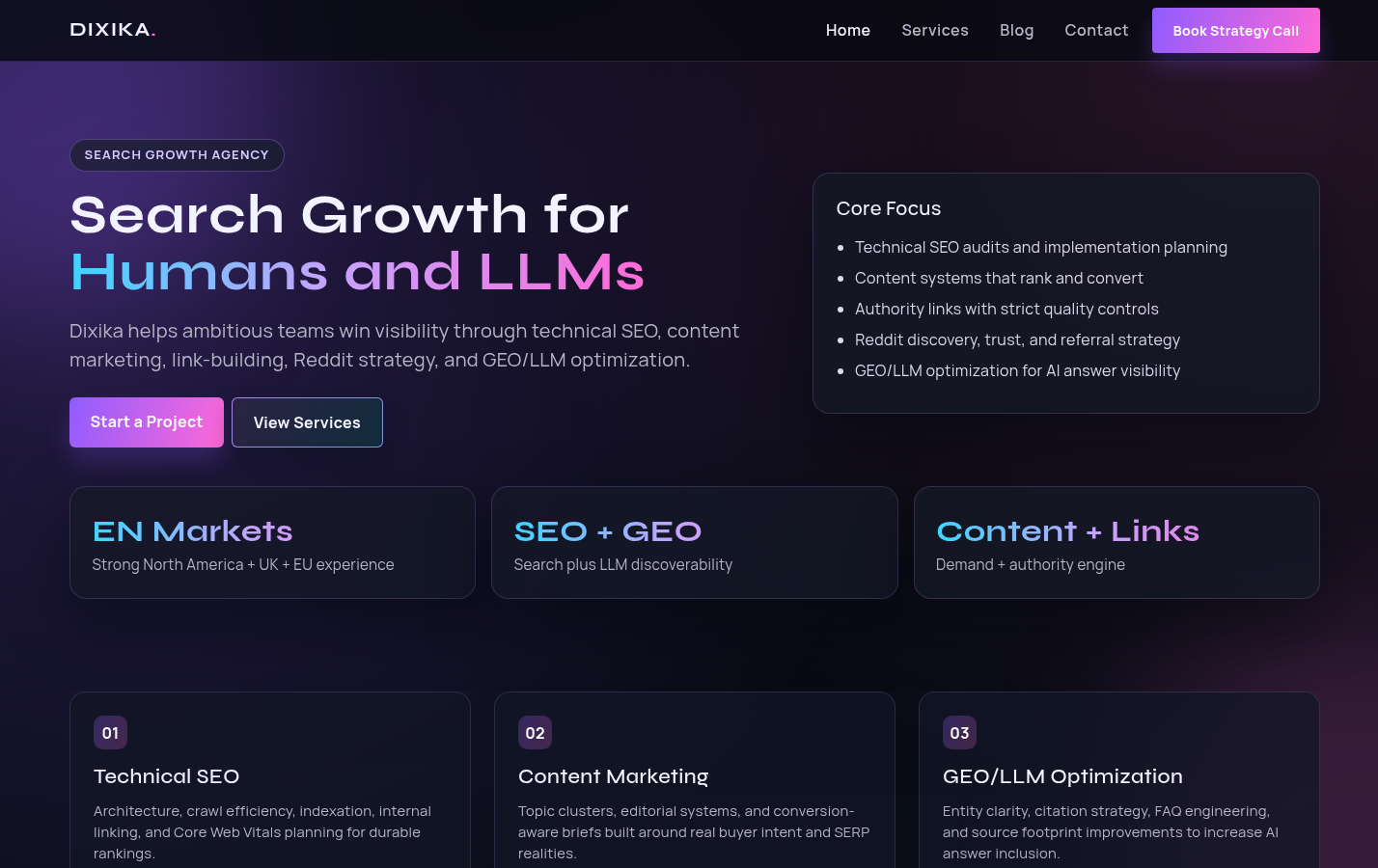
Dixika is designed for teams that need technical SEO, content marketing, link building, Reddit strategy, and GEO/LLM optimization coordinated under one search-growth strategy. Its approach begins with audits, competitor gap mapping, topical-authority analysis, and an implementation roadmap, then moves into technical tickets, editorial work, authority building, and ongoing iteration.
This model is most useful when growth is constrained by several connected issues rather than one isolated problem. For example, a company may need cleaner indexation, stronger commercial content, more credible third-party references, and better entity clarity for AI discovery at the same time.
The trade-off is that an integrated agency is not automatically the right answer for a narrowly defined technical migration or a single PR campaign. Prospective clients should apply the same standard used for every provider: ask for relevant evidence, a proposed roadmap, delivery-team access, and transparent measurement.
Technical SEO specialist: best for complex site constraints
This model is strongest when crawl and indexation problems, platform migrations, JavaScript rendering, international SEO, or engineering bottlenecks are the main barrier to growth. A specialist can provide deep diagnostic work and detailed implementation guidance that a broad generalist may not match.
It is ideal for complex sites where technical risk is immediate and expensive. The limitation is execution range: you may need internal content resources or another partner to handle topical coverage and authority building once the foundation is repaired.
Content-led SEO agency: best for publishing and updating at scale
A content-led agency is a good fit for organizations with a stable technical foundation that need better research, editorial systems, expert-led pages, and systematic improvement of a large content library. It can be particularly effective when the opportunity is clearly a coverage gap rather than a crawl or platform issue.
The limitation is that content volume cannot compensate for weak technical health or insufficient authority. Verify the provider's technical depth and ability to support link earning before assuming a publishing program will solve every search problem.
Digital PR and link-building specialist: best for authority gaps
This model is appropriate when your important pages are strong, the site is technically healthy, and competitors still outrank you because they have more reputable, relevant editorial mentions and links. Specialists can bring focused outreach processes, media relationships, and campaign ideation.
The limitation is that placements should not become a standalone volume target. The provider needs to work with your content and technical priorities so earned attention supports pages and topics that can create business value.
Enterprise SEO consultancy: best for governance and complex stakeholders
Enterprise consultancies are valuable for large organizations that need audits, operating models, training, international coordination, executive alignment, and help navigating complex stakeholder groups. Their greatest contribution is often turning SEO from an isolated marketing activity into a repeatable organizational capability.
The trade-off is execution. Consulting-led partners may rely on your internal teams or separate vendors to implement recommendations and produce content, which can extend timelines if ownership is unclear.
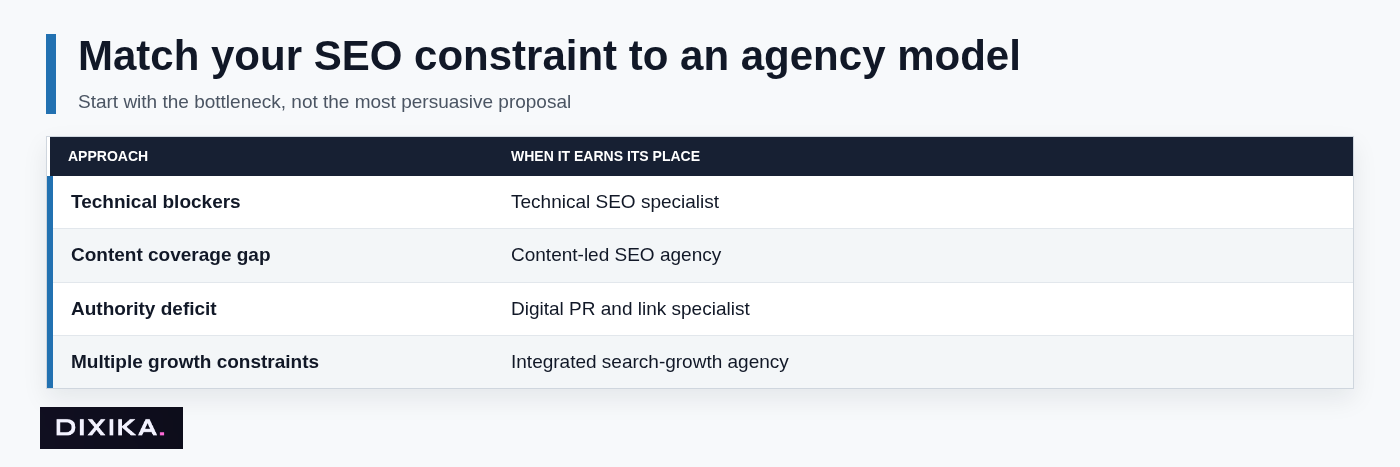
Choose the Agency Model That Matches Your Primary Constraint
Start with the bottleneck, not the proposal that sounds most impressive.
- Pick an integrated search-growth agency if technical, content, authority, and AI visibility work must move together.
- Pick a technical SEO specialist if platform, crawl, rendering, indexation, migration, or internationalization issues are suppressing performance.
- Pick a content-led SEO agency if you have a sound foundation but lack topical coverage, editorial capacity, or a content-refresh process.
- Pick a digital PR or link-building specialist if your main pages are competitive but authority and credible mentions are the missing piece.
- Pick an enterprise SEO consultancy if governance, training, stakeholder alignment, and implementation coordination are the real blockers.
Hiring an SEO agency is worth it when the partner brings scarce expertise, prioritizes work your team cannot easily execute, and provides a measurable path to commercial outcomes. It is not worth it when the agency simply adds another layer of reporting to work your team is already capable of doing.
A Shortlist Process That Produces a Better SEO Agency Decision
A disciplined buying process improves both proposal quality and the odds of a productive partnership. Define the outcomes and constraints first, create a weighted scorecard, shortlist three to five providers, and issue the same brief to each one.
Then meet the proposed delivery team, validate references or case evidence, compare assumptions and exclusions, and start with a clearly scoped roadmap. Do not compare agencies solely by deliverable counts or price. Compare who owns implementation, how decisions will be made, and how success will be measured.
What to include in your agency brief
- Revenue goals and the outcomes organic search should influence
- Target audiences, products, markets, and priority geographies
- Site and platform details, including planned migrations or releases
- Analytics access, measurement setup, and known data limitations
- Previous SEO work, current vendors, and existing learnings
- Available internal resources across engineering, content, design, and subject-matter expertise
- Content approval workflows, brand requirements, and legal constraints
- Budget range, timing, and the decisions that need to be made internally
Share known limitations early. A realistic proposal that accounts for engineering capacity, approval delays, and market complexity is more valuable than an aggressive plan built on assumptions no one can fulfill.
Make the Best SEO Agency Choice With Evidence, Not Promises
The best SEO agency for your business can diagnose the real constraint, explain trade-offs clearly, execute responsibly, and report progress against commercial goals. It should help you improve visibility across traditional search and AI discovery without pretending that either channel is fully controllable.
If your team needs an integrated strategy across technical SEO, content, authority building, Reddit discovery, and AI visibility, discuss your growth constraints with Dixika and assess the fit against a concrete roadmap.