
A top spot on an LLM model leaderboard can be useful, but it is not a shortcut to better rankings, stronger content, or more visibility in AI answers. Marketing teams get into trouble when they treat an aggregate benchmark score as a buying decision.
The practical question is simpler: which model can complete your specific SEO or GEO work accurately, efficiently, and safely enough to improve the workflow? Benchmarks help you narrow the field. Your own controlled tests should make the final call.
Define the SEO or GEO decision before you open an LLM benchmark leaderboard
Start with the job, not the model. "We need the best AI model" is not a usable requirement; "we need to turn source packs into accurate content briefs with fewer than 10 minutes of editor rework" is.
LLM model benchmarks measure performance on defined test tasks. They do not measure organic traffic growth, editorial judgment, brand safety, crawlability, or whether a model understands your company's products and customers. A model can lead an AI benchmark ranking and still be a poor fit for a workflow that depends on strict citations, predictable JSON, fast outputs, or private-document handling.
Write down the decision you are making. Common use cases include:
- Competitive research and SERP-informed content briefs
- First-draft production, rewriting, and content refreshes
- Technical SEO QA, regex generation, log-file analysis, and scripts
- Schema markup generation and structured data validation
- Localization and multilingual content review
- GEO analysis, including entity coverage, source representation, and AI-answer citation patterns
Then define the operating constraints. Capability matters, but so do reliability, factual behavior, citation handling, structured-output quality, latency, per-output cost, context-window limits, data retention, and integration requirements. A content team producing 20 briefs per month may choose differently from an agency automating thousands of title-tag checks each week.
The common mistake is to select the highest-scoring model on a single LLM benchmark comparison and assume the work is done. A composite score hides trade-offs. It cannot tell you whether the model follows your briefing template, invents sources under pressure, or returns valid schema consistently.

Build a task-to-benchmark scorecard for your workflow
Translate the work into capabilities you can inspect and acceptance criteria you can score. This creates a bridge between public benchmark evidence and the standards that matter in production.
For each workflow, assign weights based on the downside of failure. A low-risk ideation task can tolerate an occasional weak suggestion. A source-grounded research brief, schema generator, or technical recommendation cannot tolerate unsupported claims or malformed output.
A simple scorecard can use a 1-to-5 score for each criterion, multiplied by its weight. For example, a GEO source-analysis task might weight citation fidelity at 30%, entity consistency at 25%, instruction adherence at 20%, useful synthesis at 15%, and speed plus cost at 10%.
| Criterion | What to assess | Example acceptance standard |
|---|---|---|
| Factual support | Whether claims are traceable to supplied evidence | No unsupported factual claims in a reviewed sample |
| Instruction adherence | Whether required format and constraints are followed | At least 95% valid outputs without repair |
| Structured output | JSON, schema, tables, regex, or other machine-readable output | Passes parser or validator on first response |
| Usefulness | Whether a strategist or editor can act on the output | Reviewer scores 4 or higher out of 5 |
| Operating cost | Time, tokens, retries, and human revision effort | Lower total cost per approved deliverable |
Do not give every criterion equal weight by default. If an incorrect schema recommendation can damage implementation, formatting validity and technical accuracy should outweigh eloquence. If the task is a rough campaign brainstorm, speed and breadth may matter more.
Match common SEO and GEO tasks to the right evidence
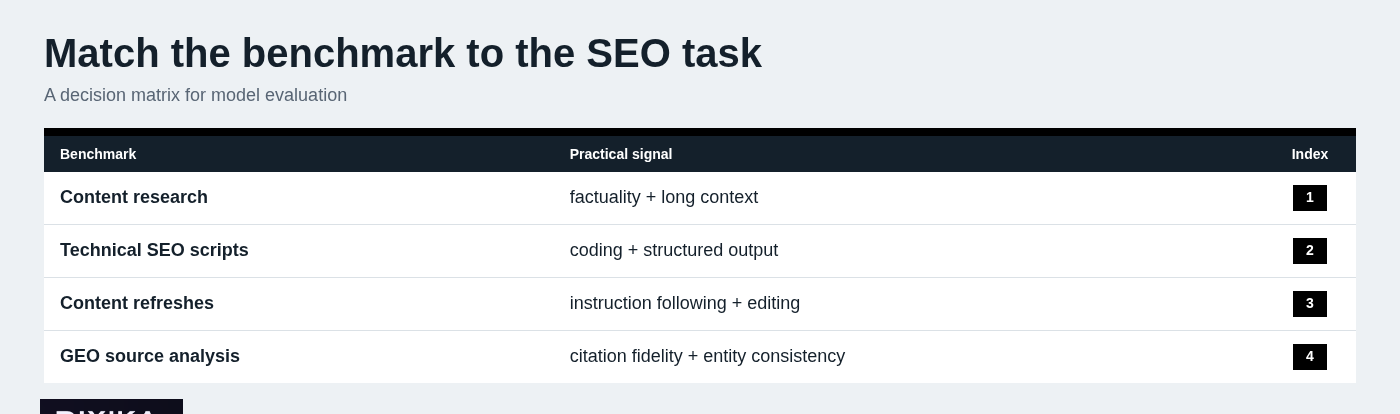
Different benchmarks answer different questions. Content briefs and competitive research benefit from evidence on reasoning, retrieval-grounded factuality, long-context handling, and instruction following. A model that can summarize a long source pack without losing important qualifiers is more useful than one that merely performs well on generic knowledge questions.
Technical SEO automation requires a different lens. Look for coding performance, function calling where relevant, structured-output reliability, and tests of whether generated code or scripts actually run. LLM coding benchmarks can be valuable when you need Python helpers, regex patterns, spreadsheet formulas, or API transformations. They do not prove that the same model can write publishable search content or evaluate a search intent correctly.
For AI-answer optimization, focus on citation fidelity, entity consistency, source handling, and the ability to distinguish evidence from inference. A model should preserve the names, relationships, qualifications, and source boundaries that shape how a brand is represented across the web.
Read LLM model benchmarks without overtrusting the headline score
A benchmark is not a universal truth about model quality. It is a result from a fixed task set, scoring method, prompt design, model version, and inference configuration. Change any of those inputs and the ranking can change.
When reviewing an LLM benchmark dashboard, inspect the details behind the headline number:
- Date: Is the result recent enough to reflect the model version you can actually access?
- Exact model snapshot: Provider names often cover several versions, modes, and context limits.
- Prompting conditions: Were few-shot examples, chain-of-thought-style prompting, tools, search, or agent loops used?
- Inference settings: Temperature, reasoning modes, and output limits can materially affect results.
- Sample size and uncertainty: Small differences may not be meaningful, especially without confidence intervals.
- Source of the result: Independent reproduction is generally more useful than a self-reported score alone.
Leaderboard movement is not always a signal to switch models. It may reflect a new model release, a modified test set, a pricing update, benchmark saturation, or a different testing configuration. Treat a leaderboard as a source of hypotheses: "This model may be worth testing for structured extraction," not "This is now the best choice for every task." Record each hypothesis in a comparison sheet with the benchmark name, category, model snapshot, date, test conditions, relevant score, and the workflow it may support.
Separate broad capability tests from workflow-specific tests
Reasoning, knowledge, multilingual ability, long-context processing, coding, safety, and agentic behavior are complementary signals. They are not interchangeable. A high reasoning score does not guarantee correct citations. Strong coding results do not ensure that a model will follow a brand's style guide.
Local models also deserve a fair evaluation. A local LLM model may trail frontier APIs on broad public tests yet be the better operational choice for regulated clients, confidential research, on-premise processing, lower marginal costs, or predictable availability. The right decision depends on the full workflow, not status on a public LLM model benchmarks list.
Watch for contamination and benchmark saturation
Benchmark contamination happens when test material, close variants, or answer patterns appear in a model's training data. Models can also become optimized for well-known public tests, producing impressive scores that overstate their ability to handle unfamiliar work.
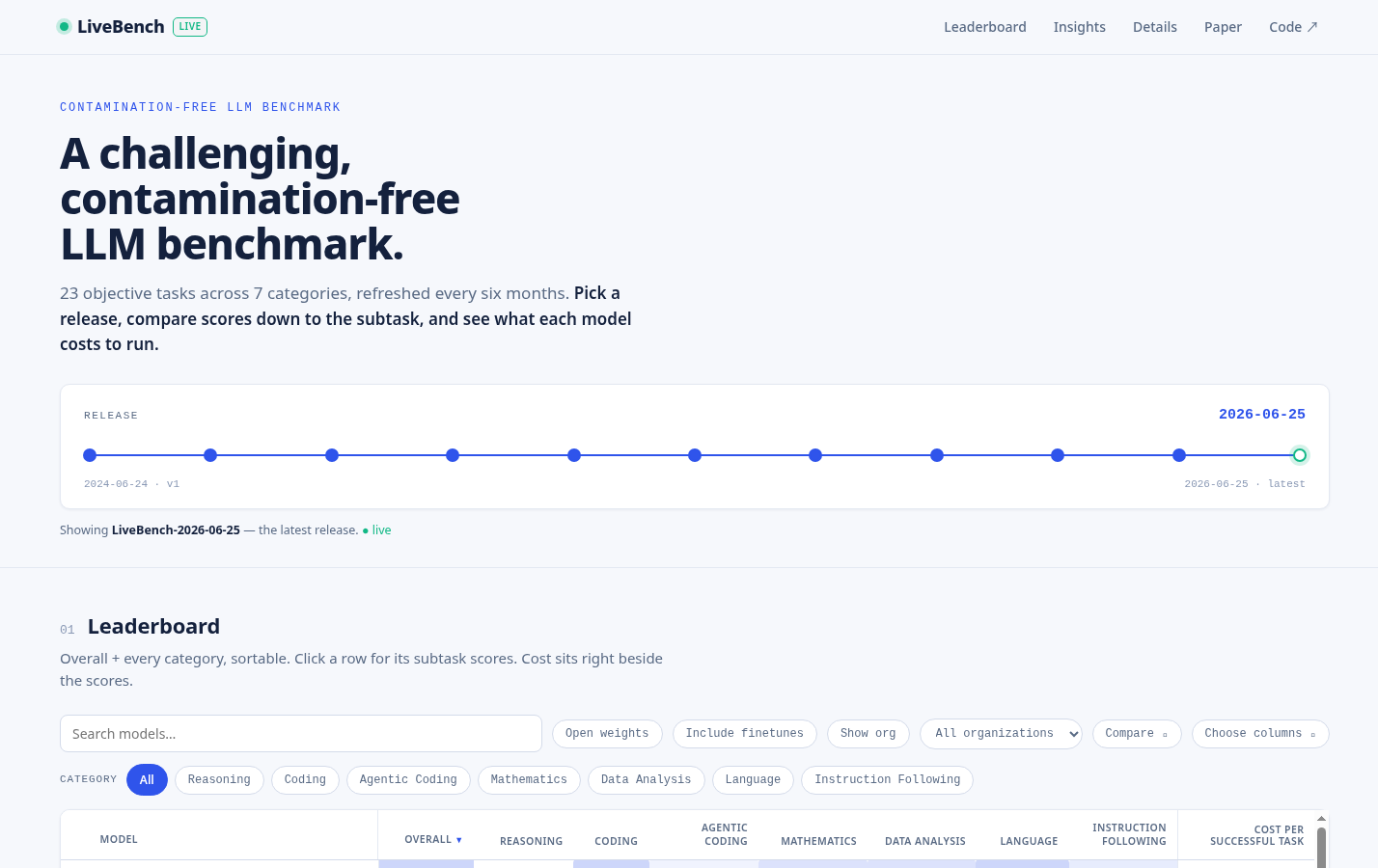
Refreshed or contamination-aware evaluations can provide a more useful signal. LiveBench, for example, uses regularly refreshed tasks and category-level reporting. That does not make it a final authority, but it can reduce the risk of basing decisions on a stale, overly familiar test set.
The correct approach is to use public evidence for screening, then use private, representative tasks for validation. Your own source packs, technical edge cases, and editorial standards are harder to game and more relevant to the decision.
Choose a benchmark dashboard that exposes the trade-offs you need
You do not need to collect every LLM benchmark comparison available. Choose two or three credible sources that reveal the dimensions tied to your work: capability, price, response speed, context limits, release recency, and methodology.
Every dashboard has limits. Results may not resemble your prompts, your region, your tool-calling setup, or the long documents your team handles. Use dashboards to create a shortlist of two to four plausible models, not to avoid testing.
LiveBench for refreshed, category-level capability signals
LiveBench is useful when you want a periodically refreshed view of model capabilities across objective task categories. Rather than relying only on an overall position, inspect the category-level scores related to your task. A technical team might care most about coding and instruction following; a research team may prioritize reasoning and source-sensitive analysis.
Use those results to form a test hypothesis. For instance, a model that performs consistently in the categories most relevant to structured extraction may earn a place in your pilot. It should not win a publishing or procurement decision without workflow evidence.
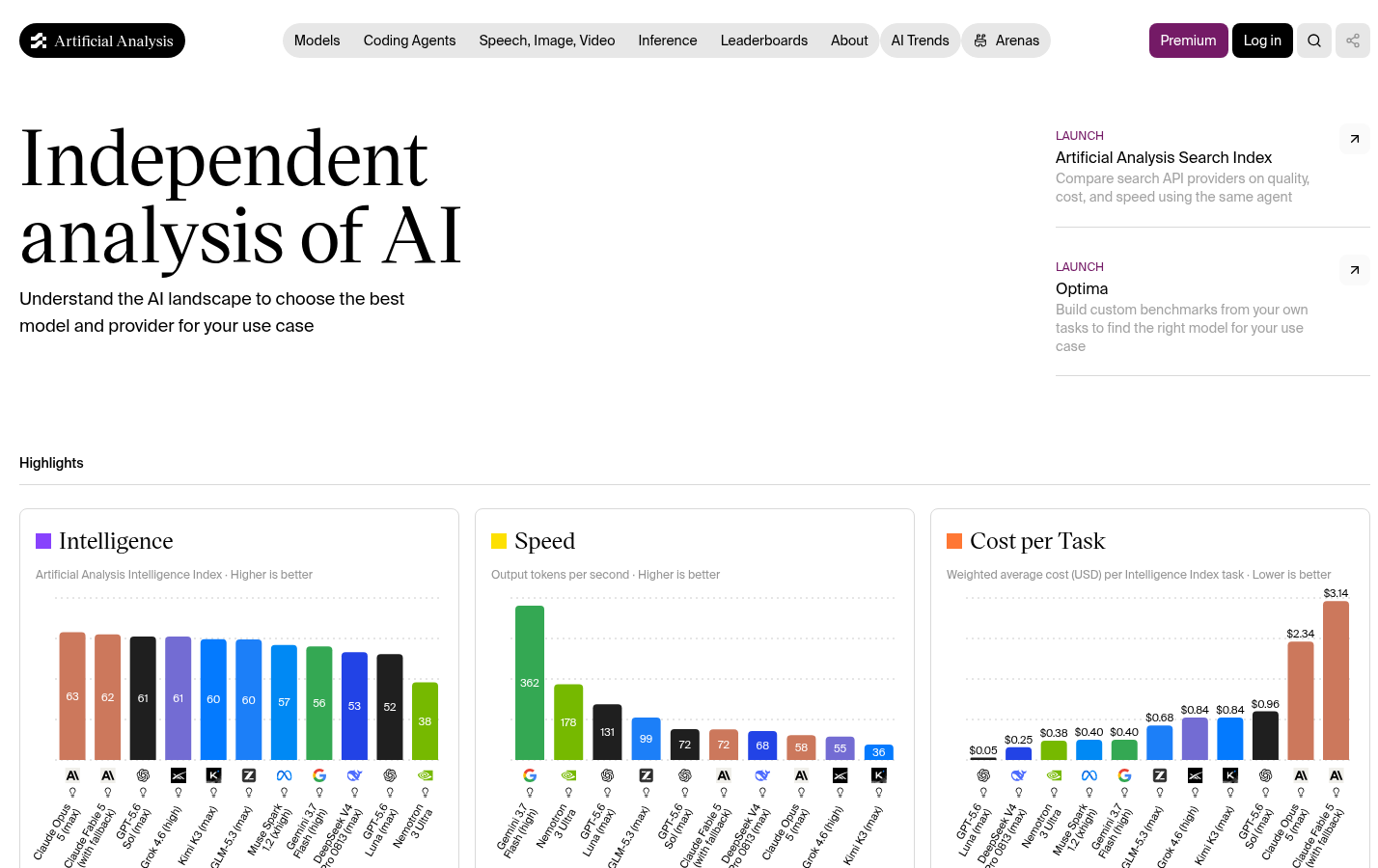
Artificial Analysis for capability, price, and speed trade-offs
Artificial Analysis is particularly useful when intelligence needs to be balanced against API cost and output speed. This matters when a process scales: a slightly lower-scoring model may deliver comparable approved work at a much lower total cost because it is faster, cheaper, or less likely to require retries.
Record the exact model version and the measurement date in your comparison sheet. Offerings, context windows, rate limits, and pricing can change quickly, so a decision memo without dates becomes stale faster than most teams expect.
BenchLM for broad benchmark coverage and source evidence
BenchLM can help teams investigate a broad set of model attributes and score sources in one place. That makes it useful when you need to understand where a claimed strength comes from rather than simply accepting an overall AI benchmark ranking.
Do not average every score you find into one mega-score. Many benchmarks overlap in what they test, so combining correlated results can create false confidence. Keep only the evidence that maps directly to the work you intend to automate or support.
Turn public scores into a controlled SEO and GEO pilot
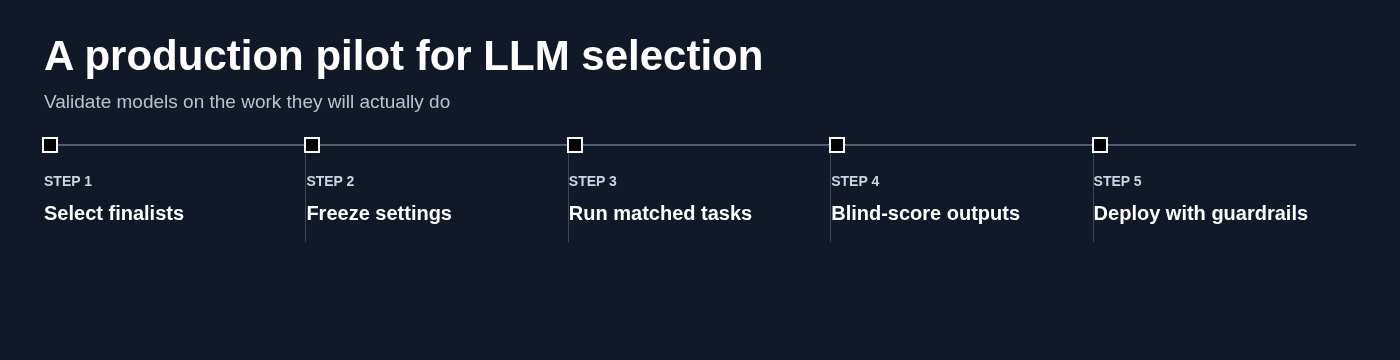
Once you have a shortlist, run a pilot on the work the model will actually do. Select two to four finalists, freeze the model versions and settings, and give each model the same inputs and instructions.
Start with plain, controlled prompts. Do not introduce provider-specific web search, tools, memory, or special reasoning modes until you understand baseline behavior. Otherwise, you will not know whether better results came from the model, the feature, or an inconsistent setup.
Blind-score the outputs where possible. Remove model names before reviewers assess quality, and require a human gate for factual claims, citations, brand voice, search-intent fit, and technical validity. A benchmark result must never bypass editorial or implementation QA.
Create a representative test set
Use real work with safely anonymized details, not toy examples. A useful test set can contain 20 to 40 tasks, depending on volume and risk. Include normal cases and difficult cases that expose failure modes.
- A SERP-informed content brief with a defined audience, primary query, and competing page patterns
- A source-grounded outline built from supplied documents, with every material claim tied to evidence
- A content refresh that must retain accurate existing claims while improving usefulness and intent match
- A schema markup, regex, or spreadsheet-formula task with a pass/fail validation check
- A GEO audit that reviews entity naming, source coverage, factual consistency, and citation behavior
- A long document with conflicting sources, ambiguous wording, or missing information
One common mistake is testing only clean, easy prompts. Models tend to look similar when the task is obvious and the input is short. Add conflicting source statements, incomplete context, unusual formatting, and requests that require the model to say "insufficient evidence." Those conditions are closer to real production work.
Score quality, risk, and operating cost together
Use a shared rubric and capture more than output quality. Score factual support, instruction adherence, usefulness, formatting validity, edit time, response time, retry rate, and cost per run. Then calculate the total cost per accepted deliverable.
For example, Model A may cost less per token but require 18 minutes of fact checking and cleanup. Model B may cost more at the API level but need only five minutes of review and produce valid structured output on the first attempt. Model B is often the cheaper production choice.
Document failure modes alongside average scores. Note whether the model invents citations, drops constraints in long prompts, changes entity names, produces invalid JSON, or becomes vague when sources conflict. Average performance can hide the type of error that creates the greatest SEO or GEO risk.
Measure whether the selected model improves search and AI-answer outcomes
Model selection should improve the system around the work, not just generate more output. Track leading indicators first: less editorial rework, fewer unsupported claims, faster resolution of technical tasks, higher brief acceptance rates, and more consistent entity and source coverage.
Then track broader outcomes with appropriate caution. Depending on the workflow, that may include organic visibility, qualified traffic, conversion support, inclusion or citation in AI answers where measurable, and changes from a pre-launch baseline.
Do not attribute ranking gains or AI-answer visibility to the model alone. Search performance depends on content quality, authority, technical crawlability, source availability, competitive conditions, and platform behavior. The model is one component of the production process, not the strategy itself.
Avoid benchmark mistakes that create SEO and GEO risk
The biggest mistake is choosing by one composite score. Other recurring errors include testing only easy prompts, using stale leaderboard data, overlooking model-version drift, and failing to review citation behavior.
Set a refresh schedule for high-volume workflows. Re-run a smaller validation set when a provider changes the model version, alters pricing, introduces a new reasoning mode, or changes key product behavior. You do not need to repeat a full evaluation every week, but you should not assume model performance remains fixed.
Handle privacy and governance before uploading client material. Confirm whether prompts and outputs may be retained, whether sensitive data is permitted under your agreement, and whether an approved enterprise deployment or local LLM model is required. Remove personal data, client identifiers, and confidential commercial information from test sets whenever possible.
Prompt or model-routing experiments can improve a mature implementation, but they do not replace task-level validation, source review, or editorial accountability.
Use benchmarks to shortlist models, then let real workflow evidence decide
An LLM benchmark leaderboard is a useful starting point, not a strategy. Use it to narrow the market, build a weighted pilot around the work that matters, and keep measuring after deployment as models and business requirements change.
The best model for SEO and GEO is usually not the one with the most impressive headline score. It is the one that reliably produces quality-approved work at an acceptable cost, handles your evidence correctly, and fits the controls your team needs.
Teams that need help connecting technical SEO, content systems, and GEO measurement can explore Dixika's services or Dixika's approach to AI-answer visibility.