Most link building fails for a simple reason: teams chase links before they have anything worth linking to. A long prospect list and a polished outreach template cannot compensate for a weak page, an irrelevant pitch, or a tactic built around volume rather than usefulness.
The best link building strategies create a credible reason for another site to reference your work. That takes more effort than buying a batch of placements, but it also produces links that are more durable, more relevant, and less likely to become a liability when search systems get better at detecting manipulation.
What Is a Link Building Strategy - and Does It Still Matter for SEO?
A link building strategy is a repeatable plan for earning relevant third-party links to pages that deserve to rank. It defines the asset you will promote, the people or publications most likely to find it useful, the outreach process, and the standards that determine whether a link is worth pursuing.
Link building is still relevant to SEO. Links remain a trust, relevance, and discovery signal, particularly when an established site editorially cites a useful resource. But raw backlink volume is not the goal. A relevant link from a real publication, partner, industry resource, or cited research page is generally far more valuable than dozens of low-quality directory listings or paid blog posts.
The sustainable approach is straightforward: build pages with clear value, seek legitimate editorial opportunities, measure topical and business fit, and avoid tactics that risk violating search spam policies. Good link building supports content quality; it does not try to disguise poor content.
Choose the Right Strategy Before You Start Building Links
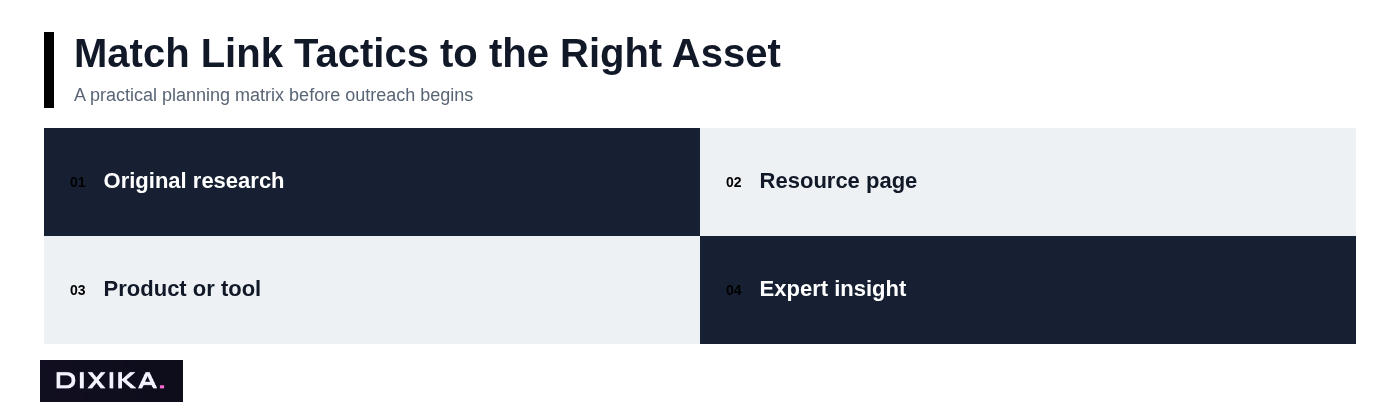
Not every page deserves the same outreach plan. A competitor comparison may be useful for value-add outreach, while a unique dataset is better suited to digital PR and journalist pitches. Trying to use one tactic for every URL leads to generic emails and disappointing results.
Before investing in outreach, match each tactic to three things: the type of page you are promoting, the realistic effort required, and a quality-control check. For beginners, this prevents wasted time on campaigns that need data, relationships, or technical resources they do not yet have. For advanced teams, it helps allocate effort to opportunities that can scale without sacrificing standards.
Ask three practical questions: Does this page solve a problem well enough to be cited? Who specifically benefits from linking to it? Can you explain the suggested placement in one sentence without resorting to vague SEO language? If the answer is no, improve the asset before building the list.
1. Replicate Competitor Backlinks Selectively
Competitor backlink research is one of the fastest ways to find proven opportunities, but it is not a command to copy every link a competitor has. Start with a small group of direct organic competitors, identify the pages earning relevant links, and look for patterns in the referring domains and content formats.
A competitor may have earned links because of a benchmark report, a useful template, a partnership, or a well-timed expert quote. That insight is more valuable than the individual placement. It tells you what audiences cite and what kind of asset you need to create or improve.
Qualify each prospect before outreach. Check whether the site is topically relevant, visibly editorial, maintained, and capable of sending real referral traffic. Then ask whether the link is realistically replicable. A link from a customer's case study may not be, while a curated industry resource page may be. Tools such as Ahrefs Backlink Checker and Semrush Backlink Analytics can help uncover these patterns.
2. Create Original Research and Citation-Worthy Assets
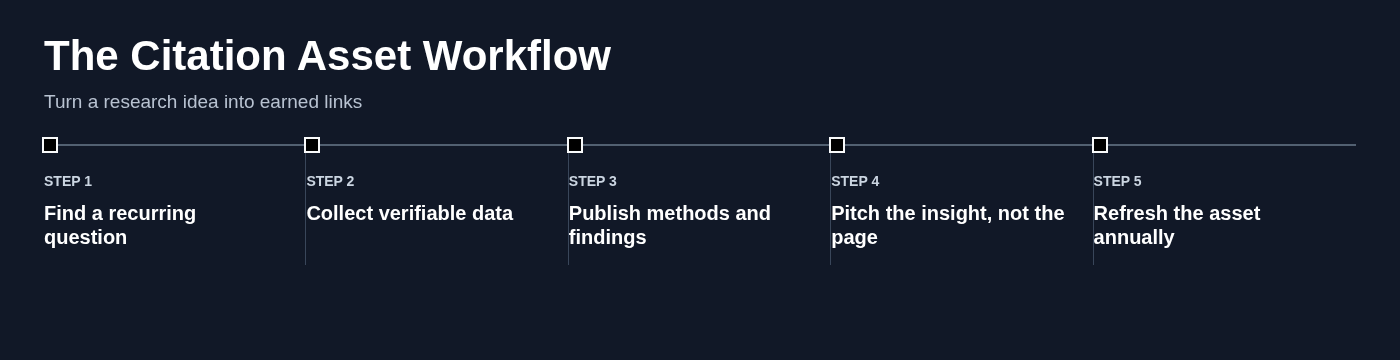
Original research is among the best link building strategies because it gives writers a reason to cite you rather than merely mention you. The asset can be a survey, anonymized product data, an industry benchmark, a calculator, a template, a visual reference, or a carefully documented dataset.
For example, an annual benchmark on how marketing teams allocate content budgets can become a useful source for journalists, consultants, agencies, and industry bloggers. The difference between a credible asset and thin "research" is methodology: explain where the data came from, how it was collected, what it does and does not represent, and when it was last updated.
Publishing is only the first step. Build a distribution plan around the strongest finding, not a broad request to "check out our report." Pitch the surprising statistic, the useful comparison, or the practical implication for a specific audience.
3. Earn Relevant Resource Page Links
Resource pages can be valuable when they genuinely help a defined audience find useful information. Look for pages maintained by trade groups, educational organizations, nonprofits, professional communities, and credible publishers that cover the same problem your resource addresses.
Your pitch should identify a specific gap, outdated recommendation, or relevant section where the page improves the list. "Please add our link" is not a reason to edit a curated page. "Your section on onboarding templates does not include a downloadable workflow for distributed teams; ours is free and includes the implementation checklist" is much stronger.
Keep a short record for every prospect: topic fit, editor or owner, page quality, recommended placement, outreach date, and follow-up date. This makes quality control easier and prevents repetitive, low-value follow-ups.
4. Use Broken Link Building to Fix a Real Problem
Broken link building works when you treat it as site maintenance, not as a loophole. Find external links that lead to missing, obsolete, or clearly outdated resources, then offer a genuinely comparable replacement.
Lead with the reader experience: identify the broken URL, mention where it appears, and explain that you found a resource that may help them repair the page. Your page should cover the same subject at a similar or higher level of usefulness. Replacing a broken beginner guide with a loosely related sales page will not work.
This tactic is especially effective for evergreen educational content on university, nonprofit, and curated industry sites, where keeping references current is part of the page's purpose.
5. Reclaim Unlinked Brand and Asset Mentions
Unlinked mentions are often the lowest-friction opportunities because the author already knows your company, product, founder, or data. Monitor for mentions that lack a clickable citation, then prioritize cases where a link would genuinely improve attribution or help readers verify the claim.
A short note is enough: thank the author, link to the exact source page, and suggest a natural destination URL. Do not turn every social post or casual reference into a link request. A cited statistic, proprietary framework, product recommendation, or quoted executive is a far better fit than an incidental mention.
6. Publish Expert Contributions on Relevant Sites
Contributed articles can earn valuable links when your expertise materially improves a reputable publication's coverage. The standard should be editorial usefulness: a specific lesson from experience, an original example, a counterintuitive insight, or a practical explanation the existing publication cannot easily produce in-house.
Do not confuse that with scaled guest posting. Keyword-stuffed author bios, recycled articles, and placements bought primarily for links create obvious risk and weak reader value. Where a relationship or compensation needs disclosure, disclose it clearly. Editorial contribution and paid placement are not the same thing.
Who this is for: teams with genuine subject-matter expertise and someone who can turn that expertise into a strong, publication-specific pitch.
7. Turn Partnerships Into Editorial Link Opportunities
The easiest high-fit links often come from relationships that already exist. Complementary businesses, technology partners, suppliers, associations, customers, event organizers, and community programs all have legitimate reasons to discuss work you do together.
Look for natural placements such as integration directories, partner pages, event recaps, joint case studies, scholarship or community initiatives, and co-marketed guides. The value exchange should be concrete: shared research, a webinar, a useful implementation guide, or a documented customer outcome.
A reciprocal link is not automatically harmful, but automated "you link to me, I link to you" schemes are a poor strategy. Build something worth sharing, and make the relationship visible where it helps the audience.
8. Run Digital PR Campaigns With a Newsworthy Hook
Digital PR is not sending the same company announcement to hundreds of journalists. It is creating a focused story with a timely, useful, or surprising angle that fits a reporter's beat and audience.
Good hooks include an original finding, a local trend, a seasonal shift, a public-data analysis, or expert commentary on a developing issue. Give journalists what they need to use the story: a concise summary, transparent methodology, quotable experts, and visuals or data they can verify.
Digital PR can earn authoritative editorial links, but it is inherently variable. Even an excellent story may not land if the news cycle changes or the angle does not fit current coverage. Treat it as a disciplined media effort, not a guaranteed backlink machine.
9. Become a Reliable Source for Journalists
Journalists work under deadlines, so reliability matters as much as expertise. Respond to requests only when you can offer firsthand knowledge, evidence, or a clear point of view that actually answers the question.
Create reusable expert profiles with credentials, approved bios, proof points, relevant examples, and a fast internal review process. That preparation lets your team respond quickly without overstating claims or introducing errors.
The objective is a helpful, publishable source response. A link may follow, but it is not guaranteed, and demanding one undermines the relationship. Over time, useful contributions can create repeat source relationships that are more valuable than one-off pitches.
10. Improve Existing Content With Value-Add Outreach
Value-add outreach targets existing listicles, tutorials, comparisons, and guides that would be better with a specific addition. The key is to pitch a narrow improvement, not a generic request to insert your URL.
For instance, if a guide explains content auditing but lacks a working prioritization template, a well-designed template can be a legitimate addition. If a comparison is missing a relevant use case your product addresses, provide a concise, verifiable clarification rather than a promotional paragraph.
This approach works best when you own something demonstrably useful: a template, a dataset, a strong example, or an implementation detail that makes the original content more complete.
11. Build Free Tools, Templates, and Embeddable Assets
Practical assets give other sites a natural reason to reference you. Free calculators, checklists, open-source tools, templates, and embeddable widgets work because they save people time or make a difficult task easier.
Make the asset easy to trust and use. Include clear instructions, a dedicated landing page, a maintenance schedule where relevant, and transparent methodology for any calculations. For embeddable tools, provide attribution guidance, but do not design the widget mainly to force exact-match anchor text back to your site.
Who this is for: teams with product, design, data, or development capacity that can maintain the asset after launch. A neglected calculator with outdated assumptions quickly loses its link-worthy value.
12. Participate in Communities Without Spamming Them
Communities are where you learn the language people use, the questions they repeat, and the resources they actually trust. Reddit, specialist forums, Slack groups, and professional communities can all improve your research and create qualified referral traffic.
They are not link drop zones. Read each community's rules, contribute useful answers before sharing anything, and only link when the resource directly solves the question at hand. A nofollow link can still drive relevant visitors, reveal content gaps, and put your work in front of people who may later cite it editorially.
For teams building visibility beyond traditional search, community participation also matters because search behavior is expanding across AI answers, social discovery, and peer recommendations. Trust is earned in those places the same way it is earned elsewhere: by being useful.
How to Measure Link Quality, Cost, and Risk Before Scaling
Link building is hard when the asset is undifferentiated, the prospect list is low quality, or every outreach email sounds interchangeable. It becomes more manageable with a clear process: build a useful page, identify realistic prospects, personalize the reason for contact, and track outcomes by quality rather than volume.
A high-quality link usually has four characteristics: topical relevance, editorial legitimacy, a sensible placement in the content, and a plausible chance of sending interested readers. Domain-level metrics can be useful screening signals, but they should not override what the page, publication, and audience actually tell you.
Legitimate link earning is not illegal. However, buying links or participating in manipulative link schemes can violate search engine spam policies and create business risk, especially when paid placements are undisclosed or built at scale. The safer standard is simple: would this link make sense to readers if search engines did not exist?
Cost varies widely. An in-house campaign may primarily cost staff time, research, design, content production, and outreach software. A more ambitious original-data campaign may require analysts, PR expertise, and visual production. Agency retainers also vary based on niche competitiveness, asset creation needs, relationship depth, and the quality bar for placements. Be skeptical of fixed promises for a specific number of links without a clear explanation of how those links are earned.
SEO is not being replaced. Search is broadening into AI-generated answers, social platforms, communities, and other discovery surfaces. That makes strong technical foundations, credible content, recognizable entities, and earned mentions more important, not less. A good link program supports that wider visibility rather than chasing a single ranking signal.
Build a Link Program That Compounds Over Time
For most teams, the top three starting points are competitor-gap research for direction, original assets for durable demand, and relationship-led outreach for high-fit placements. Together, they answer the three questions that matter: what has worked in your market, what can you create that people genuinely need, and who has a credible reason to reference it?
Do not try all 12 tactics at once. Choose one asset type, one audience, and one repeatable outreach motion. Measure the links earned, referral traffic, assisted conversions, and the quality of relationships created. Then improve the process before expanding it.
Teams that need an integrated technical SEO, content, link-building, and AI-visibility plan can explore Dixika's services.