The cheapest SEO quote is often the most expensive decision. When an agency promises rankings, dozens of links, technical fixes, and unlimited content for a tiny monthly fee, something important is usually missing: real strategy, skilled execution, or accountability.
An affordable SEO agency should not simply be inexpensive. It should give your business a transparent scope, sensible priorities, and work that supports qualified traffic and conversions. Use this checklist to compare proposals without getting distracted by vague deliverables or vanity metrics.
Start With a Realistic Affordable SEO Budget
Affordable SEO is not defined by the lowest monthly retainer. It is defined by whether the budget funds a clear, prioritized body of work that fits your business, competition, and internal resources.
A small local service business with a handful of core services may need focused local visibility work, technical cleanup, and conversion improvements. A B2B company competing nationally will usually need deeper research, ongoing content, technical coordination, and authority building. Those are not comparable scopes, even when both are called "SEO."
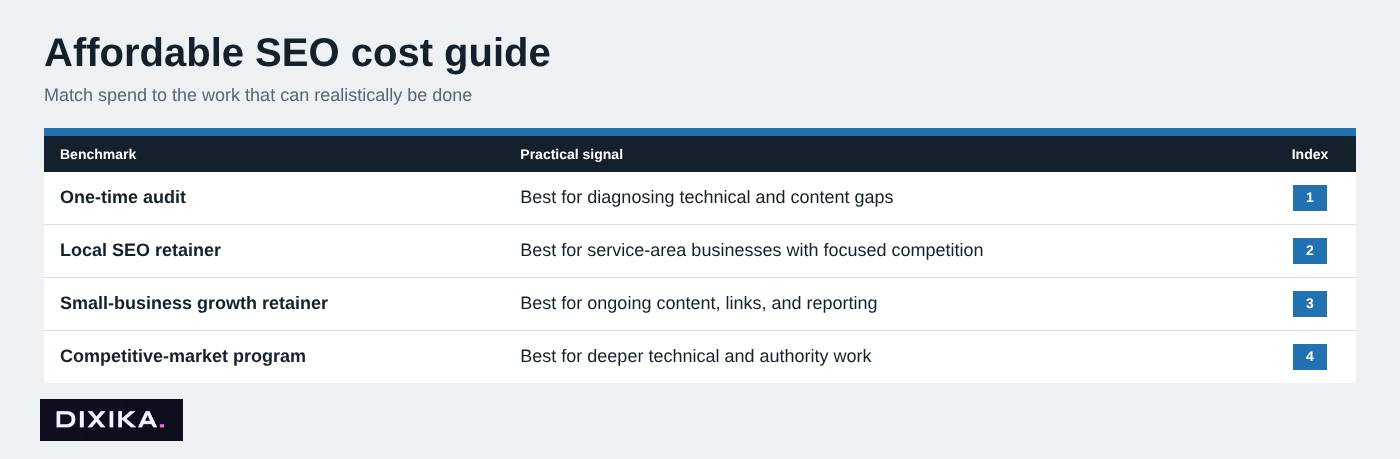
Pricing varies by market and site complexity, but these broad bands help set expectations. For more detail on common pricing structures, see SEO Agency Fees: Costs, Pricing Models, and What to Expect:
- One-time audit or strategy project: Useful when you need to diagnose technical, content, or competitive gaps before committing to ongoing work. It should result in prioritized recommendations, not a spreadsheet of unfiltered crawl errors.
- Focused local SEO retainer: Suitable for service-area businesses with manageable local competition. Work may center on location pages, business profiles, reviews, citations, core site fixes, and local conversion paths.
- Small-business growth retainer: Appropriate when ongoing content optimization, new commercial pages, technical support, reporting, and selected authority work are needed.
- Competitive-market SEO program: Necessary for larger sites or difficult markets where meaningful progress requires deeper technical work, content hubs, digital PR or editorial links, and coordination with in-house teams.
One-off audits, project engagements, and retainers solve different problems. An audit identifies what is holding performance back. A project completes a defined set of improvements. A retainer supports recurring strategy, production, measurement, and iteration. Do not expect a single low-cost monthly package to do all three well.
Be especially cautious of offers that guarantee fast rankings, a fixed volume of high-authority links, or every imaginable service for one unusually low fee. Search performance is not a vending machine. Sustainable gains come from useful pages, accessible sites, credible signals, and consistent execution.
Check 1: Define the Business Goal Before You Compare Agencies
Before reviewing agency proposals, decide what organic growth needs to accomplish. "More traffic" is not enough to judge whether an engagement is working or worth the cost.
- Identify the services, products, or pages that drive revenue. Give the agency a clear picture of what you sell, your margins where appropriate, and the offers worth prioritizing. A page that attracts visitors but produces no qualified demand is rarely the first SEO win to pursue.
- Define your markets and qualified lead criteria. Specify target countries, regions, cities, industries, company sizes, or buyer roles. Clarify what counts as a qualified inquiry, demo request, booked appointment, or sale.
- Map the conversion path. An agency should understand what happens after a search visit: form submission, phone call, booking flow, trial signup, or sales conversation. This helps it prioritize pages that can contribute to commercial outcomes.
- Share the data needed for informed recommendations. Credible agencies ask for analytics, Search Console, sales feedback, existing keyword data, and access to relevant stakeholders. A proposal built without context is often a generic package in disguise.
Ask how keyword and content priorities connect to your actual goals. Rankings and impressions can be useful leading indicators, but they are not the finish line. A strong proposal will state assumptions rather than pretending to know your business before discovery.
Check 2: Make Sure the Scope Matches the Price
Request a written breakdown of monthly deliverables, estimated effort, owners, reporting cadence, and exclusions. This is the fastest way to distinguish a focused affordable service from an under-resourced one.
A lower-priced engagement can be legitimate when the scope is narrow: perhaps local page optimization, profile management, and a limited number of site improvements. It is not credible to promise comprehensive technical SEO, frequent expert content, digital PR, and high-quality link acquisition for the same small fee.
Technical SEO audit and implementation
- Confirm the audit covers the issues that affect discoverability. At a minimum, look for crawlability, indexation, redirects, canonicals, internal linking, site architecture, mobile usability, page experience, and structured data where it genuinely applies. Use this technical SEO audit checklist to review the proposed coverage.
- Separate diagnosis from implementation. An audit identifies problems; it does not automatically fix them. The proposal should state whether the agency creates developer tickets, implements changes directly, supports your developers, or only provides recommendations.
- Require prioritization and validation. Each important issue should explain business impact, urgency, implementation guidance, and how the fix will be checked after deployment.
Content strategy and production
- Ask how keyword and topic opportunities are selected. The agency should consider search intent, commercial relevance, competitive gaps, existing site performance, and your ability to support claims with real expertise.
- Get a specific production plan. Confirm the number and type of pages, whether work includes new content or refreshes, and what editorial stages are included. A content calendar without clear page purposes is just publishing activity.
- Protect accuracy and brand voice. Ask who researches, writes, edits, fact-checks, and approves content. High-volume AI-generated drafts are not a substitute for useful, differentiated material that reflects your business.
Link building and authority work
- Define what link building means in the proposal. Effective work focuses on relevant editorial mentions and links that can improve authority and referral visibility. It should not mean bulk placements on unrelated websites.
- Ask about outreach and placement standards. Request the relevance criteria, outreach process, link attributes, reporting format, and policy on paid placements. A transparent answer is more valuable than a vague domain-metric promise.
- Reject context-free link packages. Guaranteed domain authority scores or fixed volumes of links tell you little about relevance, editorial quality, traffic, or risk.
Check 3: Ask How the Agency Chooses Priorities
Affordable SEO works when it directs limited resources toward the work most likely to matter. Ask for a 30-, 60-, and 90-day plan that explains sequencing, dependencies, and the leading indicators the agency expects to watch.
- Look for an impact-versus-effort approach. Priorities should account for opportunity size, site health, competitive pressure, revenue relevance, and the effort needed from your internal team.
- Confirm that dependencies are visible. A new content hub may depend on navigation changes, templates, expert review, or developer capacity. Good planning identifies these constraints instead of presenting a wish list.
- Question identical roadmaps. The same monthly checklist for every client is a warning sign. A local contractor, SaaS company, and ecommerce brand do not have the same highest-impact SEO tasks.

Check 4: Verify the Quality of Technical SEO Work
Technical SEO becomes expensive when teams spend months fixing low-impact errors while important indexing, template, or internal-linking problems remain untouched. Ask to see a redacted audit or issue sample before signing.
- Look for evidence and business context. A useful issue write-up shows what was found, why it matters, which pages are affected, the recommended fix, and the expected priority. Exported crawl errors alone are not strategy.
- Check for coverage of core technical risks. Recommendations should assess indexing controls, redirects, canonicals, internal links, templates, page speed, mobile usability, and structured data only when it is relevant to the site.
- Confirm developer coordination. Ask who translates recommendations into tickets, answers implementation questions, and checks completed work. Technical advice without a path to deployment rarely improves performance.
- Require post-launch validation. The agency should re-crawl, monitor relevant reports, or otherwise verify fixes after release. Marking a task complete before confirming the result is not enough.
Check 5: Review Content Quality Before Signing
Content is where many affordable SEO packages lose value. Publishing more pages does not help if those pages misunderstand intent, repeat competitors, make unsupported claims, or fail to guide the right reader toward the next step.
- Request samples that resemble your intended work. Review whether the content satisfies search intent, uses clear language, reflects real expertise, and supports conversion without becoming a sales brochure.
- Ask who owns each editorial stage. Know who researches, drafts, edits, approves, and publishes. Your subject-matter experts may need to validate claims, but they should not have to rebuild every draft from scratch.
- Check for optimization of existing pages. A capable agency will identify high-potential pages that need clearer intent, stronger evidence, improved internal linking, or consolidation. New content is not always the best next investment.
- Set quality standards early. Agree on voice, source requirements, product accuracy, review cycles, and approval timing. This prevents the common problem of paying for content that cannot be published.
Check 6: Vet Link Building Without Buying Risk
Link acquisition should strengthen your reputation, not expose your domain to a pile of low-value placements. The right question is not "How many links will we get?" It is "Why would a credible, relevant publisher mention us?"
- Evaluate topical relevance and editorial fit. A relevant industry publication, partner resource, expert contribution, or cited research asset is usually more meaningful than a random site with an attractive metric.
- Ask for placement transparency. You should understand the types of sites being targeted, what a placement looks like, how links are reported, and whether sponsored or paid opportunities are disclosed.
- Check traffic and audience quality. A link can provide referral value as well as authority signals. Look beyond third-party scores to whether the site has a real audience and a logical reason to cover your business.
- Avoid known risk patterns. Private blog networks, automated outreach at scale, sitewide footer links, concealed source lists, exact-match anchor manipulation, and guaranteed high-metric link quotas deserve scrutiny.
The right pace depends on your market, existing authority, content assets, and competitive landscape. There is no universal link quota that makes sense for every site.
Check 7: Confirm Local SEO, National SEO, or AI Search Scope
The work should match the visibility problem you are trying to solve. A proposal that treats every business as a national content publisher or every brand as a local listing project is unlikely to be efficient.
- Match local SEO to local buying behavior. Local businesses may need business profile improvements, review strategy, citation consistency, service-area information, location pages, and conversion-focused pages for priority services.
- Match national SEO to broader competition. Brands competing across regions or countries often need stronger commercial landing pages, topic clusters, internal linking, technical scalability, and earned authority from relevant sources.
- Ask how AI search work fits into the wider strategy. AI-search visibility should complement sound technical foundations, useful source content, entity clarity, credible citations, and earned mentions. It does not replace conventional SEO fundamentals.
- Reject guarantees about AI-generated answers. No agency can responsibly guarantee placement in AI answers. Look for a practical plan to make your information clearer, more credible, and easier for search systems to understand.
Check 8: Demand Reporting That Connects Work to Outcomes
Monthly reporting should help you make decisions, not bury you in screenshots. Require a baseline, agreed KPIs, a completed-work log, next-step priorities, and a plain-language explanation of what changed.
- Prioritize meaningful performance indicators. Track qualified organic leads, conversions, revenue where measurement allows, visibility for high-intent pages, engagement with key landing pages, and resolution of important technical issues.
- Use rankings as supporting evidence, not the whole story. A ranking improvement is useful only if it relates to the right audience, market, page, and commercial opportunity.
- Confirm data access and sources. You should retain access to analytics, Search Console, dashboards, and the underlying data. Ask how often reports arrive and how questions will be handled between reporting cycles.
- Expect honest attribution language. SEO influences journeys that may include direct visits, paid campaigns, referrals, and sales follow-up. A good agency explains those limits rather than claiming every conversion.
Check 9: Read the Contract for Ownership, Flexibility, and Risk
Do not leave the contract until after you have chosen an agency. Pricing can look reasonable until setup charges, long commitments, unclear cancellation rules, and hidden publishing costs appear.
- Review term length and exit conditions. Check the minimum commitment, notice period, renewal terms, setup fees, cancellation process, and how scope changes are handled.
- Confirm ownership of essential assets. Your business should retain ownership of analytics properties, Search Console access, content, creative assets, website changes, and acquired placements where applicable.
- Ask about subcontracting. Agencies can use specialists, but the arrangement should be disclosed. You need to know who performs the work and who remains accountable for quality.
- Identify competitor and third-party costs. Ask whether the agency works with direct competitors and whether outreach, publishing, software, development, or paid media expenses sit outside the retainer.
Check 10: Use This Pre-Signature Scorecard
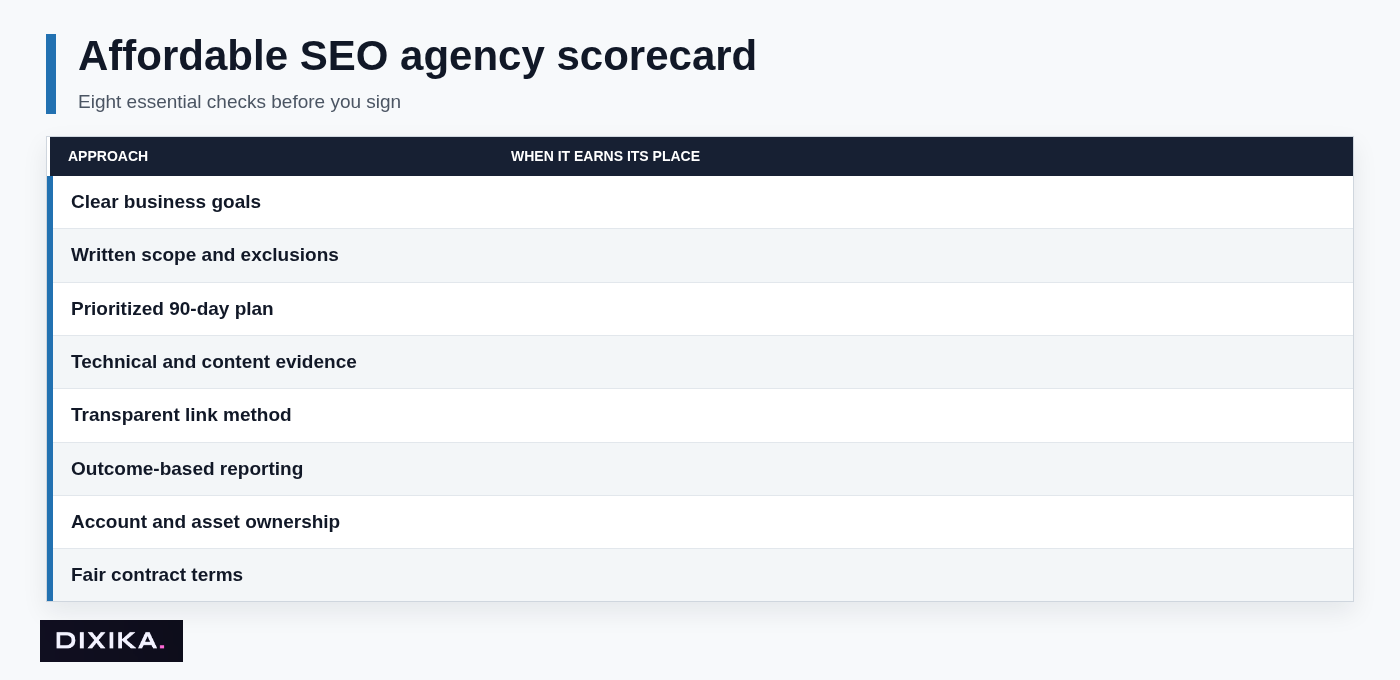
Compare shortlisted affordable SEO agencies side by side. Do not choose based on the lowest quote before checking whether each proposal can realistically produce the work you need. For a broader review process, use this 10-Point Professional SEO Agency Selection Checklist.
Must-have checks:
| Criterion | Evidence to request | Pass/concern |
|---|---|---|
| Business goals and qualified leads | Goal, market, and lead-definition summary | Clear / vague |
| Scope, cadence, ownership, and exclusions | Written deliverables and exclusions | Specific / unclear |
| Prioritized 90-day plan | Sequenced plan with dependencies | Prioritized / generic |
| Technical and content evidence | Redacted audit and relevant content samples | Thoughtful / filler |
| Link-building method | Relevance, outreach, placement, and reporting standards | Transparent / vague |
| Outcome-based reporting | KPIs, completed-work log, and next actions | Useful / vanity-led |
| Account and asset ownership | Contract terms for data, content, and properties | Retained / restricted |
| Fair contract terms | Commitment, costs, renewal, and cancellation terms | Clear / unclear |
Useful but secondary signals:
- Relevant industry experience. Familiarity can speed up discovery, though it should not replace curiosity and rigorous research.
- Proactive conversion-rate ideas. SEO traffic is more valuable when landing pages make it easy for qualified visitors to take action.
- Training for internal teams. Documentation and enablement can make the engagement more durable if your team will support implementation.
- AI-search visibility expertise. This is valuable when your audience uses AI-assisted search and the agency can explain a grounded approach.
Choose Affordable SEO That Protects Long-Term Growth
The best affordable SEO agency does not promise everything. It concentrates a realistic budget on the work most likely to improve qualified visibility, strengthen your site, and support conversions over time.
Compare affordable SEO agency reviews and proposals with the same discipline: inspect the scope, ask for evidence, understand the risks, and make sure your business retains control of its assets. If you need a transparent search-growth plan covering technical SEO, content, link building, and AI-search visibility priorities, Dixika can help you map the work that matters most.