The monthly number on an SEO proposal rarely tells you what you are actually buying. A $1,000 retainer can be sensible for a tightly defined local SEO task. A $10,000 retainer can be sensible for a competitive ecommerce brand that needs technical work, content production, digital PR, and coordination with an internal development team.
What SEO agency fees typically cost in 2026
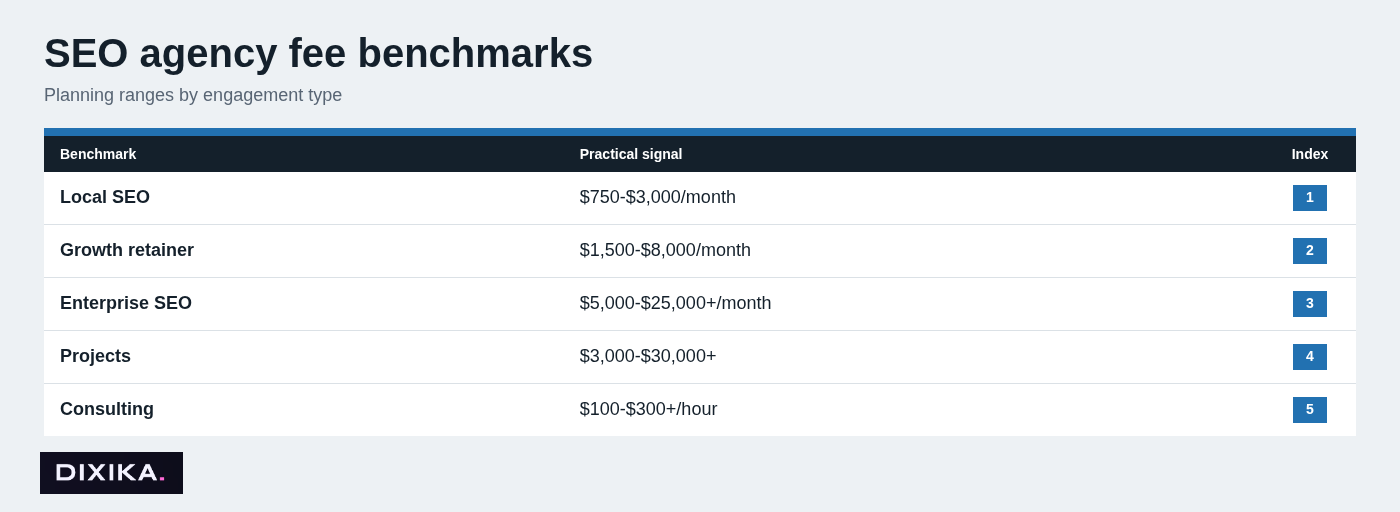
For planning purposes, most SEO agency fees fall into a few broad ranges. These are indicative USD planning ranges for agency-led work, not a market-wide standard or a single-geography rate card. They describe agency fees only; market competition, site condition, internal resources, required speed of execution, and costs outside the retainer can all affect the final price.
| Engagement type | Typical planning range (USD) | Common fit |
|---|---|---|
| Local SEO | $750-$3,000 per month | Single-location or regional businesses with focused local visibility needs |
| Growth retainer | $1,500-$8,000 per month | Small and mid-market companies building ongoing organic growth |
| Enterprise SEO | $5,000-$25,000+ per month | Large, international, heavily regulated, or highly competitive sites |
| Defined projects | $3,000-$30,000+ | Audits, migrations, content programs, and major technical initiatives |
| Consulting | $100-$300+ per hour | Senior advice, QA, training, and support for an internal team |
Quick answer: how much should you pay for SEO services?
Many established small and mid-market companies should expect to invest roughly $1,500 to $5,000 per month for a credible ongoing SEO program. At that level, an agency may be able to provide strategic direction, technical prioritization, content planning, optimization work, reporting, and some combination of outreach or authority building.
How much SEO costs for a small business can be lower when the scope is deliberately narrow: for example, cleaning up a Google Business Profile, improving core service pages, fixing obvious indexation issues, and maintaining local listings. Ecommerce, SaaS, national service businesses, and brands competing in crowded search results usually need more capacity and therefore a larger budget.
A low fee is not automatically a warning sign. The question is whether the scope is honest. A $900 monthly package can be useful if it clearly includes local listing maintenance and one defined optimization task. It is not credible if it also claims to deliver comprehensive technical SEO, several articles, premium links, conversion optimization, and guaranteed rankings.
Why SEO agency costs vary so widely
SEO agency pricing is largely a question of capacity and expertise. You are not purchasing a ranking position; no reputable agency can sell one. You are funding the research, technical work, content, authority development, implementation support, and iteration needed to make your site more competitive.
Two businesses can target the same keyword and require entirely different programs. One may have a fast, well-structured site, useful existing content, strong brand recognition, and developers ready to implement changes. The other may have duplicate pages, unclear site architecture, weak product data, no content process, and several better-known competitors. Their SEO charges should not be the same.
Your starting point and technical debt
Technical debt is the accumulated set of site issues that makes a website harder for search engines and users to navigate. It is not always dramatic. It may appear as important pages blocked from crawling, pages that cannot be indexed, duplicate category pages, inconsistent canonicals, thin filter pages, slow templates, broken internal links, or analytics that cannot reliably measure organic conversions.
Early work is often heavier when a site has recently migrated, uses a restrictive platform, operates across multiple countries, or has accumulated years of ungoverned publishing. Core Web Vitals planning, structured data, international targeting, and analytics cleanup can require input from developers, product teams, and content owners. An agency may identify the work quickly, but implementation still needs a clear owner.
This is why a technical audit fee and an ongoing technical SEO retainer are different purchases. An audit diagnoses and prioritizes. An ongoing program helps ensure recommendations are ticketed, implemented, quality-assured, and monitored after release.
The gap between your site and the search results you want
Search competition is not just a keyword difficulty score. It is the practical gap between what your site offers and what currently earns visibility. That gap can include better competitor content, more useful tools or templates, stronger brand recognition, more editorial mentions, a broader product catalog, better local reviews, or pages built specifically for complex search intent.
Local-map competition may require better location-page architecture, review generation processes, accurate business information, and locally relevant content. A national B2B company may need deep comparison pages, implementation guides, case-study support, and stronger topical coverage. Ecommerce sites often need category-page improvements, crawl controls for faceted navigation, product-feed quality, and scalable internal linking.
The more crowded the results page, the more important it becomes to understand what actually wins there. A proposal should connect its planned work to that competitive reality instead of selling a generic bundle of blogs and backlinks.
Scope, speed, and seniority
Every SEO engagement involves trade-offs. A narrow program can be affordable and effective when it targets one bottleneck. A faster, multidisciplinary program needs more people working in parallel: technical specialists, strategists, writers, editors, outreach professionals, and project managers. That naturally costs more.
Senior involvement matters most when the business faces difficult choices: a platform migration, international expansion, a drop in organic traffic, a complex ecommerce architecture, or a major content investment. Ask who will set priorities, who will perform the work, and how senior review is built into the process. Agency location and overhead can affect price, but the more useful question is whether qualified people are assigned to your account.

The main SEO pricing models and when each makes sense
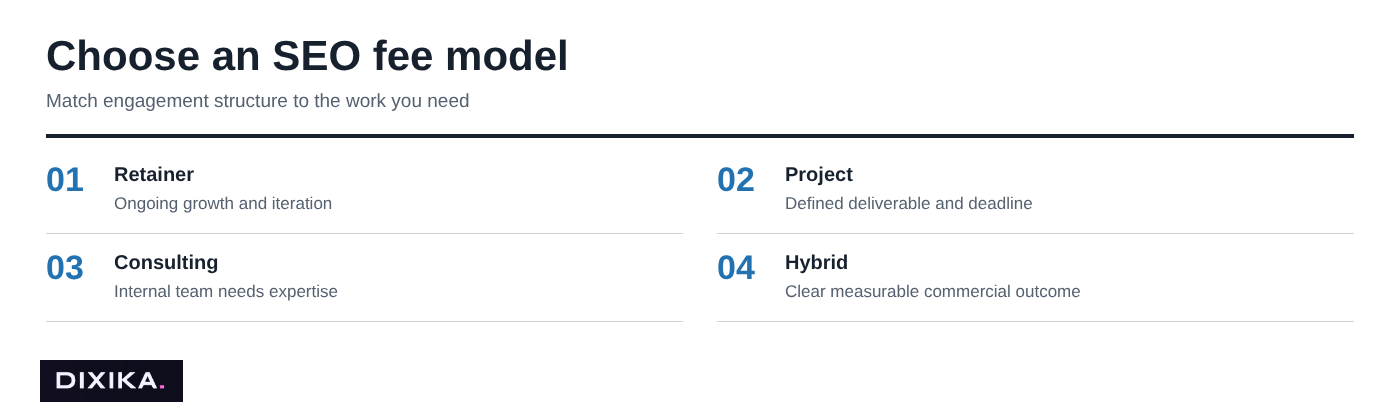
SEO pricing packages are often presented as if monthly retainers, audits, consulting, and performance agreements are interchangeable. They are not. Each model shifts predictability, risk, and responsibility between the client and the agency.
Monthly SEO retainers
A monthly retainer is usually the best fit for an ongoing growth program. It gives the agency room to prioritize work as evidence changes: fix a technical issue, build or refresh content, support implementation, earn relevant authority, monitor results, and adjust the next month's plan.
A strong retainer proposal should describe capacity rather than relying on vague phrases such as "ongoing optimization." It should clarify the expected volume of technical tickets, content briefs or pages, optimization work, outreach activity, meetings, reporting, and senior strategic review. The exact mix can change from month to month, but the operating model should be visible.
Retainers suit SEO because results compound. Publishing a page without internal links, implementation, measurement, or updates is rarely enough. The program needs time to learn what gets indexed, earns impressions, attracts links, produces qualified visits, and contributes to pipeline or revenue.
Project-based SEO fees
Project fees work well when the deliverable and deadline are clear. Common examples include a technical audit, a site migration plan, keyword-to-page mapping, a content refresh program, an ecommerce category-page initiative, or a structured-data implementation plan.
Before signing, define acceptance criteria. For a migration project, that could include redirect mapping, launch checklists, post-launch monitoring, and a documented handoff. For a content project, it might include the number and type of pages, review rounds, subject-matter-expert inputs, publishing ownership, and measurement setup.
Projects become expensive when the scope expands after work begins. Agree on how change requests will be priced, especially when new markets, templates, stakeholders, or implementation obstacles emerge.
Hourly consulting and advisory
Hourly consulting is valuable when you already have people who can execute. An internal SEO lead may need an experienced reviewer for a migration, a developer team may need technical QA, or a content department may need training and editorial standards. It can also help leadership make a better decision before committing to a larger retainer.
The lower total agency spend can be misleading if your internal team lacks capacity. A consultant can identify the highest-impact work, but developers, writers, designers, product managers, and approvers still need to deliver it. Consulting is best when ownership and implementation are already realistic.
Performance-based and hybrid agreements
Performance-based SEO agreements sound attractive because they appear to reduce risk. In practice, they need unusually careful definitions. Eligible outcomes, tracking baselines, seasonality, brand activity, paid-media effects, sales-cycle length, site releases, and attribution all complicate the picture.
Ranking-only guarantees create poor incentives. They can push an agency toward easy, low-value keywords or short-term tactics rather than qualified traffic and commercially meaningful outcomes. A hybrid structure can make more sense when it combines a base fee for sustained work with a clearly defined incentive tied to outcomes both sides can measure and influence.
What should be included in an SEO agency package
There is no universal "complete" SEO package. A business with a healthy site and a thin content library needs something different from a company with strong content but a broken ecommerce taxonomy. What matters is that priorities, inclusions, exclusions, and responsibilities are explicit.
Strategy, research, and measurement foundations
Every serious engagement should begin with discovery. That includes business goals, target customers, conversion paths, existing performance, keyword and intent research, competitor analysis, and a practical view of what the internal team can implement.
The agency should also establish KPIs and reporting cadence. Organic sessions alone are not enough for most B2B and ecommerce teams. Useful reporting may include non-branded impressions, rankings for priority themes, indexed pages, qualified organic traffic, leads, assisted conversions, revenue, and technical health indicators. The right mix depends on the business model.
Technical SEO and implementation support
Technical SEO work can range from a short audit to ongoing implementation management. Look for clarity on audit depth, prioritization logic, developer-ready tickets, documentation, QA, structured data, internal linking, crawl monitoring, and indexation review.
One important distinction: some agencies provide recommendations only, while others help manage implementation through to completion. Neither model is inherently better. But a recommendation is not a fix, and it should not be treated as one when comparing agency packages.
Content planning, creation, and optimization
Content scope should be more specific than "four articles per month." Ask what type of pages will be produced, what search intent they address, how they fit into a topic cluster, who provides subject expertise, how much editing is included, and whether publishing is handled.
Useful work may include editorial strategy, conversion-aware briefs, new landing pages, comparison pages, product or service-page improvements, content refreshes, internal links, and pruning or consolidation of weak pages. Page count matters less than whether the work closes a meaningful gap and can be reviewed by people who know the product and audience.
Authority building and digital PR
Authority building is the work of earning credible third-party references to your brand and content. It can include journalist outreach, relationship building, expert commentary, editorial placements, data-led assets, and genuinely useful resources that other sites choose to cite. Teams comparing approaches can review these link building strategies as part of their planning.
Ask how links are earned or acquired, what quality controls apply, and what reporting you will receive. You should also know whether third-party placement costs, content production, or digital PR assets are included in the retainer, billed separately, or handled by your internal team. Unexplained link volume is not a strategy.
Local SEO, ecommerce SEO, and AI-search visibility
Specialized requirements can materially change SEO fees. Local businesses may need Google Business Profile management, citation consistency, local landing pages, review strategy, and map-pack monitoring. Ecommerce businesses often need category and product-page improvements, faceted-navigation controls, product-data cleanup, and templates that work across thousands of URLs.
AI-search visibility, sometimes called GEO or LLM optimization, focuses on helping search engines and AI systems understand and confidently reference your brand. The work can include entity clarity, citation-ready content, well-structured FAQs, clear source footprints, and stronger topical coverage. It is an extension of sound technical SEO, useful content, and credible authority - not a replacement for those foundations.
When several of these streams are needed, choose an agency that can scope them around the business's actual constraint rather than selling a prebuilt package. A search growth agency such as Dixika can combine technical SEO, content, authority building, Reddit discovery strategy, and work to improve visibility in AI-generated answers.
A worked example: turning an SEO proposal into a true monthly cost
Here is a hypothetical example of a mid-market ecommerce company selling specialized home-office equipment. It has several hundred products, category pages that are underperforming, inconsistent product attributes, and a small internal development team. This is not a quote or a prediction; it is a way to compare proposals honestly.
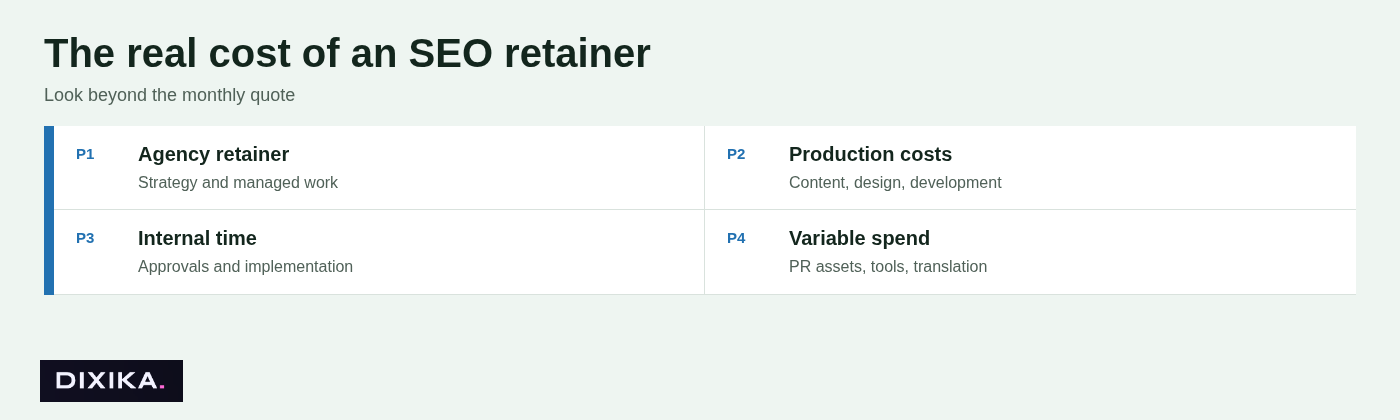
The quoted retainer: $4,000 per month
An agency's $4,000 monthly retainer might cover strategic oversight, technical prioritization, category-page recommendations, content planning, optimization of selected existing pages, outreach planning, monthly reporting, and account management. In some months, more effort may go to technical tickets; in others, the focus may shift toward content briefs and internal-linking improvements.
That can be a reasonable fee if the agency defines capacity. The buyer should know, for example, whether the retainer includes a specified number of briefs, how many pages receive hands-on optimization, whether outreach execution is included, and whether technical QA happens after the development team deploys changes.
The costs outside the retainer
The agency fee may not cover all execution. The ecommerce company might need specialist copywriting, product photography or design, developer implementation, product-data cleanup, translation for international stores, a data asset for PR, or tool subscriptions. It will also spend internal time reviewing claims, approving pages, managing releases, and providing product knowledge.
For each item, label it clearly:
- Included: funded by the retainer and performed by the agency.
- Pass-through: purchased by the agency but billed to the client, such as a specialist asset or third-party placement cost.
- Optional: available if needed but not assumed in the base scope.
- Client-owned: work the internal team must perform, such as development, legal review, or publishing.
The decision: compare 6-month total investment and expected capacity
Over six months, the visible agency fee is $24,000. But perhaps the company also needs $9,000 of copywriting and design support, $6,000 of development time, and meaningful internal hours for product review and approvals. The real investment is larger than the retainer, and that is normal. The key is to see it before signing.
Now compare that proposal with a $2,000 monthly alternative that supplies recommendations but no content, no outreach execution, no implementation support, and no QA. Its six-month agency bill is lower, but the internal team must absorb much more work. If that team cannot do so, the lower-priced proposal may produce less progress and cost more in missed opportunity.
As we covered in the section on pricing models, the better comparison is not the headline fee. Compare total execution capacity, the bottlenecks each proposal removes, and the leading indicators you expect to see along the way.
How to evaluate an SEO proposal before you sign
A useful proposal makes it easier to manage the engagement after the sale. It should explain what happens first, what depends on your team, what gets delivered, how decisions are made, and how progress will be measured. For a broader evaluation framework, use this 10-Point Professional SEO Agency Selection Checklist. If you cannot compare two proposals line by line, ask both agencies to make their operating model clearer.
Questions about scope and capacity
- Who will work on the account, and what roles do they hold?
- Who is responsible for strategy, technical SEO, content, outreach, and quality assurance?
- What estimated hours, deliverable volume, or monthly capacity is included?
- How often will you meet, and what is the expected turnaround time for requests?
- What approvals are required from your team?
- Which activities are explicitly excluded from the fee?
- Who owns implementation, publishing, and post-release QA?
Do not accept "we handle everything" as an answer. SEO touches product, engineering, design, content, analytics, and leadership. A good agency will be candid about where it needs access and cooperation.
Questions about methods and quality control
- How are technical priorities identified and validated?
- How will content use real subject-matter expertise rather than generic summaries?
- How are editorial links and mentions earned or assessed for quality?
- How is AI used in research, drafting, editing, and quality control?
- What is the process for responding to major search changes, traffic declines, or a site migration?
- How do you prevent duplicated, low-value, or poorly indexed content from accumulating?
AI can speed up research and production workflows, but it does not eliminate the need for editorial judgment, fact checking, brand knowledge, and technical validation. An agency should be able to explain its controls in plain language.
Questions about reporting and commercial accountability
- What baseline will be recorded before work starts?
- Which leading indicators and business outcomes will be reported?
- What are the known attribution limitations for our sales cycle?
- Will we retain access to source data in analytics and search platforms?
- Can you show an anonymized reporting format?
- How are priorities changed if the evidence points elsewhere?
Look for reporting that explains decisions, not just charts. A useful report should connect completed work, observed signals, obstacles, next priorities, and commercial context.
Red flags in cheap SEO packages and expensive proposals
Cheap SEO is not always poor SEO, and expensive SEO is not automatically sophisticated. The concern is not price by itself. It is the mismatch between the claims being made and the people, time, methods, and deliverables available to support them.
Red flags in low-cost SEO offers
Be cautious when an offer guarantees rankings, promises a large number of backlinks without explaining sources, sends generic automated reports, or skips discovery entirely. Other warning signs include vague "directory submissions," no path for implementing technical recommendations, and long locked-in contracts that do not leave you with usable work product.
A legitimate low-cost offer is usually narrow and direct. It might cover a local profile cleanup, citation correction, an audit of a small site, or monthly advisory for a business that has an in-house marketer. It should not pretend to be a full-service growth engine.
Red flags in premium proposals
Higher fees deserve equally high scrutiny. Watch for polished but generic decks, unnamed senior involvement, inflated deliverable counts, opaque subcontracting, and a lack of prioritization. A proposal that promises dozens of activities but cannot explain why those activities matter to your market is not strategically rigorous.
Vanity metrics are another concern. Impressions, broad keyword counts, and raw links may be useful diagnostics, but they should not replace qualified traffic, meaningful conversions, revenue context, or the removal of concrete technical and content constraints.
Build an SEO budget that matches your growth stage
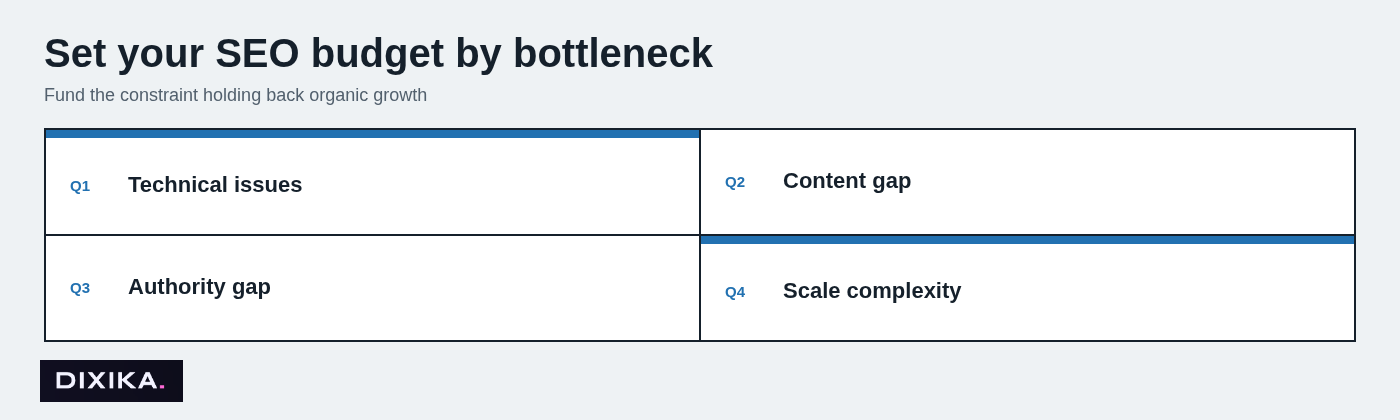
The best SEO budget is not a generic SEO cost calculator result. It is a response to the constraint currently limiting organic growth. That may be technical health, insufficient content coverage, lack of authority, poor conversion paths, or an internal inability to implement recommendations.
Early-stage and local businesses
Early-stage and local companies should resist the urge to buy an oversized package before the fundamentals are in place. Start with measurement, technical cleanup, clear core service or product pages, local visibility where relevant, and a manageable process for maintaining the site.
For a local service business, that may mean accurately representing locations, improving service pages, collecting legitimate reviews, resolving duplicate listings, and publishing useful local information. A focused program is often more valuable than trying to compete immediately for every broad national keyword.
Established small and mid-market companies
Established companies usually need a balanced program. That commonly includes ongoing technical work, content expansion and refreshes, internal linking, authority development, and reporting that connects visibility to leads or revenue. The budget needs enough room for implementation, not just planning.
At this stage, a useful question is: what happens after the agency finds the opportunity? If the answer is unclear, fund the bottleneck. That could mean development capacity, subject-matter-expert review time, content production, or a stronger outreach program.
Competitive ecommerce, SaaS, and enterprise sites
Competitive sites need more than a larger volume of blog posts. They often require dedicated technical streams, template-level improvements, content governance across large page sets, digital PR, international coordination, stakeholder management, and a longer planning horizon.
SaaS companies may need category education, integration pages, comparison content, and clear product positioning. Ecommerce businesses may need a disciplined approach to categories, filters, product availability, and structured data. Enterprise teams also need an agency that can work within governance, legal, brand, and release-management constraints.
How long SEO fees should run before you judge results
SEO should be judged with patience, but not blind patience. Search engines need time to crawl, process, and evaluate changes, while competitive content and authority work take time to earn traction. The exact timeline depends on the site, market, implementation speed, and starting point.
A practical approach is to run a 90-day operating review, then assess commercial progress over six to 12 months. In highly competitive markets or on large sites with slow release cycles, the longer end of that range is often more realistic.
What to look for in the first 90 days
The first three months should establish the conditions for progress. Look for analytics and access cleanup, completed diagnosis, an agreed roadmap, a prioritized backlog, movement on implementation, a functioning content pipeline, and clear ownership across teams.
You may also see early indexation improvements, changes in impressions, better crawl efficiency, or initial movement for optimized pages. These are leading indicators, not a substitute for commercial results. Their value is that they show whether the operating system is working.
What to assess after six months
By six months, assess execution consistency and business relevance. Are priority technical fixes live? Has non-branded visibility improved for the themes that matter? Is qualified organic traffic growing? Are content pages earning impressions, engagement, links, leads, or assisted conversions? Has the agency adapted based on evidence?
Also evaluate the quality of learning. A strong program does not keep repeating the original plan when results reveal a different constraint. It updates priorities, doubles down on what is working, and stops spending effort on activities that are not justified.
Making SEO agency fees a productive investment
SEO agency fees become productive when they buy the right execution capacity for your situation. Compare proposals on total cost, work ownership, transparency, implementation support, and the constraint they solve - not only the monthly retainer.
Ask for a plan that connects technical health, content, authority, and measurement to your commercial goals. Then make sure the people who need to approve or implement work are part of the operating model from the start.
If your team needs a tailored program spanning technical SEO, content, link building, Reddit strategy, or AI-search visibility, speak with Dixika about a scoped search growth plan.