
Hiring the wrong SEO agency can waste a year of budget while leaving the real problems untouched: pages that cannot be indexed, content with no commercial purpose, weak authority, or a site that is invisible in emerging AI answers.
A professional SEO agency should make the work clearer, not hide it behind jargon, generic dashboards, or ranking guarantees. Use this pre-signing checklist to compare proposals, record each agency's answers, and choose a partner that can produce measurable search growth. For a broader framework on evaluating strategy, execution, and AI readiness, see how to compare an SEO agency's strategy, execution, and AI readiness.
Pre-Check: Define the Business Problem SEO Needs to Solve
Do not begin by asking for an SEO package. Begin with the business outcome you need: more qualified demos from a specific market, stronger ecommerce category visibility, a recovery from declining non-branded traffic, or greater inclusion in AI-generated answers.
Write down your target audience, priority products or services, markets, internal constraints, and timeline. An agency cannot responsibly prioritize work without knowing whether a technical migration is imminent, developers are available, sales capacity is limited, or a new market is the actual growth priority.
Be equally clear about the immediate type of support required. You may need a technical SEO audit, a content growth plan, earned links, local visibility, ecommerce SEO, or a coordinated program that covers several of these areas. The right professional SEO agency will diagnose the gap before prescribing the deliverables.
1. Confirm the Agency's Services Match Your Actual Needs
Confirm the scope in plain language. A capable agency should explain what it handles across technical SEO, content strategy, on-page optimization, authority building, and reporting. You should know what will be produced, who will use it, and what changes are expected on your site.
Reject a fixed package that skips diagnosis. Standardized retainers can be useful after a strategy is set, but they are a poor substitute for understanding your site, competitors, market maturity, and operational limits. If every prospect receives the same number of blog posts and links, the agency is selling inventory rather than solving a problem.
Ask whether the technical audit will produce prioritized, implementation-ready fixes. The dedicated audit review in point 5 should explain the expected coverage, evidence, ownership, and post-deployment validation.
Content, authority, and AI search visibility
Check how content activity connects to commercial goals. Keyword research should lead to focused briefs, improvements to existing pages, internal linking decisions, and publishing priorities that match search intent. More content is not automatically better content.
Ask for a concrete approach to AI search optimization. If visibility in AI-generated answers matters to your team, the agency should be able to discuss entity clarity, trustworthy source footprints, citations, well-structured FAQs, and useful first-party pages. Vague promises to "rank in LLMs" are not a strategy.

2. Ask for Evidence Relevant to Your Market and Goals
Prioritize relevant proof over impressive-looking screenshots. A B2B SaaS company should not be persuaded by an unrelated local-services traffic chart, and an enterprise ecommerce team needs more than evidence from a small brochure site. Look for work comparable in site type, competition, geography, and objective.
Ask for verifiable case studies. A credible example explains the starting position, the work performed, the timeframe, the measurement method, and the result. It should be possible to understand the link between actions and outcome rather than simply admire a final metric.
Results should show the path, not just the outcome
Ask how gains were attributed. Search performance can move because of seasonality, brand demand, redesigns, paid campaigns, product launches, or broader market changes. A professional agency will acknowledge those factors instead of taking credit for every upward trend.
Look beyond raw organic sessions. Depending on your goal, useful evidence may include qualified non-branded traffic, conversion rate, leads, pipeline, revenue, indexed pages, topic visibility, or technical improvements. Traffic without commercial relevance is not a win.
References should reveal the working relationship
Speak with a current or recent comparable client. Ask what it was like to work through blockers, competing priorities, and difficult decisions. This is usually more revealing than a polished testimonial.
Test for execution support. Find out whether the agency's reporting led to decisions, whether recommendations were implementable, and whether strategists stayed engaged after the contract was signed. Strong ideas have little value if they do not survive the reality of product, engineering, and content workflows.
3. Evaluate the Strategy Before You Evaluate the Sales Pitch
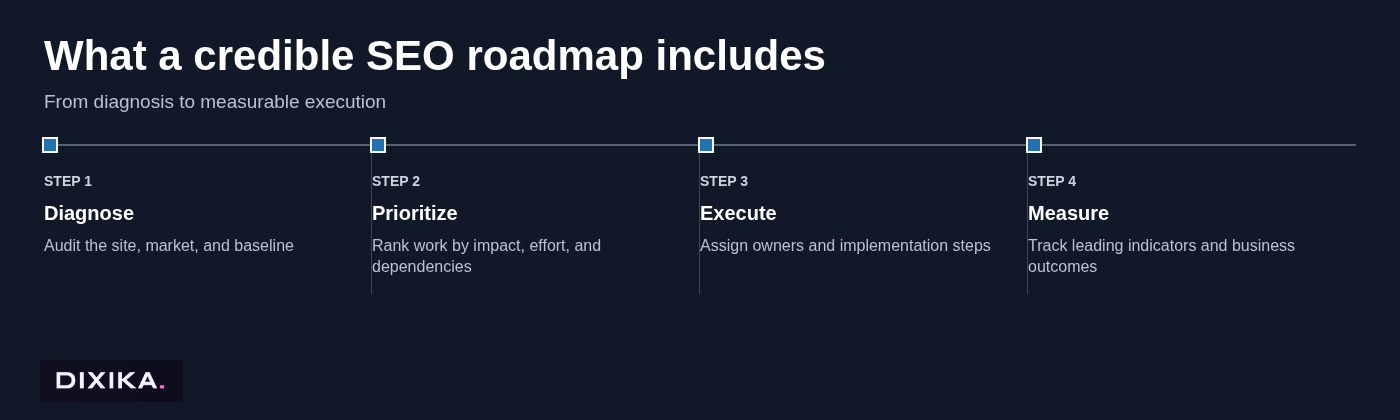
Ask what the first 90 days would look like. A credible answer separates discovery, diagnosis, prioritization, implementation support, and measurement. It does not promise first-page rankings by a certain date.
An agency can commit to disciplined work, transparency, and progress against agreed milestones. It cannot control algorithm changes, competitor investment, or every factor influencing search demand.
Look for a prioritized roadmap
Require recommendations ranked by impact and effort. The roadmap should show expected impact, implementation effort, dependencies, and risk. A flat list of 100 tasks forces your team to do the agency's prioritization for it.
Clarify ownership before work begins. Ask who will implement technical tickets, write or review content, approve changes, and remove roadblocks. Good agencies work effectively with developers, writers, product managers, and external vendors; they do not assume someone else will absorb the difficult work.
Challenge guarantees and one-size-fits-all plans
Treat guaranteed rankings as a warning sign. Claims of guaranteed No. 1 positions, instant results, or secret methods usually point to poor judgment or tactics the agency would rather not explain. Search is competitive and variable by nature.
Question unusually generic plans. A business with indexation problems needs a different first move from one with solid technical foundations but no category authority. Strategy should respond to the actual constraint.
4. Check Who Will Actually Do the Work
Ask for the named delivery team. You should know the strategist, technical SEO lead, content lead, and link-building or digital PR specialists assigned to your account. The senior person in the sales meeting is not necessarily the person who will make day-to-day decisions.
Confirm how work is produced and reviewed. Ask what is completed in-house, by contractors, or through white-label partners, and how quality assurance works. Subcontracting is not inherently bad; concealing it is.
Assess senior involvement and specialist access
Define senior review and escalation paths. Find out how often senior strategists review the account, when specialists join discussions, and what happens when an implementation issue stalls. Technical and editorial questions should reach people qualified to answer them.
Check capacity honestly. If the agency cannot explain account load, turnaround times, or staffing coverage, expect the same ambiguity after signing.
5. Review the Technical SEO Audit Process
Make sure the audit leads to action. A technical SEO audit service is valuable when it identifies the limited number of fixes most likely to improve discoverability, user experience, and conversion paths. It is not valuable simply because it found thousands of URLs with minor issues.
Ask how issues are validated. The agency should explain how it discovers problems, confirms their impact, and translates them into implementation-ready recommendations. Automated crawlers are useful inputs, not complete diagnoses.
What a useful technical SEO audit checklist covers
Review the core technical areas. Look for crawling and indexing, XML sitemaps, robots directives, redirects, canonicals, page experience, mobile rendering, schema, internal links, and log-file analysis when site scale warrants it. Not every audit needs the same depth, but omissions should be deliberate and explained.
Separate urgent fixes from hygiene work. A missing canonical tag on a marginal URL may matter far less than an accidental noindex directive on a revenue-generating template. Ask how the agency makes that distinction.
What the final audit deliverable should enable
Require evidence and implementation guidance. The report should identify affected URLs or templates, recommended fixes, owner guidance, acceptance criteria, and a retest plan. Developers need clear tickets, not abstract advice to "improve technical SEO."
Confirm post-launch validation. Changes can behave differently in production. Ask whether the agency will verify that fixes were deployed correctly and whether unintended consequences were introduced.
6. Scrutinize Link Building and Content Quality Standards
Protect the brand before chasing volume. Link acquisition should be based on relevant, credible opportunities and editorial value, not anonymous sites assembled to sell placements. Cheap link packages are often expensive once cleanup, lost trust, or missed opportunity costs are considered.
Demand content that earns attention. Pages should meet user intent, add original usefulness, and fit into a coherent topical plan. Publishing at scale just to fill a calendar creates a larger maintenance burden without building authority.
Ask for the link acquisition methodology
Request transparency on prospecting and placement standards. Ask how publications are selected, how relevance is judged, and whether you can approve prospects. The agency should also explain how it handles sponsored, nofollow, affiliate, and low-quality placements. Reviewing credible link building strategies can help you assess whether the proposed approach is suitably transparent and sustainable.
Reject unexplained link quotas. A promise of a fixed number of links each month means little without source quality, topical relevance, editorial context, and acquisition method. The number alone is not a quality metric.
Review content quality controls
Inspect the editorial process. Ask about research, subject-matter input, editing, fact-checking, approvals, and internal linking. A good brief should make the writer more useful to the reader, not merely more repetitive with keywords.
Set standards for AI-assisted production. AI can speed up parts of research and drafting, but human accountability remains essential. Require original value, accurate claims, expert review where necessary, and safeguards against thin or duplicative pages.
7. Make Reporting Tie SEO Work to Business Outcomes
Agree on the reporting system before the engagement starts. Set baseline metrics, data sources, reporting cadence, and the decisions the report is meant to support. A monthly dashboard without context is not strategic reporting.
Expect a narrative, not just charts. Useful reporting explains what changed, why it matters, what was completed, what is blocked, and what should happen next. It should make trade-offs visible.
Use leading and lagging indicators
Track leading indicators to manage execution. These can include technical fixes deployed, pages indexed, content published or refreshed, movement for priority topics, and qualified links earned. They show whether the plan is being implemented before revenue data has time to mature.
Connect lagging indicators to business value. Depending on your model, measure organic conversions, qualified leads, pipeline, revenue, retention, or another agreed outcome. Rankings are diagnostic signals, not the final reason to invest.
8. Understand SEO Agency Fees, Scope, and Contract Terms
Compare proposals on value and capacity, not monthly cost alone. SEO agency fees vary because the underlying work varies: strategic depth, specialist access, content production, technical support, digital PR, and implementation complexity all affect price. An affordable SEO agency may be appropriate for a narrow need, but extremely low pricing often signals shallow research, heavy automation, or risky shortcuts.
Ask what is included, excluded, and billable
List every expected deliverable. Clarify whether fees include audits, strategy, content, development support, digital PR, tools, meetings, reporting, and implementation validation. Do not assume that a proposal headline includes the execution required to make it useful.
Set a change-control process. Work outside scope will arise. Agree on how additional requests are priced, approved, and prioritized so costs do not drift and urgent work does not disappear into an email thread.
Check commitment, ownership, and exit terms
Review the contract mechanics. Check commitment length, renewal terms, notice periods, handover obligations, and deliverable ownership. Long commitments are not automatically unreasonable, but they should be matched by clear obligations and exit provisions.
Retain control of critical accounts. Your organization should own analytics, Search Console, tag management, content, outreach assets, and key site access. An agency can receive appropriate permissions without becoming the owner of your infrastructure.
9. Test Communication and Collaboration Before Signing
Notice the questions the agency asks. Strong partners want to understand your customers, margins, sales cycle, technical stack, compliance requirements, competitors, and internal resources. That curiosity is not a delay tactic; it is how they avoid recommending work that cannot generate value.
Use early conversations as a working test. The team should explain trade-offs clearly, welcome scrutiny, and acknowledge uncertainty when evidence is incomplete. This matters more than a flawless pitch deck.
Run a practical proposal review
Ask the agency to walk through one priority opportunity. Have them explain the evidence, recommendation, dependencies, expected impact, and measurement plan for a real page, topic, or technical issue. This tests their reasoning under useful pressure.
Assess whether the plan fits your operating reality. The best recommendation is not always the most ambitious one. It is the one your organization can approve, implement, measure, and build on.
10. Watch for SEO Agency Red Flags
Disqualify secrecy and false certainty. Do not hire agencies that cannot explain their methods, conceal subcontracting, demand ownership of critical accounts, or rely on ranking guarantees. You are buying strategic expertise, not a black box.
Watch for weak evidence and vague delivery. Irrelevant case studies, unexplained link sources, generic deliverables, no implementation plan, and reports dominated by vanity metrics all signal a weak engagement model. A professional SEO agency should be able to show how work becomes business progress.

Your Professional SEO Agency Selection Checklist
Use this final pass before choosing an agency. The must-do items below should be answered clearly in the proposal, contract, and early working sessions.
- Define the business problem. Set the outcome, audience, markets, timeline, and constraints that SEO needs to address.
- Confirm service fit. Make sure technical SEO, content, authority building, local or ecommerce needs, and AI search visibility support match your actual priorities.
- Verify relevant evidence. Review case studies and references that resemble your market, site type, and commercial objective.
- Review the 90-day roadmap. Look for diagnosis, prioritization, owners, dependencies, execution steps, and measurement rather than generic promises.
- Meet the delivery team. Identify the strategists and specialists who will do the work, review quality, and handle escalations.
- Inspect technical audit standards. Require clear evidence, prioritized tickets, implementation guidance, and post-deployment validation.
- Scrutinize content and link practices. Demand transparent sourcing, editorial controls, relevance, and safeguards for your brand.
- Align reporting to business outcomes. Track delivery indicators alongside conversions, pipeline, revenue, or the outcome that matters to your business.
- Compare fees, scope, and terms. Check what is included, what costs extra, who owns assets, and how the relationship ends.
- Reject red flags. Walk away from guarantees, hidden methods, vague deliverables, unexplained links, and agencies that want control of accounts you should own.
The right partner is not the agency with the boldest promise. It is the one that can make a transparent, prioritized case for work your team can implement and measure.
If you need coordinated support across technical SEO, content, authority building, and AI search visibility, Dixika can help identify the highest-impact opportunities for your growth plan.