AI search is changing how buyers discover vendors, but it has also created a market full of inflated promises. Plenty of agencies now claim they can make a brand "rank in AI," even though no provider controls what ChatGPT, Google AI Overviews, Perplexity, or other answer engines choose to say on a given day.
The useful question is not which agency promises the most AI citations. It is which one can improve the underlying conditions that make your company easier to retrieve, cite, represent accurately, and visit across AI-mediated search experiences.
What AI Search Optimization Means - and What an Agency Can Actually Influence
AI search optimization, often called generative engine optimization (GEO), generative AI search engine optimization, or LLM optimization, is the work of improving a brand's likelihood of appearing accurately in AI-generated answers. That can mean a brand mention, a citation to a useful page, a recommendation within a buying-oriented answer, or a referral visit from an AI search product. For a broader explanation, see What Is AI Search Optimization? A Practical Guide to AI Visibility.
The terminology is still inconsistent. The practical work is less mysterious: strengthen the pages, entities, evidence, technical accessibility, and external signals that search systems and AI-mediated experiences can discover and use.
No AI search optimization agency can guarantee a ChatGPT citation, dictate an AI Overview, or permanently control an answer generated by a model. Outputs can change based on the platform, prompt wording, location, language, conversation context, personalization, source availability, and model updates.
An agency can influence the inputs. That includes making important pages crawlable and indexable, improving site architecture and internal linking, publishing evidence-backed content, clarifying what your company does, earning credible third-party mentions, and creating source pages that help a buyer take the next step.
This is why credible AI SEO services overlap heavily with strong technical SEO, content strategy, digital PR, authority building, and conversion-focused page design. Treating GEO as a separate bag of tricks usually leads to shallow work. A practical framework for this work is covered in How to Build a Generative Engine Optimization GEO Program.
Quick Verdict: Choose an Agency That Can Prove Its Method, Measurement, and SEO Foundation
Prioritize an agency that can diagnose visibility across the AI and search surfaces relevant to your buyers, improve the eligibility and quality of source pages, document what it changes, and report outcomes alongside traditional organic performance.
Be skeptical of broad claims about "ranking in AI" that lack an operating model. A good proposal should explain what the team will investigate, what it will prioritize, who will execute it, how progress will be measured, and which factors remain outside anyone's control.
The best AI SEO agency for your company is not necessarily the one naming the most AI platforms. It is the one that can connect a real business objective to a specific visibility gap and a workable execution plan.
Start With Your AI Visibility Goal and Search Landscape
Before you contact AI SEO companies, decide what you are trying to win. A vague objective such as "show up in ChatGPT" is too broad to guide a strategy or assess a proposal.
Start with your priority audiences, products, markets, and high-value buyer questions. Then identify which search and AI surfaces matter for those questions. For one B2B company, that may mean Google results and AI Overviews around category evaluation. For another, it may mean comparison queries in Perplexity, brand research in ChatGPT, and referral traffic from Reddit discussions.
Build a baseline before work begins. Capture branded and non-branded prompts, competitor mentions, cited domains, current organic rankings, relevant source pages, referral traffic, and conversions where the data is available. An agency that skips this stage cannot credibly show what changed later.
"How to rank in AI search" is the wrong mental model if it implies a single universal position. The more useful goal is to earn consistent coverage for a defined topic set by improving the sources and signals behind relevant answers.
Decide Which Outcomes Matter
AI visibility can produce several different outcomes, and they are not interchangeable. A brand mention may improve awareness. A citation can expose a useful source page. Qualified referral traffic can create sales opportunities. Better supporting content can also lift conventional organic search performance.
Choose a small number of topic clusters tied to commercial reality. For example, a cybersecurity company might track "zero trust implementation," "best identity security tools," and "how to compare access-management vendors" rather than hundreds of loosely related prompts.
- Brand inclusion: Your company is named accurately in relevant answers.
- Citation or source inclusion: Your first-party pages appear as sources where the platform provides citations.
- Qualified referral traffic: AI-mediated visits reach relevant pages and engage meaningfully.
- Assisted conversions: Those visits contribute to demo requests, trials, or pipeline.
- Supporting SEO gains: The pages built for AI visibility also improve organic reach and conversion paths.
Map the Competitive Citation Set
Ask each prospective agency to show which competitors, publishers, review sites, communities, and third-party sources appear repeatedly for your priority questions. That is your competitive citation set.
The agency should then explain the gaps: perhaps competitors have clearer category pages, stronger comparison content, more expert evidence, better internal links, independent reviews, or a stronger footprint in industry publications and communities.
This exercise separates diagnosis from sales language. You are not hiring an agency because it has a generic GEO deck; you are evaluating whether it can identify the specific reasons your company is underrepresented.
Compare Agencies on the Work They Will Actually Do
Labels such as AI SEO services, GEO, LLMO, and AI search optimization are used inconsistently. Compare agencies on deliverables, sequencing, and execution depth instead.
Request a written roadmap that connects each recommendation to an observed source-quality, technical, authority, or content gap. If a deliverable cannot be linked to a plausible problem, it may be a packaged tactic rather than a strategy.
Technical SEO and Retrieval Readiness
AI-facing visibility still depends on a technically sound website. Look for agencies that assess crawlability, indexation, rendering, canonicalization, internal linking, site architecture, page performance, and structured data where it is genuinely appropriate.
Schema markup can help systems interpret page details, but it is not a standalone AI search strategy. The same is true of llms.txt. Neither fixes thin content, weak authority, poor architecture, blocked pages, or unclear product positioning.
Ask how technical recommendations are prioritized and validated. A credible partner should distinguish high-impact implementation issues from speculative cleanup work, then identify who on your side will own the fixes.
Content, Entity, and First-Party Evidence
Strong source pages answer real buyer questions with enough specificity to be useful. They also make important claims supportable through product documentation, original research, customer evidence, expert input, transparent methodology, and clear explanations of where the product fits.
Entity clarity matters here. Your site should make it easy to understand the relationships between your company, products, audience, founders or experts, integrations, categories, and proof points. Inconsistent naming and vague marketing copy make accurate representation harder.
Ask prospective agencies about editorial standards, subject-matter-expert involvement, revision workflows, and content refreshes. More AI-written copy is not a content strategy. In many cases, the higher-value work is improving a weak but strategically important source page.
Authority Building and Off-Site Mentions
Relevant independent mentions help validate a company beyond its own website. Depending on your market, that may involve earned editorial coverage, expert contributions, industry directories, comparison platforms, partner ecosystems, customer reviews, community participation, or quality link acquisition.
Ask how the agency earns third-party validation and what it will not do. Opaque placements, automated outreach at scale, irrelevant links, and fabricated social proof can create risk without solving the authority problem.
A strong plan should be industry-appropriate. A developer tool, healthcare platform, enterprise SaaS product, and local professional service will not earn trust through the same channels.
Measurement, Experimentation, and Reporting
AI answer outputs are volatile, so reporting needs more than a few favorable screenshots. Look for prompt and topic tracking, citation and mention analysis, source-page diagnostics, organic performance, referral data, and business outcomes brought together in one narrative.
Ask how the agency accounts for sampling, location, language, prompt variation, personalization, model changes, and platform differences. It should also be honest about correlation: seeing a mention after content changes does not automatically prove the change caused it.
Use a Comparison Matrix Before You Shortlist AI SEO Companies
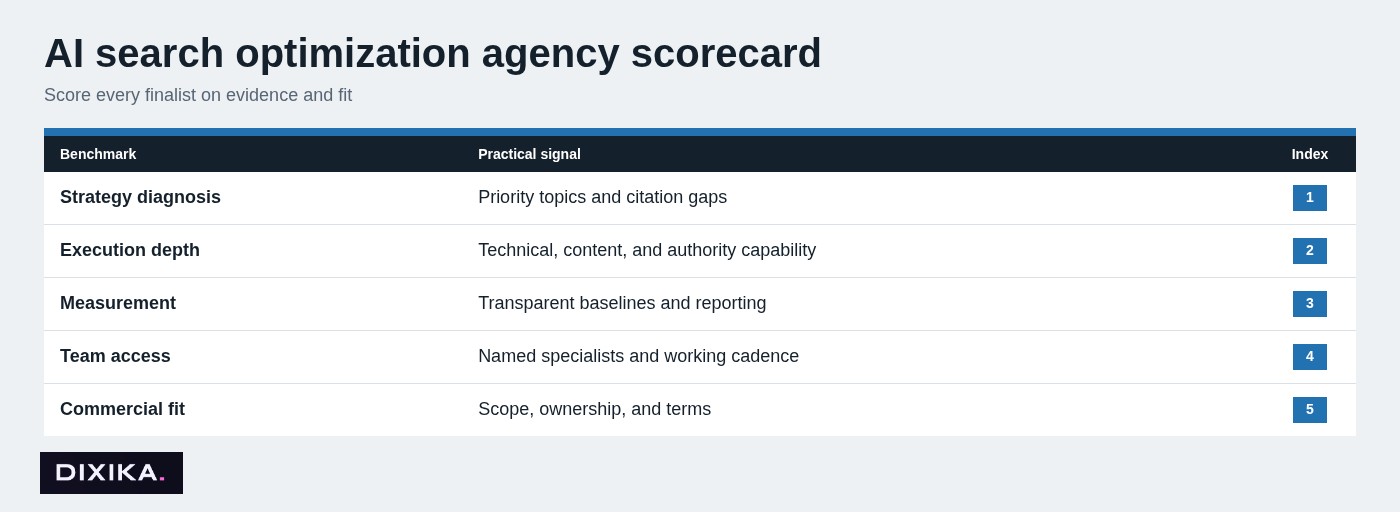
Agency reviews and polished sales materials can be useful, but they are not a substitute for a consistent evaluation process. Score each finalist against the same criteria so the most persuasive pitch does not automatically win.
Use a 1-to-5 scale, where 1 means weak or unproven for your situation and 5 means strong, specific, and supported by evidence. Weight the categories based on your constraints; for example, a site with serious indexation issues should weight execution depth more heavily than a company with a mature technical foundation.
| Evaluation area | What strong evidence looks like | Suggested weight |
|---|---|---|
| Strategy diagnosis | Priority topics, audience intent, competitive citation gaps, and a clear baseline | 25% |
| Execution depth | Practical technical, content, authority, and implementation capabilities | 25% |
| Measurement | Documented prompt set, methodology, source analysis, traffic, and business reporting | 20% |
| Team access | Named specialists, realistic senior involvement, and an agreed working cadence | 15% |
| Commercial fit | Clear scope, ownership, dependencies, terms, and budget alignment | 15% |
The strongest candidate is not necessarily the agency with the biggest claimed platform coverage. It is the one with the best fit for your goals, internal capacity, technical reality, and buying timeline.
Demand Evidence That Matches Your Situation
Case studies should help you evaluate judgment and operating discipline, not just give you a list of large percentage gains. A result can be real and still be irrelevant if the starting condition, sales cycle, site complexity, or available internal resources were completely different from yours.
Ask for examples from comparable business models or constraints. The client does not need to be in your exact industry, but the work should resemble the problems you need solved.
What a Useful Case Study Shows
A useful case study explains the starting condition, strategic choices, work completed, timeline, measurement method, limitations, and outcomes. Ideally, it connects improvements in search visibility to qualified traffic, leads, or revenue rather than stopping at impressions.
Prefer examples that show how the agency improved source pages and why. A single screenshot of a brand appearing in an AI answer is weak evidence because outputs can change quickly and may not reflect a repeatable process.
How to Verify Reviews and References
When reading AI search optimization agency reviews, look for operational detail. Useful reviews mention the quality of strategy, communication, implementation support, reporting, responsiveness, and actual deliverables.
Be cautious with vague five-star testimonials that do not explain what the agency did. Ask to speak with a current or recent client, then ask direct questions about reporting clarity, change management, missed assumptions, team continuity, and what did not go as planned.
A credible reference does not need to describe a flawless engagement. In fact, a balanced account of how the agency handled obstacles is often more valuable.
Ask How the Agency Measures AI Visibility Without Overclaiming
Measurement is one of the largest blind spots in AI SEO comparisons. Many providers present rankings, platform lists, or aggregate visibility claims without explaining the prompts, methodology, or attribution behind them.
Since AI-generated answers vary, reports should show tracked query sets, dates, platforms, locations and languages where relevant, raw examples, and trends over time. The goal is not false precision. It is a transparent view of whether the company is becoming more visible and useful across priority topics.
Metrics Worth Tracking
- Brand mention rate: How often your company appears in a defined set of relevant answers.
- Citation or source inclusion: How often your pages are linked or cited where platforms expose sources.
- Share of relevant answers: Your presence compared with key competitors across a defined topic cluster.
- Answer accuracy: Whether mentions describe your company, offer, and differentiation correctly.
- Referral traffic and engagement: AI-related visits, engaged sessions, and behavior on destination pages.
- Leads and assisted conversions: Commercial outcomes where tracking is sufficiently reliable.
- Organic visibility: Rankings, impressions, clicks, and performance of supporting source pages.
Segment these metrics by topic cluster and intent. A broad score across hundreds of unrelated prompts can hide the fact that your company is absent from the buyer questions that matter most.
Metrics and Promises to Treat Carefully
Guaranteed AI rankings or citations should be an immediate concern. So should isolated prompt screenshots, unexplained "LLM visibility" percentages, traffic projections without stated assumptions, and suggestions that an agency can directly control model-training data.
Ask the agency to explain limitations before you sign. If it cannot describe what its data excludes, how it handles answer volatility, or why it believes a metric matters commercially, its reporting is unlikely to become clearer once performance is under pressure.

Evaluate Team Access, Workflow, and Ownership
Many agency disappointments are operational, not strategic. The sales team may be impressive, but the actual work can be handed to a junior generalist, delayed by unclear approvals, or blocked because no one owns implementation.
Ask who will handle strategy, technical recommendations, writing, editing, outreach, analytics, and day-to-day communication. Distinguish senior oversight from the people doing the work each week.
Clarify ownership in writing. You should know who owns content, analytics accounts, reporting data, documentation, workflows, assets, and any links or placements secured during the engagement. Confirm what happens if the relationship ends.
Also discuss approval cadence, SME interviews, security requirements, implementation dependencies, escalation paths, and expected response times. These details determine whether a solid roadmap becomes actual progress.
Compare Pricing and Scope on an Equivalent Basis
Agency retainers are not comparable until you normalize the scope. One proposal may include strategy only, while another includes technical tickets, editorial production, implementation support, digital PR, reporting, and ongoing content refreshes.
Compare included hours, deliverables, content volume and quality controls, authority-building costs, reporting depth, meeting cadence, implementation responsibility, and contract terms. Low monthly pricing can look attractive because important work has been excluded.
If the baseline is unclear, a paid diagnostic or tightly scoped discovery phase can be a sensible first step. The outputs should be defined in advance: a prioritized audit, topic and citation-gap analysis, recommended roadmap, measurement plan, implementation dependencies, and decision rights.
Do not buy a long retainer solely because an agency promises quick AI visibility. Buy when you understand what the team will do, what your team must do, and how the work supports longer-term search growth.
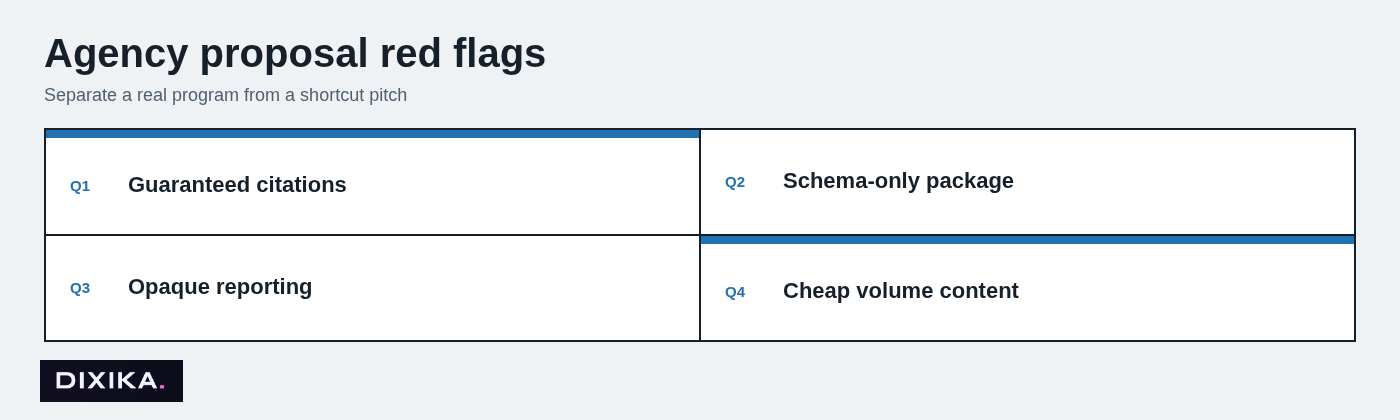
Watch for Red Flags in AI Search Optimization Services
AI search optimization is new enough that vague claims can sound sophisticated. The simplest test is whether the provider can explain trade-offs, dependencies, and limitations as clearly as it explains upside.
- Guaranteed citations or rankings: No agency controls every model output or platform decision.
- Secret proprietary tactics: A provider does not need to reveal every process detail, but it should explain the strategic logic and deliverables.
- Generic AI-written content at scale: Volume without evidence, expertise, review, or useful differentiation rarely creates strong source pages.
- One-time schema-only packages: Markup can support understanding, but it cannot replace technical health, content quality, and authority.
- Opaque link acquisition: If you cannot understand how placements are earned, assume there may be quality or compliance problems.
- No baseline: Without an initial view of sources, prompts, competitors, traffic, and pages, progress claims are difficult to audit.
- Reports without methodology: If you cannot see the prompt set, dates, platform conditions, or raw examples, treat summary scores cautiously.
A positive sign is an agency that tells you what it will not promise. That level of restraint usually reflects a more mature understanding of the work.
Run a Focused Discovery Call and 30-Day Evaluation
Once you have a shortlist, send each finalist the same brief. Include your business priorities, priority markets, key products, current SEO constraints, internal resources, and the topic clusters you want to improve.
Score written responses before discovery calls. Then ask each agency to walk through its diagnosis and first-month plan, not a promise of guaranteed placement.
A strong 30-day evaluation should produce a prioritized audit, topic and citation-gap view, source-page recommendations, technical dependencies, measurement design, named delivery team, timeline, and estimated effort. It should also make clear what requires client input or engineering support.
Judge early work by the quality of diagnosis, prioritization, documentation, and execution readiness. Immediate changes in volatile AI answers can be encouraging, but they are not the most reliable measure of whether the agency has built the right program.
Choose the Right Agency Model for Your Situation
Rather than searching for a universally "best AI SEO agency," choose the model that matches your internal strengths and primary constraint.
Choose a Full-Service Search Growth Partner if You Need Integrated Execution
This model fits teams that need technical SEO, content, authority building, and measurement coordinated around shared commercial goals. It is particularly useful when the problem spans multiple disciplines and no internal owner can stitch the work together.
Dixika is a fit to evaluate for companies seeking an integrated search-growth approach spanning technical SEO, content marketing, link building, Reddit strategy, and AI/LLM visibility work. Its approach is most relevant when a team needs an audit-led roadmap followed by ongoing execution and iteration.
The trade-off is that integrated work requires collaboration. Your team will need to provide access, product knowledge, approvals, and implementation support for the program to move at the right pace.
Choose a Specialist if Your Core SEO Program Is Already Strong
Choose a specialist when your in-house team or incumbent agency already handles technical SEO, content, and authority work well, but you need focused AI visibility auditing, tracking, or advisory support.
Before hiring, verify the handoff. The specialist's recommendations are only valuable if someone has the capacity and authority to implement them within the existing program.
Choose a Technical or Content-Led Partner When One Constraint Dominates
A technical-led partner can be the right choice when crawl, indexation, rendering, platform, or site-architecture issues are clearly limiting every other effort. A content-led partner can make sense when your main problem is weak expertise, insufficient topical coverage, unclear buyer education, or poor first-party evidence.
Do not assign an AI visibility outcome to a narrow provider if the root issue is broader. A technically perfect site with no credible content or authority will still struggle, just as excellent content cannot compensate for pages that search systems cannot reliably access.
Make the Selection Based on a Verifiable Plan, Not an AI Visibility Promise
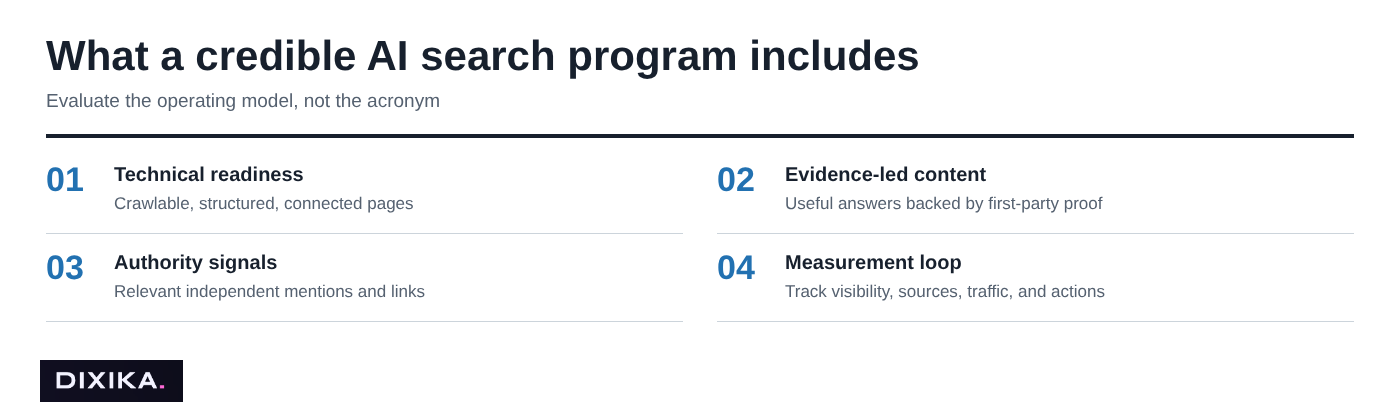
Choose the agency that can move from a measurable baseline to prioritized work, transparent reporting, and accountable execution. It should explain how technical readiness, evidence-led content, authority signals, and ongoing measurement reinforce one another.
Pick a full-service search growth partner if you need coordinated execution across SEO, content, authority, and AI visibility. Pick a specialist if your current search program is strong and you need a focused layer of expertise. Pick a technical or content-led partner if one clearly diagnosed constraint is holding the whole program back.
If you need an integrated AI search and SEO growth plan grounded in technical foundations, useful content, authority building, and measurable progress, explore Dixika's search growth services.