Most beginners hear that backlinks matter, then get pushed toward shortcuts: directory submissions, bulk emails, or cheap packages promising hundreds of links. That is how sites end up with a pile of low-value mentions and no meaningful improvement in search visibility.
SEO link building is simpler than the hype suggests. It is the process of earning links from relevant websites to useful pages on your own site, usually because your page helps the other site's readers.
What is SEO link building?
SEO link building is the practice of earning relevant hyperlinks from other websites to pages on your website. In digital marketing, those links can help search engines discover your pages, understand what your site is about, and assess whether other credible sources consider your content worth referencing.
The important word is earning. You can place a link in a forum profile, a random directory, or a blog comment, but that does not make it a valuable SEO link. Strong links tend to appear naturally within useful editorial content, on pages related to your topic, where readers have a real reason to click.
For example, imagine your company publishes original research on how buyers evaluate software vendors. A respected industry publication writes an article about procurement trends and links to your research as a source. That is a useful editorial backlink: it supports the publisher's point and sends interested readers to a relevant page.
Quality, relevance, and context matter far more than raw link volume. Ten links from genuinely relevant sites can be more useful than hundreds from unrelated, low-quality pages.
What is an SEO link?
An SEO link is a hyperlink that points from one page to another and can help users and search engines navigate the web. When people discuss link building, they usually mean an external link from another website to yours.
An external link has four basic parts:
- Referring page: the page where the link appears.
- Anchor text: the clickable words, such as "software procurement research."
- Destination URL: the exact page the visitor reaches after clicking.
- Context: the surrounding sentence or section explaining why the link is relevant.
Internal links, which connect pages on your own website, are also important. They help visitors navigate and help search engines understand your site structure. But internal linking is not usually what marketers mean by backlink-focused link building, because you control both ends of the connection.
What is the difference between link building and backlinks?
A backlink is the link itself, while link building is the ongoing process of earning, attracting, or reclaiming backlinks. Think of a backlink as one result and link building as the work that creates the result.
Not every backlink is actively built. A journalist may find and cite your study without contacting you. A customer may mention your tool in a resource list. Those are naturally earned links. Link building includes creating the kind of content that attracts those citations, as well as responsibly making relevant people aware that the resource exists.

Why do backlinks still matter for SEO in 2026?
Yes, backlinks are still relevant for SEO in 2026, but they are only one part of how search engines evaluate a page. Search performance also depends on useful content, technical accessibility, page experience, topical relevance, and whether your site demonstrates credible expertise.
A good backlink can help in several ways. Search engines may discover a new page through a link. The link can provide a signal that another source found the destination useful. It may also deliver referral traffic from real people who click through. That same outside-source footprint can matter in AI-assisted search experiences, where clear entities, useful sources, and credible citations are increasingly important.
Links do not guarantee rankings. A weak page will not become useful because it receives a few backlinks, and not every link carries the same weight. A relevant editorial citation from a trusted publication is fundamentally different from a link buried on an unrelated page created only for SEO.
How Google evaluates a useful link
A useful link is one that makes sense for readers before it makes sense for SEO. Search engines can consider many signals around a link, including:
- Topical relevance: Does the referring page cover a related subject?
- Editorial placement: Was the link included in the body of useful content rather than added to a low-value footer or profile?
- Source quality: Is the referring site credible, maintained, and useful to its audience?
- Natural anchor text: Do the clickable words accurately describe the destination without awkward keyword stuffing?
- Destination usefulness: Does the linked page genuinely help a reader who wants more detail?
You may also see link attributes such as nofollow, sponsored, and ugc. These are labels that give search engines more context about a link. A nofollow link is not automatically bad; it can still bring qualified visitors and brand awareness. Sponsored links should be properly identified when compensation is involved, and UGC generally refers to user-generated content such as forum posts or comments.
What are the main types of link building in SEO?
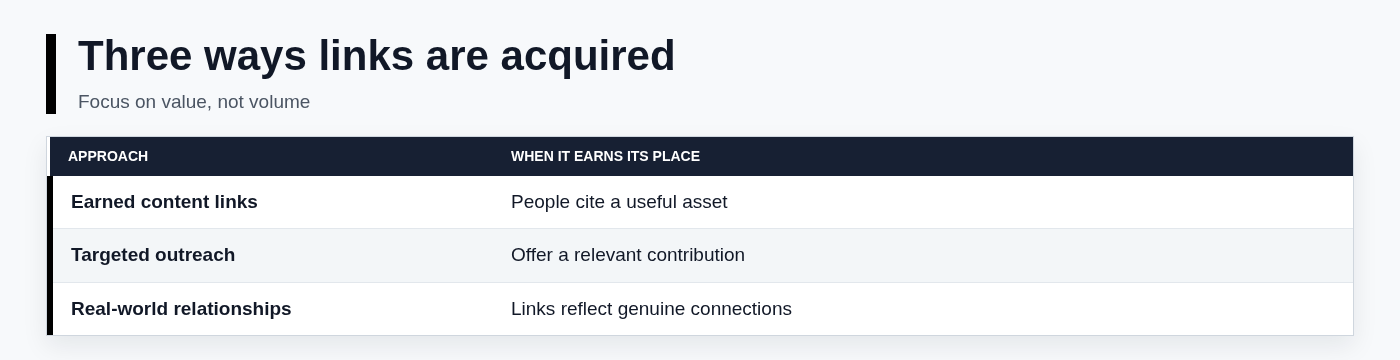
The main types of link building are earned editorial links, targeted outreach, and links based on real relationships or resources. Sustainable strategies focus on value and relevance, not on finding the fastest way to place a URL.
Earned links through linkable content
Linkable content is a page people want to cite because it gives them something useful to support their own work. This can include original data, expert commentary, a free calculator, a well-maintained template, a definitive resource, or a guide that answers a difficult question better than existing alternatives.
Here is a simple link building example: a payroll provider surveys 1,000 small business owners about hiring plans and publishes the results with clear methodology. A trade publication covering small business trends cites the report in its article. The publication gets evidence for its story, while the payroll provider earns a relevant editorial link.
Outreach and digital PR
Outreach means contacting a relevant publisher, creator, journalist, or organization with a specific reason your resource could help their audience. It is not sending the same "please link to us" email to 5,000 websites.
Digital PR often centers on a newsworthy angle, original data, or expert insight. Other legitimate approaches include pointing out an unlinked mention of your brand or suggesting a replacement for a broken resource, but only when your page materially improves the publisher's content.
Beginner mistake: Treating outreach as a volume game. Avoid this by researching each prospect first and explaining exactly why your page fits one particular article, audience, or gap.
Partnership, community, and resource links
Real-world relationships can produce legitimate links when there is a genuine connection and audience benefit. Examples include industry associations, suppliers, event sponsorships, local organizations, universities, partner pages, and carefully curated resource lists.
A local accounting firm, for instance, might be listed on a chamber of commerce website because it is an active member. That link reflects a real relationship. By contrast, submitting the firm to hundreds of generic directories is rarely a strong authority strategy.
Forum profiles, blog comments, and self-created directory listings may have limited practical value in certain situations, but they should not be the foundation of your SEO strategy. This connects to the question above about useful links because search engines and readers both benefit when a link exists for a clear reason.
Which SEO link building techniques should beginners avoid?
Link building itself is not illegal, but manipulative link practices can violate search-engine spam policies and may create advertising or disclosure problems when paid relationships are hidden. The likely outcomes range from ignored links and wasted budget to lost trust, ranking declines, or manual action in serious cases.
There is no need to panic over every imperfect backlink. The goal is not a perfectly clean-looking profile. The goal is to avoid deliberately building links whose only purpose is to manipulate rankings.
Risky tactics that create poor-quality links
Risky link tactics are designed to manufacture ranking signals rather than help an audience. Common examples include:
- Buying undisclosed links specifically to manipulate rankings.
- Private blog networks, often called PBNs, created mainly to link to other sites.
- Automated link blasts across comments, profiles, and low-quality pages.
- Irrelevant guest-post networks that publish thin articles solely to insert links.
- Keyword-stuffed anchor text repeated across many sites.
- Deceptive reciprocal-link arrangements with no real editorial value.
Paying for a legitimate sponsorship, advertorial, or partnership is not automatically wrong. The problem arises when payment is used to disguise ranking manipulation. Paid relationships should be transparent and appropriately qualified with sponsored link attributes where needed.
Common link building mistakes
The most common link building mistake is chasing metrics instead of relevance. A site may appear impressive in a third-party tool, yet still be a poor fit for your audience, industry, or destination page.
Other common mistakes include sending every link to the homepage, using generic outreach templates, promoting pages that offer nothing distinctive, and reporting only the number of links acquired. A better quality check is simple: would this publisher still reasonably include the link if search engines did not exist?
Poor SEO is not just "bad backlinks." It is any approach that prioritizes loopholes over helping users, ignores technical basics, publishes thin content, or measures activity instead of business outcomes.
How do you start link building as a beginner?
Start link building by improving one page that deserves citations, then identify a small group of relevant people who would genuinely find it useful. You do not need expensive software, a huge email list, or a complicated campaign to begin.
1. Choose one page that deserves citations
Pick one focused page that gives people a clear reason to reference it. It might contain original evidence, a useful template, a calculator, expert insight, or a better explanation of a specific problem than currently available results.
Before promoting it, check that the page is accurate, indexable, easy to read, and linked from relevant pages on your own site. It should also match a topic your business can credibly own. Asking for links to a generic service page is usually much harder than promoting a resource with clear standalone value.
2. Build a small, relevance-first prospect list
Look for publishers, organizations, resource pages, journalists, partners, and creators whose audience would benefit from your page. Start with 20 to 30 carefully reviewed prospects rather than hundreds of loosely related domains.
For each prospect, record the exact page or topic, the person or contact route, and your specific reason for reaching out. This makes your outreach more useful and prevents the beginner mistake of sending the same vague message to everyone.
3. Make a specific, helpful outreach offer
A good outreach message explains the benefit to the recipient's audience before it mentions your own goal. Keep it short, refer to the relevant page, and offer a precise resource, data point, expert contribution, or correction.
Do not demand a link. Give the recipient enough information to decide whether the resource improves their content. Track replies, live links, referral visits, and patterns in non-responses. Over time, that record will tell you which topics and angles earn attention.

Do you need link building tools or an SEO link building company?
No, you do not need paid tools or an agency to start link building, but they can save time as your work becomes more competitive or complex. DIY link building can begin with search research, a spreadsheet, strong content, and careful outreach.
Costs vary widely. Paid SEO tools, content production, digital PR, and agency services depend on your industry, the quality of the target publications, how much original content is required, and the level of strategy involved. Be skeptical of anyone who sells guaranteed rankings or a fixed number of links without explaining where those links come from.
Tools can speed up prospecting, backlink audits, and measurement. They cannot make an irrelevant pitch compelling or turn a weak page into a source worth citing. When evaluating SEO services for link building, ask about their methods, examples of relevant placements, reporting transparency, content standards, and treatment of sponsored links.
When DIY link building makes sense
DIY link building makes sense for early-stage sites, local businesses, niche experts, and teams willing to create useful assets and build relationships. It is especially practical when you have firsthand knowledge that larger publishers may want to quote or cite.
Can ChatGPT do SEO? It can assist with research organization, content angles, prospect-list cleanup, and drafting personalized outreach. It cannot replace human fact-checking, a credible source, or a genuine relationship. Use AI to reduce repetitive work, not to mass-produce shallow pages and generic emails.
Can you do SEO yourself? Yes, especially the fundamentals: technical checks, useful content, internal links, and relevance-first outreach. The four common areas of SEO are technical SEO, on-page SEO, off-page SEO, and local SEO. Link building sits mainly within off-page SEO, while the other areas make sure your site is accessible and useful once visitors arrive.
When outside help is worth considering
Outside help is worth considering when your team lacks outreach capacity, needs digital PR expertise, or competes in a market with demanding editorial standards. A capable partner should connect technical SEO, content quality, authority building, and measurement instead of treating links as an isolated commodity.
Avoid any link building company that cannot explain its sourcing process, relevance criteria, editorial standards, or handling of paid placements. Teams that need a broader system spanning technical SEO, content, authority building, and AI-search visibility can explore Dixika and review our services.
Ahrefs
Ahrefs is useful for inspecting backlink profiles, referring domains, and the pages that attract links. Its backlink checker can help beginners understand what kinds of sites already link to a domain and identify patterns in competitors' cited content.
The main limitation is that backlink data is directional, not a perfect record of the web. Treat tool metrics as research clues, then manually review the actual referring pages for relevance and quality. Ahrefs is most helpful once you have enough content and outreach activity to need faster analysis rather than relying only on manual searches.
How can you tell whether link building is working?
Link building is working when it contributes to better visibility, qualified traffic, and business results, not merely when your backlink count rises. A new link can be valuable even if it does not immediately change rankings, particularly when it reaches the right audience or strengthens a useful page's discoverability.
Review progress monthly and connect your link activity to meaningful measures:
- New referring domains and whether they are relevant to your topic.
- The quality and editorial placement of earned links.
- Referral traffic from linking sites.
- Search impressions and rankings for the pages receiving links.
- Leads, sign-ups, inquiries, or sales where measurement is available.
Search engines need time to crawl, index, and evaluate pages, while competitive rankings can move slowly. Do not judge a campaign after a few days. Look for patterns over several months, such as stronger visibility for your best resource pages, more qualified referrals, and an expanding group of relevant sites citing your work.
SEO is not outdated, and it is unlikely to be simply replaced by AI. Search behaviors and interfaces are changing, but people and systems still need reliable information, accessible websites, and credible sources. The practical question is whether your SEO work helps make your business easier to find and trust wherever people search.
Build links people would choose to cite
The best beginner link building strategy is to publish something genuinely useful, find the people it can help, and earn mentions that make editorial sense. Start with one page, one audience, and a small set of carefully chosen prospects. That disciplined approach is more durable than any shortcut.
If a potential link would help neither the publisher nor its readers, it is probably not worth pursuing. Build resources people want to reference, and your link profile can grow as a byproduct of being useful.