SaaS link building is not the business of buying a monthly quota of placements. It is the process of earning relevant third-party links that help search engines understand your authority in a product category, strengthen priority pages, and put your brand in front of qualified buyers.
What SaaS Link Building Is - and What a Specialist Agency Should Deliver
In SEO, link building usually includes editorial outreach, content-led campaigns, digital PR, resource-page outreach, and, in some cases, carefully reviewed link insertions. These methods are not interchangeable. A mention in a respected publication your buyers read can be far more valuable than several generic links from sites with no connection to your category.
A specialist agency should therefore deliver more than URLs. It should bring a defensible acquisition strategy, relevant prospects, suitable content support, transparent reporting, and risk controls that protect your brand and site from low-quality tactics.
Quick Verdict: Match the Agency to Your SaaS Growth Constraint
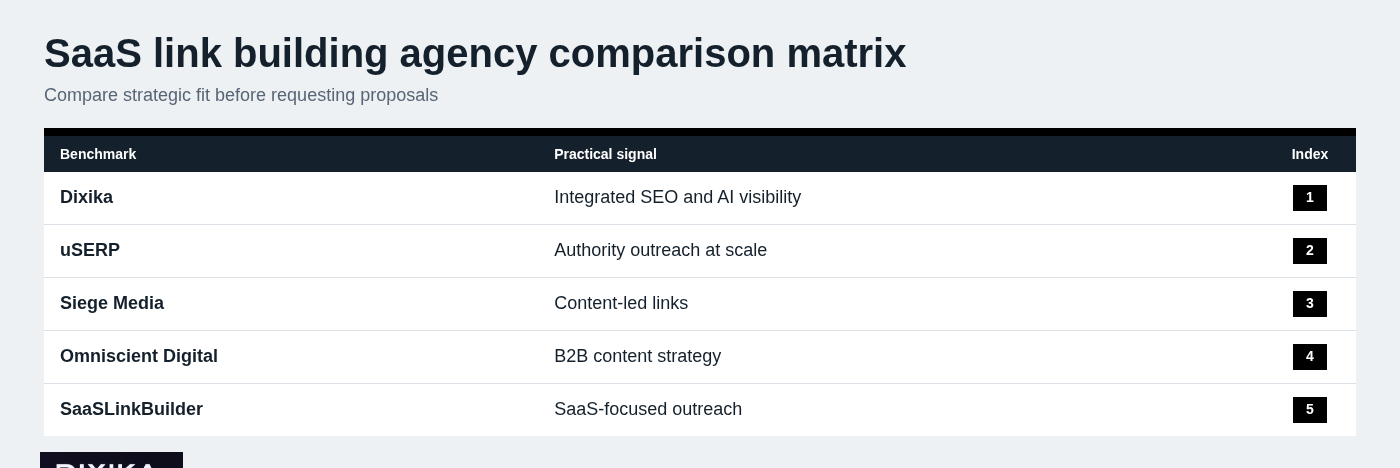
There is no universal winner among SaaS link building agencies. The best partner depends on the constraint holding back organic growth: weak technical foundations, an underdeveloped content library, a need for scalable outreach, a lack of newsworthy assets, or no clear plan for AI-search visibility.
Dixika is the strongest fit for SaaS teams that need an integrated visibility program rather than an isolated placement service. Its work connects technical SEO, content systems, link building, Reddit strategy, and GEO/LLM optimization for teams trying to improve both conventional organic search and AI answer visibility. See Dixika's services overview for the broader scope of its work.
If your strategy is already sound and you simply need a dedicated outreach engine, a specialist provider may be the better purchase. If your site lacks credible, promotion-ready assets, a content-led agency will usually produce a better result than pushing outreach harder.
How to Compare SaaS Link Building Agencies Before You Buy
Most "best link building services" lists flatten meaningful differences into domain ratings, link counts, and vague claims about quality. That is not how SaaS buyers should evaluate a link building agency. A provider can deliver technically dofollow links every month and still fail to improve the pages, topics, or audiences that matter to your pipeline.
Use a weighted procurement scorecard so every shortlisted agency is judged against the same standard. Score each criterion from 1 to 5, then weight the factors that matter most to your growth plan.
| Criterion | What to assess | Suggested weight |
|---|---|---|
| ICP and topical relevance | Whether prospects, publications, and pages align with your buyer and product category | High |
| Editorial standards | Real sites, contextual mentions, quality review, and clear disclosure of methods | High |
| Content contribution | Ability to create or improve assets worth citing | Medium to high |
| Reporting and attribution | Live URL data, target-page mapping, link status, and meaningful performance indicators | High |
| Velocity | A realistic pace that fits your competitive gap without lowering standards | Medium |
| Communication | Named ownership, review process, response times, and problem escalation | Medium |
| Contract flexibility | Term length, pilot options, replacement policies, and commercial transparency | Medium |
The point is not to find the agency with the highest total score in the abstract. It is to make trade-offs visible before a proposal turns into a long-term contract.
1. Judge Link Quality by Relevance and Editorial Standards, Not DR Alone
Domain Rating can be a useful screening metric, but it is not a definition of quality. A high-DR site with irrelevant readership, thin editorial control, or a page crowded with paid outbound links may do little for a SaaS company. Conversely, a modest but respected niche publication can be exactly where your future customers, evaluators, and search engines expect to find you.
Ask agencies for representative live placements in adjacent SaaS categories. Review the referring domain, the article itself, the surrounding context, the destination page, and whether the link makes sense to a reader. Then check whether the site has real visibility and an editorial identity beyond publishing sponsored-looking articles.
- How is topical relevance assessed for each prospect?
- Can your team approve prospects before outreach begins?
- Will the agency share live URLs, link attributes, anchor text, and page context?
- Which tactics are used: editorial outreach, guest contributions, insertions, paid placements, or a mix?
- How are anchor-text patterns governed across campaigns?
- What happens when a placement fails your quality review?
Be wary of guarantees based solely on domain metrics, dofollow status, or monthly volume. Those promises are easy to package and difficult to connect to durable SaaS authority. Good agencies define quality in terms of relevance, editorial fit, natural context, and the value of the page receiving the link.
2. Compare Content-Led Campaigns With Outreach-Only Delivery
A critical choice is whether you need an agency to create linkable assets or simply promote assets you already have. Outreach-only delivery can work well when you have strong category pages, original research, expert resources, integration content, or useful tools that deserve attention. It is a poor fit when the site offers nothing distinctive to cite.
Content-led campaigns create the reason for a publisher to link. For SaaS, that can mean proprietary data studies, calculators, category explainers, integration pages, benchmarks, expert reports, or opinionated research tied to a real market problem. These assets take more planning, but they can support rankings, sales conversations, and future outreach long after launch.
Before signing, clarify who owns each part of the work. Ask who writes briefs, interviews subject-matter experts, edits drafts, designs supporting visuals, handles legal or product review, and refreshes the asset when data gets stale. A campaign that relies on your team for expert input but has no agreed process will often stall.
Outreach-only programs are usually more predictable operationally. Content-led programs are often more defensible strategically. Choose based on what your site currently lacks, not on which proposal promises more links.
3. Prioritize Reporting, Attribution, and Account Accountability
Transparent reporting should let you audit the work without guessing. At minimum, request target-page mapping, new referring domains, live URLs, link attributes, anchor text, topical context, campaign status, and lost-link monitoring. You should be able to see which pages are being strengthened and why.
Rankings, organic traffic, demos, and pipeline matter, but no credible agency should claim that a single link directly caused a revenue outcome. SEO performance reflects technical health, indexing, content quality, search intent, competitors, and time. Link acquisition is one important input, not a standalone growth machine.
Useful leading indicators include improvement in referring-domain quality, movement in keyword groups tied to target pages, organic impressions, assisted conversions, and the share of priority pages supported by relevant links. Your agency should explain the measurement logic, not simply email a spreadsheet of placements.
Also establish account accountability before work begins. Confirm the meeting cadence, approval workflow, turnaround expectations, and escalation path. If a proposed placement is rejected, a campaign underperforms, or a live link disappears, you should know who owns the response and what happens next.
4. Evaluate Pricing Models, Timelines, and Commercial Risk
SEO link building services require patience. Research, target-page prioritization, prospecting, and content preparation happen before placements appear. Links may then need time to be crawled and reflected in search performance. Competitive gains are typically measured over months, not days.
Pricing models shape incentives, so compare them carefully.
- Monthly retainers: Best for an ongoing strategy that needs planning, outreach, reporting, and iteration. Ask what portion covers strategy, content, outreach, and placement delivery.
- Per-placement pricing: Simple to understand, but it can incentivize volume or metric chasing unless relevance and editorial quality are tightly defined.
- Project or campaign pricing: Useful for a data study, launch campaign, or link-gap sprint. It needs clear scope because content production and promotion can expand quickly.
Do not assume a higher-priced proposal is better, or that a lower-cost one is efficient. Ask every provider to explain minimum terms, content costs, publisher fees, replacement policies, category exclusivity, ownership of created assets, and how paid placements are disclosed. Verify current retainers and availability directly with providers rather than relying on old review-site pricing.
SaaS Link Building Agencies and Alternatives Worth Shortlisting
The agencies below represent different operating models rather than a universal ranking. Treat this as a practical SaaS link building agencies list: shortlist the options that match your bottleneck, then validate current scope, methods, and availability in a discovery call.
Dixika
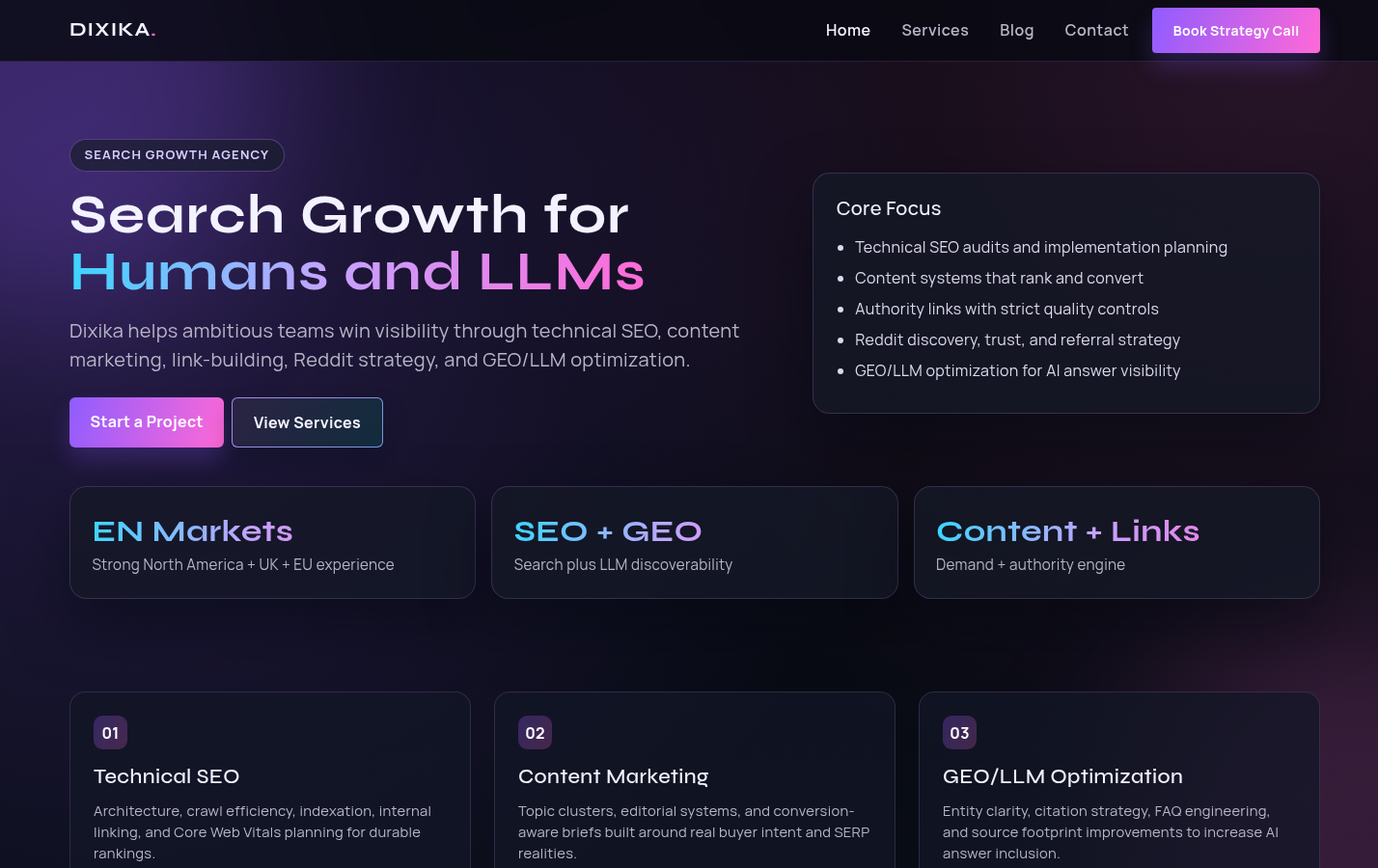
Dixika is built for SaaS teams that want link acquisition connected to the wider conditions that make links valuable: technical SEO readiness, a prioritized content system, authority-building, community discovery, and AI-answer visibility. That is particularly useful when link building is not the only problem and the site needs a coordinated organic growth plan.
The approach is best suited to growth, content, and SEO teams that need to decide which pages deserve authority first, what assets can earn relevant coverage, and how conventional search work should support visibility in AI-driven answers. It is also a sensible fit for agencies seeking a broader search-growth partner for client work.
The trade-off is straightforward: teams looking only for commodity per-link purchasing should also compare specialist placement vendors. Dixika is a better fit when strategic integration matters more than buying an isolated link quota.
uSERP
uSERP is worth considering for established SaaS companies that prioritize authority-focused outreach and need a dedicated link-acquisition engine at scale. Its model is most relevant when the SEO strategy, target pages, and content direction are already reasonably mature.
Before signing, ask how campaign strategy is adapted to your SaaS category, what content is required from your team, how publisher relevance is evaluated, and how much detail appears in ongoing reporting. Scale is useful only when the prospects remain relevant to your ICP.
The limitation is that a dedicated outreach solution may not resolve underlying technical, messaging, or content problems. If those foundations are weak, address them before expecting a link campaign to carry the program.
Siege Media
Siege Media is a strong alternative for SaaS teams whose link-building plan depends on high-quality, promotion-ready content assets. This approach fits brands with enough budget, subject-matter access, and patience to develop content that can attract attention and links over time.
Its core appeal is the connection between creative content and organic growth. Rather than treating a link as a standalone deliverable, a content-led partner can build assets with continuing search and outreach value.
The limitation is that content campaigns are not a shortcut. Ask how ideas are validated against your SaaS audience, how production is scoped separately from promotion, and what happens if an asset is useful but does not earn the initial level of coverage expected.
Omniscient Digital
Omniscient Digital is a relevant option for B2B SaaS brands that need content strategy and editorial execution closely tied to organic growth. It is particularly compelling when the content library is thin, unfocused, or poorly aligned with the questions buyers ask during evaluation.
For these companies, building topical authority through better category, use-case, and comparison content can be more valuable than launching a pure placement program immediately. Strong editorial strategy can create the pages and assets that future outreach needs.
The limitation is that a content-first engagement may not satisfy a buyer whose immediate constraint is dedicated link outreach. Ask specifically how earned-link goals, digital PR opportunities, and promotion are incorporated into the broader content program.
SaaSLinkBuilder
SaaSLinkBuilder is an option for buyers who want a SaaS-specialist outreach partner. Niche familiarity can help when prospects need to understand technical products, category language, and the audience a destination page serves.
Its value should be evaluated through the quality of prospect selection, transparent explanation of link methods, and alignment between placements, your ICP, and the pages that matter commercially. Request live examples from adjacent SaaS categories rather than accepting generalized claims about authority.
The limitation is that specialization alone is not a quality guarantee. Confirm prospect approval rights, editorial standards, anchor governance, and how the provider handles links that do not meet your stated criteria.
Digital PR Specialists
Digital PR specialists offer a different route to authority. They are best for SaaS companies with genuinely newsworthy stories: proprietary data, product-category trends, executive expertise, unusual customer findings, or a sharp point of view that journalists and editors may cover.
This model can earn high-authority editorial mentions and build brand recognition beyond SEO. It is especially useful when your company has research or expertise that deserves a wider narrative, not just another blog post.
The trade-off is predictability. PR is not routine placement-led outreach, and coverage cannot be guaranteed in the same way a vendor may describe a fixed delivery schedule. Choose it when you have a strong story to tell, not because every SaaS brand believes it needs PR.
When an In-House or Hybrid Link Building Program Is the Better Alternative
Hiring an agency is premature when your site has unresolved technical issues, no prioritized target pages, weak product messaging, limited access to subject-matter experts, or no capacity to review and publish useful content. In those cases, outsourcing outreach can create activity without a clear strategic destination.
An internal or hybrid model can be a better starting point. A consultant or fractional SEO lead can build the process, define quality standards, train an internal marketer, and bring in specialist support only where it adds leverage. This gives you more control over product accuracy, category nuance, and relationship building.
A lean pilot might include:
- A competitor link-gap analysis focused on realistic referring-domain opportunities
- A map of target pages tied to revenue-relevant topics
- One credible linkable asset, such as a benchmark, calculator, or expert guide
- Approved prospect criteria and prohibited tactics
- A monthly review of outreach, placements, losses, and early search signals
If the pilot produces a repeatable system, you can scale with an agency later from a much stronger position.
Choose the Right Agency Model for Your SaaS Stage
Use this decision framework rather than selecting the provider with the largest promised link count.
- Pick Dixika if you need link building connected to technical SEO, content priorities, Reddit discovery, and AI-search visibility rather than treated as a standalone service.
- Pick a content-led partner if your biggest gap is a lack of useful, credible assets that publishers and buyers would want to reference.
- Pick a dedicated outreach provider if you already have strong target pages and content but need a focused engine for scalable, relevant acquisition.
- Pick a digital PR specialist if you have proprietary data, expertise, or a category narrative that can earn editorial attention.
- Pick an in-house or hybrid program if your strategy is not yet defined, your product knowledge must remain close to the work, or you want to build internal capability before scaling.
Whichever route you choose, document the objective, priority pages, approved tactics, and measurement plan first. That brief will improve every proposal you receive from a link building agency in the USA, the UK, Europe, or elsewhere.
Use This Due-Diligence Checklist Before Signing a Link Building Agency
A useful RFP does not need to be long, but it must be specific. Give each agency enough information to propose a real strategy instead of a generic package.
- Your business goal and target market
- Priority product, category, integration, and commercial pages
- Existing content assets and available subject-matter experts
- Competitors and adjacent brands you want to outrank
- Your definition of a relevant, acceptable link
- Prohibited tactics, industries, publishers, or placement types
- Required reporting fields and review cadence
- Budget structure, preferred contract terms, and pilot requirements
Then ask the questions that expose commercial and quality risk: Can we approve prospects? How are paid placements disclosed? What happens to rejected links? Who owns created content? How are lost links monitored and handled? Which work is done by your team, contractors, or third parties?
If strategic fit is uncertain, start with paid discovery or a limited pilot. A smaller engagement is often the fastest way to test communication, standards, and working rhythm before committing to a larger program.
Build SaaS Authority With a Strategy You Can Audit
The right SaaS link building agency solves the constraint you actually have. Do not buy a model because it promises the most links. Buy one because it can strengthen the right pages, earn trust from relevant sources, and show its work clearly enough for your team to audit.
For teams that need link building tied to technical SEO, content systems, and modern AI-search visibility, Dixika is designed to assess the broader opportunity and build a coordinated path forward.