
Marketing plans often fail for a simple reason: they are built around one forecast as if it were guaranteed. Conversion rates move, auction prices spike, demand shifts, and a channel that looked efficient on Monday can look very different by month end.
Stochastic optimization gives marketers a more realistic way to choose. Instead of asking, "What allocation wins if our forecast is exactly right?" it asks, "Which decision performs well across the range of outcomes we could reasonably face?"
Start with the Marketing Decision, Not the Algorithm
Stochastic means involving chance, randomness, or variable outcomes. It is commonly pronounced "stuh-KAS-tik." In marketing, stochastic behavior is everywhere: two identical days of ad spend can produce different click volumes, conversion rates, lead quality, and revenue.
Stochastic optimization is the process of finding a decision that performs well when important inputs are uncertain. That decision could be a paid-media allocation, bid range, promotional offer, publishing priority, forecast range, or experiment plan.
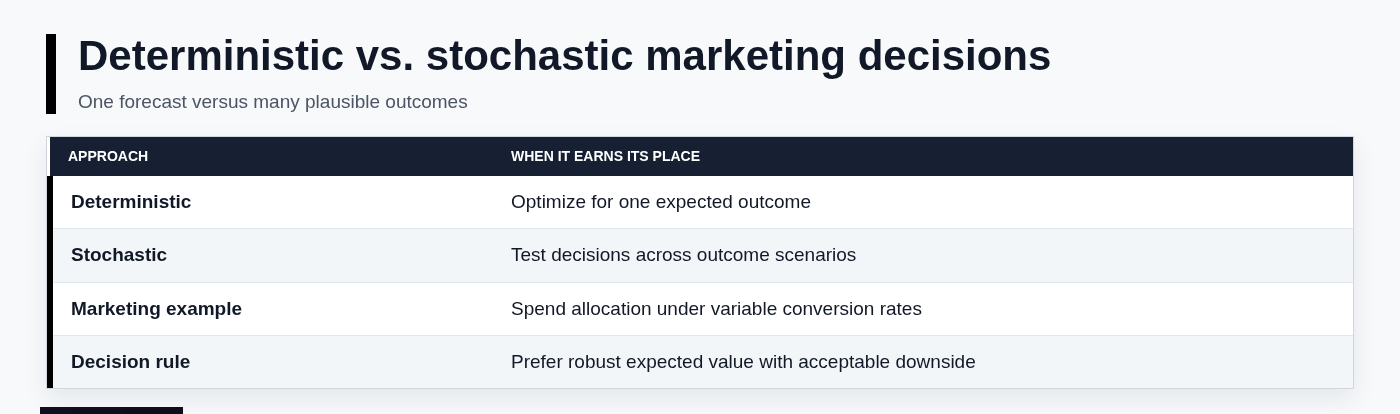
The opposite is deterministic optimization. A deterministic model assumes the inputs are fixed: spend $10,000, get a known number of clicks, convert at a fixed rate, and receive a predictable return. Given the same inputs, it produces the same answer every time. That can be useful for a quick baseline, but it is rarely enough for a real budget decision.
Stochastic thinking replaces a single-point forecast with a distribution of plausible futures. Rather than optimizing for one assumed conversion rate, you test a decision against many possible conversion rates, costs, and demand levels. The preferred option is usually the one with strong expected value and downside the business can tolerate.
Define the Objective Function and Constraints
Do not begin with "get more leads." That is an aspiration, not an optimization problem. Start by stating the decision, outcome, time horizon, and boundaries in operational terms.
For example: "Allocate $50,000 of paid-media budget over the next 30 days to maximize expected contribution margin while keeping the probability of CAC exceeding $400 below 20%."
That statement contains an objective function: maximize expected contribution margin. It also contains a risk constraint: limit the likelihood of breaching the CAC threshold. The possible channel allocations are your decision variables.
Common marketing constraints include:
- Total available budget.
- Channel minimums or caps, such as a $5,000 minimum needed to keep a campaign learning.
- Creative, sales, or landing-page capacity.
- Brand-safety exclusions and geographic restrictions.
- Target CAC, payback period, margin, or qualified-pipeline requirements.
- Diminishing returns when additional spend reaches weaker audiences.
This is constrained optimization: finding the best answer while honoring real operating limits. Some textbook problems are linear, meaning a fixed increase in spend always creates a proportional increase in results. Marketing rarely behaves that way. Response curves are usually nonlinear, uncertain, and subject to saturation.
Convex optimization can be highly efficient when a problem has the required mathematical structure, but most teams should not force their media data into a convex model just because the method is elegant. Use a model that reflects the decision well enough to improve it.
Choose a Metric That Reflects Incremental Value
Last-click ROAS is often a poor standalone objective. It can reward channels that harvest existing demand while under-crediting channels that create demand or assist conversions. It can also look better during a seasonal spike even if the channel itself did not cause the increase.
Choose one primary outcome and define it precisely. Useful choices include expected contribution margin, incremental conversions, qualified pipeline value, or expected revenue after fulfillment and sales costs. Then document the cost definition: media spend only, or fully loaded acquisition cost?
Set a decision horizon, such as 14 days for a short promotion or one quarter for content prioritization. Add guardrails that stop a superficially attractive answer from damaging the business: CAC, sales acceptance rate, average margin, frequency, unsubscribe rate, or lead-to-opportunity conversion.
Model the Uncertainty That Can Change the Decision
A stochastic effect is simply the effect of randomness on an outcome. In a campaign, that may be a sudden change in CPC, a week of weaker lead quality, or an unusually high conversion day that does not repeat.
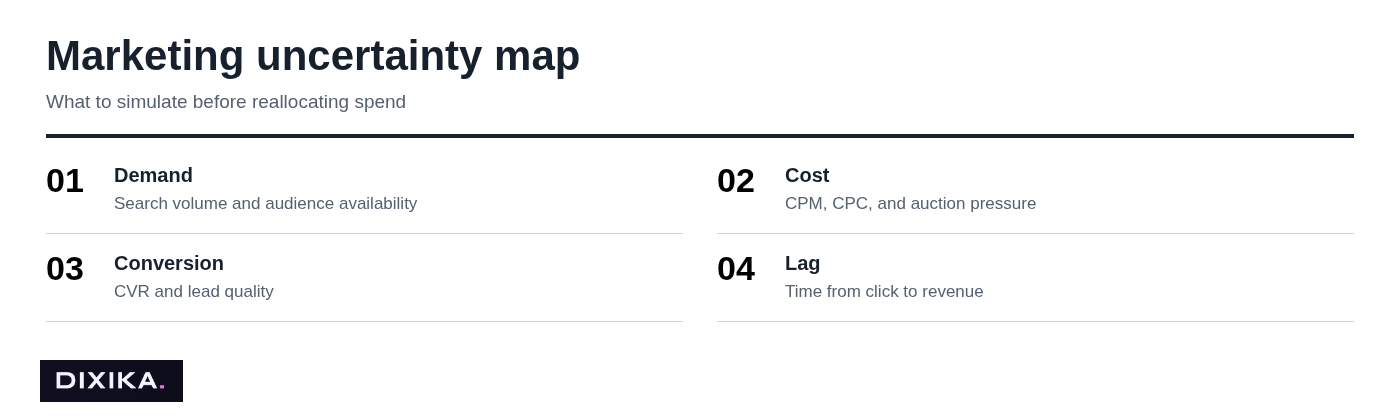
Before optimizing, list the uncertainties that could materially change the recommendation:
- Conversion-rate variation by audience, device, creative, and week.
- CPM, CPC, and auction pressure.
- Seasonality and changes in search demand.
- Attribution lag between click, lead, opportunity, and revenue.
- Creative fatigue and frequency effects.
- Sales-team acceptance rates and close rates.
- Competitor promotions, bidding changes, and market events.
A clear example of a stochastic system is daily paid-search performance. Even with the same budget, keyword set, landing page, and bid strategy, search volume changes, competitors enter auctions, and the visitors who arrive vary in intent. The result is a range of possible outcomes, not one fixed answer.
Why are stochastic processes hard? Future states vary, the data you observe is noisy, and the sample may be limited. More importantly, today's decision can change tomorrow's outcome. Increasing spend can exhaust the highest-intent audience, raise frequency, alter auction dynamics, or teach an automated platform to pursue different users.
In probability, stochastic processes are often grouped into four broad types: discrete-time discrete-state, discrete-time continuous-state, continuous-time discrete-state, and continuous-time continuous-state processes. Marketing models do not need that taxonomy to be useful, but it explains why a daily channel-budget model differs from a real-time bidding model with continuously changing prices.
Build Scenarios from Historical Data and Business Assumptions
Scenario building turns uncertainty into inputs an optimizer can use. Start with clean historical data: date, channel, campaign, spend, impressions, clicks, conversions, qualified conversions, revenue, and any available margin or pipeline data.
Next, segment carefully. Combining branded search with prospecting social, or combining holiday weeks with ordinary weeks, creates averages that describe neither group. Use segments that align with how you can actually make decisions.
For each channel, estimate plausible ranges for cost, conversion rate, and value per conversion. Then generate hundreds or thousands of future scenarios. Each scenario might represent a possible month in which search demand is strong, paid-social CPMs rise, and lead quality softens.
Bootstrapping is often the most defensible starting point. Instead of assuming outcomes follow a normal distribution, resample historical weeks or days with replacement. This preserves the skew and occasional bad periods that are common in marketing data. It is particularly useful when revenue is lumpy or conversion counts are sparse.
Do not treat every historical observation as valid randomness. Tracking failures, broken forms, campaign launches, pricing changes, one-off promotions, and major creative shifts should be corrected, excluded, or modeled as separate business scenarios. Otherwise, the optimizer will learn from noise that is not likely to recur.
Account for Dependencies Between Channels
Channels do not move independently. During a seasonal demand spike, branded search, retargeting, and email conversion may all improve together. During a weak market period, several channels may decline at once.
Independent simulations can make a plan look safer than it is because they underestimate these shared shocks. Start with a practical approach: create common demand scenarios and apply grouped multipliers. For example, a "soft demand" scenario may reduce conversion rates by 15% across several acquisition channels while raising paid-social CPM by 10%.
Sensitivity testing is another useful default. Change one shared assumption at a time and see whether the recommended allocation survives. Advanced correlation models can help later, but they should not delay a well-documented first model.
Select an Optimization Method That Matches the Problem
Numerical optimization is the broad category for solving quantified decision problems with computation. The right method depends on how many choices you have, the constraints, whether the response curve is known, how expensive it is to evaluate an option, and how explainable the result must be.
You do not need to deploy every stochastic optimization algorithm. For many marketing teams, a transparent scenario model and a disciplined testing process will beat a sophisticated method fed with weak attribution data.
Use Monte Carlo Search for Transparent Budget Allocation
Monte Carlo search is the accessible default for a small set of channels or discrete decisions. Generate many feasible allocations, simulate each allocation across many scenarios, then compare results.
For each candidate mix, calculate expected contribution margin, worst-case or lower-percentile performance, probability of meeting a pipeline target, and probability of exceeding your CAC guardrail. Choose the allocation based on a stated risk rule rather than whichever option has the highest average return.
For instance, you might select the mix with the highest expected margin among all options that have at least an 80% chance of staying below a $400 CAC. This approach is easy to audit and explain to finance or leadership.
The trade-off is computational. With three channels and $1,000 allocation increments, brute-force search is manageable. With dozens of campaigns, placements, audiences, and bid settings, the number of possible combinations grows quickly.
Use Bayesian Optimization When Evaluations Are Expensive
Bayesian optimization is useful when each test is expensive or slow. It uses prior results to estimate which next setting is most promising or most informative, balancing exploitation of what appears to work with exploration of uncertain options.
Apply it to decisions such as landing-page configurations, audience settings, creative parameters, offer thresholds, or campaign setups where each evaluation requires real spend and time. Rather than testing every possibility evenly, the process directs more trials toward options that could improve the outcome.
It is not a substitute for trustworthy measurement. If conversion events are misconfigured or revenue takes 90 days to mature, a more advanced optimizer cannot manufacture reliable evidence.
Use Stochastic Gradient Methods for Continuously Updated Models
In AI, stochastic usually refers to learning or generating with randomness or samples rather than processing every possible observation at once. Stochastic learning commonly means updating a model from individual samples or small batches of data.
Stochastic gradient descent is a standard example. Instead of calculating an update from the entire dataset, the model updates its parameters using a batch of observations. That makes large-scale training practical for propensity, conversion, lead-scoring, or predicted-value models.
Keep the distinction clear: training a conversion model is not the same as deciding how to allocate budget. The model estimates an input to the decision. The business policy still needs objectives, constraints, risk limits, and validation.
Run a Worked Example: Allocate a $50,000 Campaign Budget Under Uncertain Returns
Assume a team has $50,000 to allocate across paid search, paid social, and a partner channel for the next month. The following inputs are hypothetical and intended to illustrate the decision logic, not provide a universal channel benchmark.
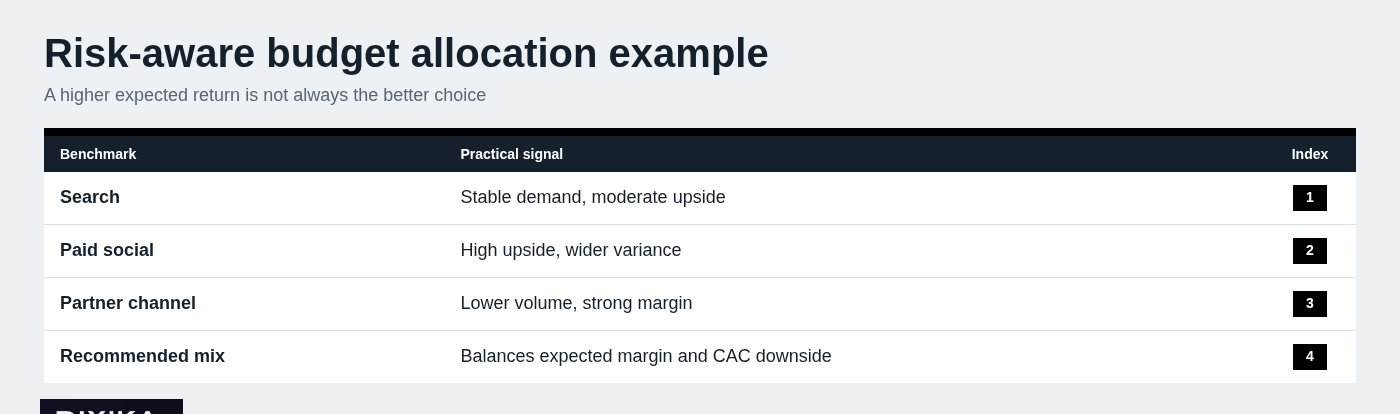
Search has relatively stable demand and conversion rates, but limited scale. Paid social has more upside and volume, but greater variance in CPM, CTR, and downstream lead quality. The partner channel has lower volume but strong contribution margin when qualified traffic is available.
A simple expected-ROAS model may push aggressively toward paid social because its average modeled revenue looks highest. A stochastic model simulates different CPCs, conversion rates, and revenue per conversion across thousands of plausible months. It then applies the rule: maximize expected contribution margin while keeping the chance of CAC exceeding $400 under 20%.
| Allocation approach | Search | Paid social | Partner | Expected contribution margin | Chance CAC exceeds $400 |
|---|---|---|---|---|---|
| Expected-ROAS maximum | $12,000 | $32,000 | $6,000 | $31,800 | 34% |
| Risk-aware recommendation | $20,000 | $20,000 | $10,000 | $30,600 | 16% |
| Conservative baseline | $25,000 | $12,000 | $13,000 | $27,900 | 9% |
The risk-aware mix gives up some modeled average margin to sharply reduce the probability of an unacceptable CAC outcome. That is not timid decision-making. It is a deliberate choice to protect a financial constraint while maintaining meaningful upside.
Validate the Recommendation Before Changing Spend
Simulation is a decision aid, not proof. Validate a recommendation in market before making a large or irreversible reallocation. Where possible, use holdouts, geo experiments, phased reallocations, matched-market tests, or controlled campaign splits.
Set thresholds before looking at the outcome. Define the minimum expected lift worth pursuing, the maximum acceptable downside, the required probability of meeting a guardrail, and a rollback trigger. For example, a team may scale a new allocation only if qualified pipeline improves by at least 8% without pushing CAC above $400 for two consecutive reporting windows.
This is stochastic thinking in practice: making choices from distributions and trade-offs instead of waiting for a certain forecast that will never arrive.
Separate Exploration from Exploitation
Exploration means reserving controlled budget to learn about uncertain channels, audiences, or offers. Exploitation means funding the choices with the strongest evidence. A healthy plan needs both.
A practical default is to protect a fixed exploration pool, such as 10% to 15% of flexible spend, while keeping the remaining budget in proven channels. Use stable allocation windows so ordinary daily noise does not trigger constant changes. Weekly or biweekly adjustments are usually more sensible than reacting to every dashboard fluctuation.
Common mistake: moving budget immediately after a few favorable or unfavorable days. The correct approach is to define a minimum observation window and review against the model's expected range, not against a single target number.
Implement a Repeatable Stochastic Optimization Workflow
Use this operating sequence to make stochastic optimization repeatable rather than a one-off analytics project:
- Define the decision, primary outcome, time horizon, and guardrails.
- Collect and clean channel, conversion, revenue, and margin data.
- Identify the uncertainties that can change the decision.
- Build scenarios from historical patterns and documented business assumptions.
- Generate feasible allocations or settings within your constraints.
- Simulate each decision across scenarios.
- Select a risk rule, such as maximum expected margin subject to a CAC-risk limit.
- Validate through controlled rollout, holdout, or phased reallocation.
- Monitor results and recalibrate when the underlying conditions change.
Python is useful for reproducible stochastic optimization workflows, especially when the model needs versioned data preparation, bootstrap simulations, Monte Carlo search, and automated reporting. But do not wait for production code. A spreadsheet-based scenario model can be a strong starting point for three to five channels.
Monitor data freshness, attribution changes, actual-versus-simulated outcomes, constraint violations, and drift in cost or conversion distributions. If actual performance repeatedly falls outside your modeled ranges, investigate the cause before simply widening the range. You may have a measurement problem, a market shift, or a model that no longer reflects the business.

Avoid the Most Common Stochastic Optimization Mistakes
The first mistake is optimizing a noisy proxy metric. Cheap clicks, last-click ROAS, or form fills can look excellent while creating poor pipeline or low-margin revenue. Tie the objective to incremental business value whenever possible.
The second is assuming historical variance will persist unchanged. New creative, pricing, platform settings, competitors, seasonality, and tracking changes can all alter the distribution. Recalibrate rather than treating last quarter's data as a permanent law.
The third is ignoring channel dependencies. If multiple channels weaken in the same demand slump, a model that assumes independent outcomes can materially understate downside risk.
The fourth is overfitting to a short period. A few excellent weeks are not enough to justify a complex model or a major spend shift. Use broader history, segment it intelligently, and test sensitivity to the assumptions that matter most.
Finally, do not treat simulated output as certainty. A deterministic plan still has value as a baseline, fallback, or easy-to-explain operating plan. But its fixed assumptions should be visible. The point of stochastic optimization is not to eliminate randomness; it is to choose decisions that remain acceptable when reality varies.
Make Marketing Decisions That Hold Up Under Uncertainty
Start with a specific decision and real constraints. Model plausible uncertainty, compare feasible options across those scenarios, choose based on value and downside risk, then validate the recommendation in market. That sequence is more useful than chasing an algorithm label.
Better optimization depends on better inputs: reliable measurement, meaningful conversion definitions, sound technical foundations, and content that reaches the right demand. Teams that need stronger systems for SEO, content, technical performance, or AI-search visibility can explore Dixika's services and review what we offer to improve the quality of the growth decisions they make.