
Marketing teams waste time when they treat every decision as a creative debate. Which topic should ship next? Where should budget go? Which landing page deserves another test? These are optimization problems, whether the team calls them that or not.
The goal is not to find a magical formula that runs marketing unattended. It is to make repeatable choices with clearer assumptions, measurable trade-offs, and enough guardrails to avoid optimizing for the wrong outcome.
Define the marketing decision before choosing an optimization algorithm
An optimization algorithm is a repeatable method for finding the best available choice by maximizing or minimizing a measurable outcome while respecting constraints. In simple words, it helps you choose the best next move from several possible moves.
For a marketing team, that might mean maximizing qualified leads from a fixed content budget, minimizing cost per sales-qualified opportunity, or selecting the next group of pages to improve with limited technical capacity. The algorithm does not replace judgment. It organizes the decision so judgment is applied where it matters: defining value, checking assumptions, and approving trade-offs.
Algorithms work by taking inputs, following ordered steps, evaluating possible options against an objective, and producing an output. More advanced methods repeat that process as new data arrives. A paid-media allocator might shift spend after each performance window; a content prioritization model might update its opportunity scores after rankings, conversions, and production costs change.
That is different from a rule of thumb such as "always publish more bottom-of-funnel content." A rule of thumb can be useful, but it does not quantify capacity, expected returns, opportunity cost, or risk. An optimization workflow does.

Turn a marketing goal into a solvable optimization problem
Start with one decision, not a broad ambition such as "grow organic traffic." A usable problem statement identifies what you can choose, what success means, and what cannot be violated.
Suppose you have a monthly content budget of $12,000 and want to allocate it across topic clusters. Your objective function could be: maximize expected qualified organic conversions over the next six months. Your decision variables are the number and type of pages produced for each cluster. Your constraints include budget, writer hours, editorial review capacity, technical dependencies, and a minimum confidence threshold for search demand.
For each candidate cluster, estimate expected qualified traffic, conversion rate, conversion value, production cost, and confidence. Then compare combinations of work rather than ranking topics one at a time. A lower-volume cluster with strong buyer intent may beat a high-volume informational cluster once conversion value and production effort are included.
A practical algorithmic workflow needs five things:
- Defined inputs: the data used to make the decision, such as cost, traffic potential, conversion rate, capacity, and confidence.
- Ordered steps: a consistent process for scoring, testing, allocating, or selecting options.
- An output: a recommendation, such as a prioritized backlog, budget split, or test queue.
- Feasibility constraints: limits that keep the recommendation realistic.
- A stopping or decision rule: a point at which the team accepts, rejects, updates, or pauses the recommendation.
Without a stopping rule, teams can keep tuning a model forever. For example, decide that a content allocation is approved once it fits capacity, clears the expected-value threshold, and has been reviewed by the content and SEO leads.
Separate the primary metric from guardrail metrics
Your primary metric states what you want to improve. Guardrail metrics stop the model from pursuing that goal in a damaging way. If you optimize only for clicks, you may end up funding topics that attract broad, low-intent traffic while reducing lead quality and consuming editorial capacity.
For content, a primary metric could be expected qualified organic leads. Guardrails might include a maximum monthly production budget, a minimum projected conversion rate, a cap on pages per topic cluster, and a requirement that no new page competes with an existing high-performing URL.
Other common constraints include:
- Monthly spend caps and minimum return thresholds for paid media
- Minimum margin for ecommerce promotions
- Writer, designer, developer, and subject-matter-expert capacity
- Compliance, legal review, and brand-safety requirements
- Ranking volatility limits before changing an established SEO page
A common mistake is to add constraints only after the model recommends something impossible. Put hard limits into the model from the beginning. If a business rule cannot be broken, it is not an afterthought.

Choose the algorithm family that matches your data and constraints
There is no universally best optimization algorithm. The right choice depends on the shape of the decision, the quality and volume of available data, the cost of running tests, how uncertain results are, and how strict the constraints must be.
Marketing teams do not need an exhaustive optimization algorithms list before they begin. Most recurring decisions fit a few useful families. Choose the simplest method that captures the trade-offs you actually face.
You may encounter labels such as topology optimization in broader technical reading. That approach is mainly used in engineering to refine physical structures, such as a component's shape or material distribution. It is rarely a useful starting point for SEO, content, or campaign allocation.
Use linear or convex optimization for transparent budget and resource allocation
Linear optimization is a strong default when both outcomes and constraints can be approximated with straight-line relationships. For example, a team may estimate that each additional content package in a cluster produces a known range of qualified leads, up to a stated capacity limit.
It is useful for channel allocation, assigning outreach capacity, choosing among production projects, and scheduling finite resources. The main benefit is explainability: stakeholders can see why the model selected one allocation over another.
Convex optimization covers problems where the math is more flexible but still structured so that a reliable global optimum can be found. It can be valuable when you model diminishing returns, risk penalties, or balanced portfolio allocation. Be careful, though: real marketing response curves are often estimated imperfectly. Elegant math does not make weak assumptions reliable.
Use Bayesian optimization when experiments are costly and results are uncertain
Bayesian optimization is designed for situations where each experiment is expensive or slow. Think of testing a small number of landing-page concepts, high-effort content formats, pricing messages, or bidding rules where you cannot afford to try every combination.
It balances exploration and exploitation. Exploration tests options with high uncertainty because they may reveal a better outcome. Exploitation invests in the option that currently looks strongest. This is more disciplined than repeatedly choosing the current winner, which can trap a team in a locally good but globally weaker decision.
Use it when test volume is limited and the cost of a wrong test is meaningful. Do not use it as an excuse to skip a clear hypothesis or reliable measurement.
Use stochastic optimization for noisy, changing performance data
Stochastic optimization is appropriate when results are affected by uncertainty: seasonality, auction volatility, changing search demand, delayed conversions, imperfect attribution, or variation in sales follow-up. It assumes the input data has noise rather than pretending every performance number is exact.
For paid campaigns, this may mean optimizing against expected performance ranges rather than a single reported cost per conversion. For SEO, it may mean revisiting content priorities after meaningful changes in search impressions, rankings, or conversion behavior instead of locking a plan for an entire year.
Set a re-optimization schedule. Monthly may work for channel budget decisions; quarterly may be better for a content portfolio. One good reporting period is evidence, not permanent truth.
Use machine-learning optimization only when the prediction problem is mature
Optimization algorithms in machine learning and deep learning usually operate in two layers. First, a model predicts an outcome, such as conversion likelihood or expected revenue. Then an optimizer improves the model's parameters or uses those predictions to recommend an action.
This can be useful for organizations with substantial historical, labeled data and consistent decision processes. For example, a mature ecommerce team may predict the revenue impact of offers across audience segments and optimize the campaign mix within margin and inventory limits.
Most teams should not start here. If conversion tracking is inconsistent, lead stages are unreliable, or no one can explain why a model made a recommendation, adding AI optimization will amplify confusion. Fix tracking, labels, and approval rules first.

Build clean inputs and a measurement loop before automating
An optimization model is only as useful as its inputs. Before automating any recommendation, create a decision table with consistent IDs, defined reporting windows, a source of truth for conversions, cost data, content metadata, and documented exclusions.
For an SEO content model, each row might represent a topic, page, or cluster. Include the target query group, current URL status, projected traffic, qualified-conversion estimate, production effort, business value, confidence level, owner, dependencies, and last review date.
Watch for numerical optimization problems caused by messy data: missing values that look like zeroes, duplicated leads, delayed conversions, blended channel costs, and attribution that credits the wrong touchpoint. A model cannot correct a tracking setup that cannot distinguish a newsletter signup from a sales-qualified opportunity.
Set a baseline policy before changing anything. Compare the optimized recommendation against the way work or budget would otherwise have been allocated. Where possible, retain a holdout group or comparison period. Otherwise, you may mistake market changes for model improvement.
Set an experiment cadence that fits SEO lag
SEO has a longer feedback loop than paid media. Changing titles, internal links, templates, or content coverage every few days makes causality almost impossible to interpret. Give material changes enough time to be crawled, indexed, ranked, and seen by the audience you want.
Use leading indicators early: indexation status, impressions, query coverage, internal-link discovery, engagement quality, and assisted conversions. Then judge the full decision using lagging metrics such as qualified leads, pipeline contribution, or revenue.
For a content portfolio, a monthly production review and quarterly allocation update is usually more useful than a daily score refresh. Update forecasts when evidence changes, not merely because a dashboard has new numbers.
Implement a constrained optimization workflow in Python or a spreadsheet
A spreadsheet is often enough for the first linear model. It forces the team to expose assumptions and makes review easier. Optimization algorithms in Python become worthwhile when you need repeatable scenarios, many combinations, scheduled updates, or a clearer audit trail.
Use this implementation sequence:
- Create a decision table with one row per option.
- Estimate expected value for each option using consistent assumptions.
- Define decision variables, such as whether to select an item or how much budget to assign.
- Apply bounds and constraints for capacity, spend, risk, and dependencies.
- Run the solver or scenario model to generate a recommendation.
- Review the recommendation with the people responsible for execution.
- Log the decision, assumptions, expected outcome, and actual results.
At a pseudocode level, the logic is straightforward: define the objective, define each variable's allowed range, add constraints, select a solver, validate the proposed solution, and export an approved allocation. The difficult work is not the syntax. It is deciding which estimates deserve trust and which should be treated as uncertain.
Worked example: prioritize SEO content opportunities with limited capacity
Assume your team has 160 writer hours, 30 SEO hours, and $8,000 of production budget for the next month. You have 25 candidate topics and page improvements. For each candidate, estimate qualified traffic potential, conversion value, production effort, confidence, technical dependency, and cannibalization risk.
A simple expected-value formula might multiply estimated qualified visits by expected conversion rate and value per qualified conversion, then adjust the result by confidence. The model selects the combination of opportunities with the highest expected total value while staying within writer hours, SEO hours, and budget.
Then add business rules. A topic cannot be selected if it depends on a product page that will not be ready this quarter. A new article cannot be selected if it materially overlaps with an existing page unless consolidation is part of the work. A low-confidence forecast may require manual approval even if it has a high modeled return.
This is where human review matters. Search intent, subject-matter expertise, brand positioning, and competitive reality do not always fit neatly into a numeric score. Use the model to narrow choices and make trade-offs visible, not to rubber-stamp a backlog.

Use optimization algorithms across SEO and marketing workflows
The useful unit is the decision, not the algorithm name. Once you can define the objective, variables, constraints, and feedback signal, optimization can improve several recurring workflows.
- Content portfolio prioritization: Choose which new pages, refreshes, consolidations, and supporting assets to produce. Optimize for qualified organic value while constraining production capacity, topic overlap, and required expertise.
- Internal-link and crawl prioritization: Select pages that need stronger internal discovery, updated links, or technical attention. Optimize for business importance and opportunity while accounting for template limits, page quality, and development capacity.
- Paid budget allocation: Assign spend across campaigns, audiences, or channels. Optimize for profit, pipeline, or qualified leads rather than surface-level clicks, with spend caps and learning budgets built in.
- Outreach sequencing: Prioritize prospects and follow-ups based on relevance, expected authority value, likelihood of response, relationship status, and team capacity. Do not reduce this to a domain metric alone.
- Conversion-test selection: Decide which messaging, page, or form experiments should run next. Optimize for expected learning and business value within design, engineering, and traffic constraints.
Query optimization deserves careful wording. It can mean improving the efficiency of a data query or prioritizing a keyword/query set more intelligently. It does not replace search-intent research. No scoring model can rescue a page built for the wrong audience need.
Validate recommendations and protect against bad optimization
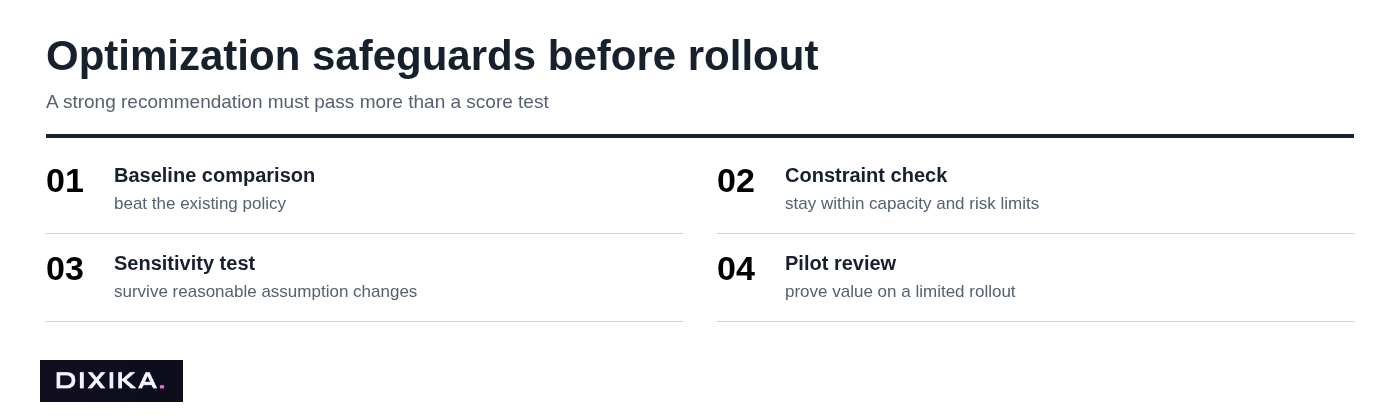
A recommendation is not ready because it has the highest score. Validate it before rollout with a baseline comparison, scenario checks, sensitivity analysis, and a limited pilot where practical.
Back-test a model against past decisions when historical conditions are comparable. Change reasonable assumptions, such as conversion rate or production cost, and check whether the recommendation remains sensible. If a tiny adjustment completely reshuffles the plan, the model is fragile and should not be treated as precise.
Several failure modes are common:
- Optimizing a proxy metric: maximizing traffic, impressions, or engagement when the business needs qualified demand or profitable revenue.
- Data leakage: allowing future information or post-conversion signals into a model that is supposed to make an earlier decision.
- Overfitting: building a model around one unusually strong month, campaign, or ranking change.
- Ignored constraints: recommending work that cannot be produced, approved, implemented, or supported by sales.
- False precision: presenting forecasts as if a projected 14.2% lift is meaningfully different from a 14.0% lift.
Set governance before automation. Name the people who can change the objective, approve exceptions, and pause the workflow. Establish thresholds in advance: for example, stop automated budget shifts if cost per qualified lead rises above the accepted range for two reporting windows, or pause SEO template changes if indexation or conversion quality drops materially.
Start with one high-value decision, then improve the model
Begin with a decision that repeats often, has measurable value, and faces real constraints. Content prioritization, outreach capacity, and paid-budget allocation are usually better starting points than an ambitious attempt to optimize an entire marketing function at once.
The best optimization algorithm is the one your team can audit, challenge, and improve over time. Start with a transparent spreadsheet model if that is what the data supports. Move to Python, Bayesian methods, or machine-learning optimization only when the decision process and measurement foundation justify the added complexity.
Teams building a durable SEO visibility system can explore Dixika and review our services for support with technical SEO, content systems, authority-building, and AI answer visibility.