
The biggest mistake in marketing planning is pretending every dollar, hour, and channel is equally available. They are not. Budgets have ceilings, teams have finite capacity, brand standards rule out certain tactics, and the "highest-return" option often stops performing at scale.
Constrained optimization gives you a practical way to make better decisions inside those limits. Rather than asking, "What could produce the most leads in theory?" it asks, "What is the best plan we can actually execute without violating the rules that matter?"
Constrained optimization in plain English: choose the best feasible marketing outcome
Optimization simply means choosing the best option from a set of options. In marketing, that might mean maximizing qualified pipeline, minimizing customer acquisition cost, or reducing the time required to publish priority content.
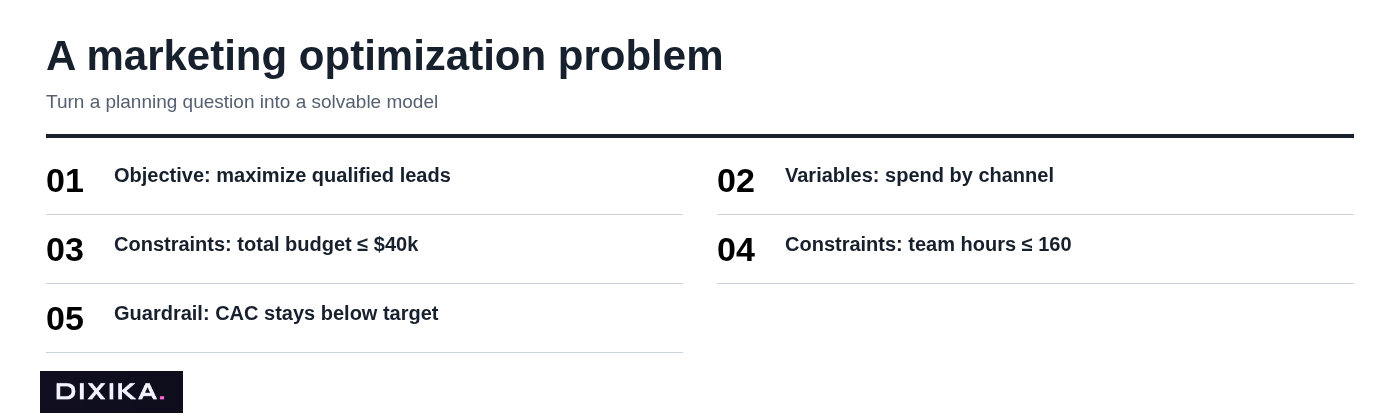
Constrained optimization means maximizing or minimizing an objective while obeying non-negotiable limits. Those limits are called constraints. A typical marketing problem could be: maximize qualified pipeline while staying within a $40,000 budget, using no more than 160 team hours, and maintaining brand-safe placements.
A constrained optimization problem has three parts: a goal to improve, choices you can control, and rules those choices must follow. This matters because marketing is never a blank canvas. A recommendation that produces more leads but requires an unavailable designer, exceeds the budget, or damages brand trust is not a useful recommendation.
The difference between constrained and unconstrained optimization is straightforward. An unconstrained model can search any possible solution, including plans that spend unlimited money or demand unlimited staff time. A constrained model searches only feasible solutions: plans that satisfy the limits you set. In real business decisions, constrained optimization is usually the relevant one.
There are broadly two types of optimization: unconstrained and constrained. The distinction is mathematical, but it is also practical. Unconstrained optimization can be useful for understanding a theoretical best point. Constrained optimization is what turns that insight into an executable plan.

Start with the decision, not the math
The first rule of optimization is simple: do not optimize until you know exactly what decision you are making. A model cannot rescue a vague question. If the team says, "Improve content performance," the first task is to turn that ambition into a decision with a measurable outcome.
For example, replace "improve content performance" with: "How should we allocate 120 monthly production hours among comparison pages, thought-leadership articles, case studies, and content refreshes to maximize qualified organic conversions over the next quarter?" That question identifies a planning horizon, controllable choices, and a useful business outcome.
Be careful with vanity metrics. Optimizing for traffic alone can favor broad, low-intent topics that bring visits but not pipeline. Optimizing for email opens can encourage subject lines that create curiosity but disappoint readers. Use a primary metric connected to the business goal, such as qualified demos, pipeline value, retained customers, or profitable revenue.
Separate decision variables, fixed inputs, and outcomes
A clean model separates what you can change from what you must accept and what you expect to happen.
| Model element | Marketing example |
|---|---|
| Decision variables | Spend by channel, number of articles published, outreach volume, campaign frequency |
| Fixed inputs | Available budget, team size, vendor rates, seasonality, contract commitments |
| Outcomes | Qualified leads, pipeline, CAC, rankings, conversion rate, qualified traffic |
Suppose your team has $40,000 to distribute across paid search, LinkedIn, and content promotion. The spending amounts are decision variables. The $40,000 budget and available campaign-management hours are fixed inputs. Expected qualified leads and CAC are outcomes the model estimates from the allocation.
A common mistake is treating an outcome as if it were directly controllable. You can set a content publishing cadence; you cannot directly set rankings. You can choose outreach volume; you cannot guarantee links. Keep those categories distinct or the model will create false certainty.
Formulate the optimization problem with an objective and constraints
To formulate an optimization problem, write down one primary objective, define the variables you control, and express the operating rules as measurable constraints. You do not need advanced math to begin, but you do need precision.
The standard constrained optimization formula is:
Optimize f(x), subject to g(x) ≤ 0 and h(x) = 0.
In plain English, x represents your decisions, such as spend by channel. The function f(x) is the outcome you want to maximize or minimize. The expressions g(x) and h(x) represent limits and required relationships.
For a channel-mix decision, the objective might be:
Maximize expected qualified leads = leads from paid search + leads from LinkedIn + leads from content promotion.
The constraints could include:
- Total spend must be less than or equal to $40,000.
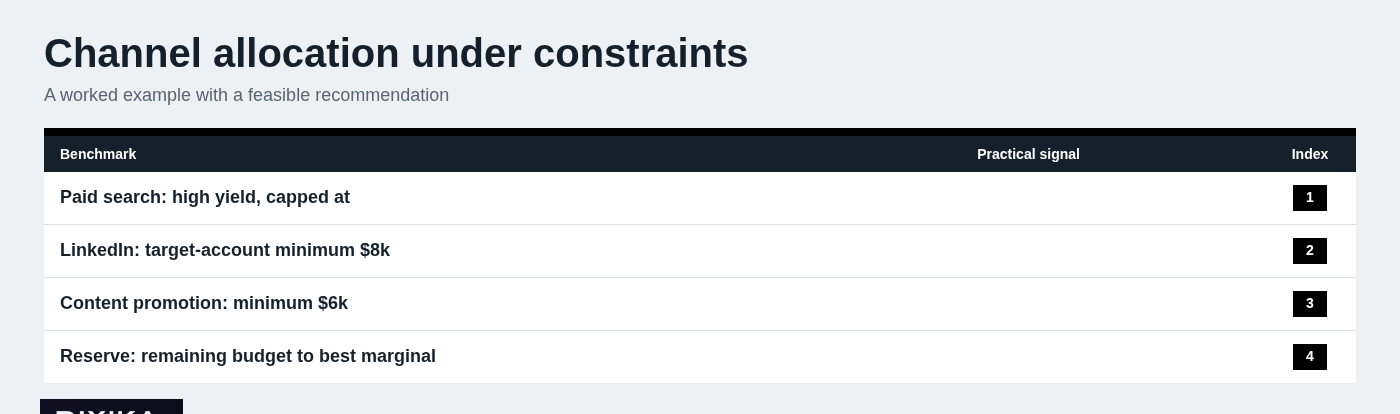
- Paid-search spend cannot exceed $18,000 because of diminishing marginal returns.
- LinkedIn spend must be at least $8,000 to reach named target accounts.
- Content promotion must receive at least $6,000 to support a launch.
- Total campaign-management time must remain within 160 hours.
- Only approved placements and audience segments can be used.
Constraints come in several forms. Upper bounds prevent a variable from getting too large. Lower bounds enforce a minimum commitment. Equality rules require an exact total, such as assigning all available budget. Binary choices represent yes-or-no decisions, such as whether to sponsor an event or use a specific tool.
Choose constraints that protect the business instead of trapping the model
Constraints should reflect real operating conditions, not every preference someone mentions in a planning meeting. Useful marketing constraints include budget ceilings, minimum contractual commitments, team capacity, launch deadlines, frequency caps, legal requirements, brand rules, and known channel saturation points.
Start with hard constraints: rules you cannot break. A fixed budget, legal review requirement, or a hard launch date belongs here. Then identify soft constraints: preferences you would rather honor but could violate if the trade-off is worthwhile.
For soft constraints, use a penalty rather than an absolute prohibition. For example, you may prefer not to exceed three lifecycle emails per subscriber per week, but a major product launch may justify a fourth. Instead of making four emails impossible, assign a cost to exceeding the preferred frequency so the model only does it when the expected gain is strong enough.
Every constraint should be measurable, controllable, and current. "Protect the brand" is important but not yet usable. "Run only on approved publishers, exclude sensitive content categories, and require an editorial review score of at least 4 out of 5" is usable.
Avoid redundant or contradictory constraints. If a minimum spend requirement across channels already totals the entire budget, the model has no meaningful choice left. If one team requires 20 articles per month while another caps writing capacity at 12, resolve the operational conflict before asking a solver to handle it.
Build in guardrails for quality, risk, and diminishing returns
A plan can technically maximize a metric and still be bad for the business. That happens when the objective ignores quality, risk, or the fact that performance often declines as you scale.
For SEO and content systems, practical guardrails might include a minimum of two hours of editorial review per long-form article, a maximum number of outreach contacts per domain segment, or a rule that no more than 25% of link-building budget goes to one publisher category. For paid media, cap spend in volatile channels until the data supports expansion.
Diminishing returns are especially important. The first $5,000 in a high-intent channel may perform exceptionally well, while the next $15,000 reaches less qualified audiences and drives CAC upward. Do not assume a channel's average historical return applies equally to every additional dollar.
Match the optimization method to the marketing decision
The right method depends on the decision shape, the data available, and the cost of being wrong. You do not need a sophisticated algorithm for every planning question.
Linear optimization is a strong default when returns and resource use are reasonably proportional. It works well for allocating a budget, assigning staff hours, or distributing production capacity across a defined set of projects.
Integer or mixed-integer optimization is useful when some choices are discrete. You cannot hire 0.3 of a full-time strategist, attend half a trade show, or publish 2.7 webinars. These models combine continuous variables, such as spend, with whole-number or yes-or-no decisions.
Convex optimization is useful when the response curves have a structure that makes finding the best solution reliable and computationally manageable. This is more common in advanced forecasting and resource-allocation work than in a basic marketing spreadsheet.
Stochastic optimization accounts for uncertainty. Use it when conversion rates, auction costs, or demand conditions can vary materially. Bayesian optimization is useful for expensive, low-volume experiments where you cannot afford hundreds of trials, such as testing a limited number of campaign configurations or landing-page variants.
Terms such as topology optimization and constrained optimization in linear algebra belong mainly to specialized engineering and mathematical contexts. They can inform advanced analytics, but they are not the default approach for a content calendar or quarterly channel plan.
When spreadsheets are enough and when optimization algorithms are needed
A spreadsheet is enough when the model is small, the relationships are understandable, and stakeholders need to inspect every assumption. A Solver-style setup can handle a channel budget, a content backlog, or basic staff allocation with a few dozen variables.
Use code or specialist support when you have many variables, nonlinear response curves, changing constraints, large datasets, or a need to rerun the model frequently. Examples include budget allocation across hundreds of campaigns, forecasting marginal returns by audience segment, or dynamically changing bids within strict CAC and pacing limits.
Common optimization algorithms include linear programming solvers, gradient-based methods, evolutionary methods, and Bayesian optimization. The important decision is not choosing the most impressive-sounding algorithm. It is choosing a method that matches the data and produces a recommendation your team can understand and implement.

Solve a worked channel-budget example
Assume a B2B team has a $40,000 campaign budget and wants to maximize expected qualified leads over one month. It can invest in paid search, LinkedIn, and content promotion.
Based on recent results, the team estimates the following marginal performance:
| Channel | Expected qualified leads per $1,000 | Constraint |
|---|---|---|
| Paid search | 4 | Maximum $18,000 due to rising CPCs and limited query volume |
| 2 | Minimum $8,000 to sustain target-account reach | |
| Content promotion | 3 | Minimum $6,000 to support a research-report launch |
The objective is to maximize total expected qualified leads. The budget must equal $40,000, paid search cannot exceed $18,000, LinkedIn must receive at least $8,000, and content promotion must receive at least $6,000.
The best allocation is:
- Paid search: $18,000
- LinkedIn: $8,000
- Content promotion: $14,000
That allocation produces an estimated 130 qualified leads:
- Paid search: 18 x 4 = 72 leads
- LinkedIn: 8 x 2 = 16 leads
- Content promotion: 14 x 3 = 42 leads
Without constraints, the model would put the entire budget into paid search because it has the highest estimated yield. But that plan is not feasible once you account for search-volume limits, target-account coverage, and the launch commitment. The constraints force a more complete campaign plan while preserving as much expected return as possible.
If paid search capacity rises from $18,000 to $24,000, the recommended allocation changes. The model would move $6,000 from content promotion to paid search, assuming the marginal yields remain valid. This is why constraints and response assumptions must be reviewed together.
Validate the answer before you execute it
A solver output is a recommendation based on assumptions, not a guaranteed business result. Before committing budget or capacity, check that the solution is feasible in the real world and that its inputs are credible.
First, verify the mechanics. Does total spend equal the available budget? Are capacity, approval, and launch-date constraints truly satisfied? Can the team actually buy the inventory, produce the assets, and launch the campaigns on time?
Next, inspect the data. Lead yields, conversion rates, and CAC estimates should come from a relevant period and comparable audiences. A six-month-old campaign result may not apply after a major pricing change, seasonal shift, or platform auction change.
Run scenarios rather than accepting one answer. Test a base case, a downside case, and an upside case. Then perform sensitivity analysis: change one assumption at a time to see what reverses the recommendation. If a 10% change in paid-search conversion rate changes the entire allocation, that input deserves extra scrutiny.
Pay attention to binding constraints, meaning the rules that are exactly at their limits. In the example, the paid-search cap is binding because the model uses all $18,000. That tells you the value of additional search capacity could be high, provided performance holds.
Test the model against a recent campaign period before relying on it for a major planning cycle. Recalibrate monthly for fast-moving paid channels and at least quarterly for content, SEO, and link-building planning, where outcomes emerge over longer periods.
Watch for the most common marketing optimization mistakes
- Using bad inputs: A precise model built on weak attribution or incomplete cost data is still weak. Validate source systems before modeling.
- Assuming returns stay flat: Most channels saturate. Use marginal estimates where possible instead of one average return figure.
- Optimizing a proxy: Clicks, impressions, and raw traffic are not the same as qualified pipeline. Connect the objective to the business outcome.
- Treating forecasts as facts: Use ranges and scenarios when uncertainty is material.
- Ignoring implementation friction: A plan may require creative approvals, tracking changes, sales follow-up, or engineering work that the model did not include.
Document each assumption alongside its owner, source, date, and refresh schedule. When a recommendation is challenged, the team should be able to identify whether the disagreement is about the objective, a constraint, or an input estimate.
Apply constrained optimization across the marketing workflow
Constrained optimization applies anywhere a team must allocate scarce resources toward competing opportunities. The method is not limited to media budgets.
- Content prioritization: Maximize expected qualified organic traffic or conversions while staying within writer, editor, SME, and design-hour limits.
- SEO roadmaps: Prioritize technical fixes by expected impact while working within engineering capacity, release schedules, and site-risk thresholds.
- Link-building: Maximize authority and referral value while meeting quality standards, avoiding excessive concentration in one site category, and respecting outreach capacity.
- Lifecycle marketing: Maximize incremental revenue while limiting message fatigue, unsubscribe risk, and overlap between campaigns.
- Events and partnerships: Choose a portfolio of sponsorships and activations that fits budget, sales coverage, and target-account priorities.
Constrained optimization in economics follows the same logic. A household tries to maximize value or utility with a limited budget. A business chooses the best combination of investments with limited capital and labor. Marketing teams are doing a version of that same resource-allocation problem every planning cycle.
AI can help estimate response curves, forecast outcomes, or recommend experiments. It cannot decide what trade-offs your business should accept. Humans still need to choose the objective, establish quality and brand guardrails, and decide when a modeled gain is not worth the risk.
Make constrained optimization a repeatable planning habit
Use this checklist whenever a marketing decision involves meaningful trade-offs:
- Define the decision in one sentence.
- Choose one primary business outcome to optimize.
- List the variables the team can actually control.
- Write measurable hard constraints and clearly labeled soft constraints.
- Select a method that matches the model's complexity.
- Validate inputs, run scenarios, and inspect binding constraints.
- Execute the plan, compare results with forecasts, and update the assumptions.
Optimization is not finding the largest possible number. It is finding the best feasible decision under real conditions. Once teams make that shift, budget debates become clearer, resource allocation becomes more defensible, and planning becomes easier to improve over time.
Teams that need help connecting SEO, content, link-building, and AI-search visibility constraints to a measurable growth plan can explore Dixika and review our services.